Understanding — How Cannabinoids Work
Alcohol and Cannabinoids — What to Know
For the person who drinks occasionally and wants to understand whether CBD or CBG interacts with alcohol — what the limited research shows, what is genuinely unknown, and what is worth being aware of.
This is a question people ask and rarely get a straight answer to. Most hemp company content either ignores the topic entirely or offers vague reassurance. Neither serves you well.
The honest answer is: the research on CBD and alcohol is limited, the research on CBG and alcohol is almost nonexistent, and what exists points toward a modest interaction that is worth understanding — not alarming, but not nothing.
What alcohol and CBD have in common
Alcohol and CBD share overlapping pharmacological territory in one important area: both enhance GABA activity in the brain. GABA is the primary inhibitory neurotransmitter — the signal that reduces neural excitability and produces sedation, relaxation, and anxiolysis. Alcohol's effects are mediated partly through GABA-A receptors. CBD also modulates GABA signalling, though through different mechanisms and with considerably weaker potency.
Because they work on overlapping systems, combining them has the potential for additive effects — not a dramatic interaction, but a possibility that the sedative and motor-impairing effects of alcohol may be somewhat enhanced when CBD is present. The existing human research on this is old and limited. A 1979 study — the most frequently cited human data on the combination — found that CBD combined with alcohol produced lower blood alcohol concentrations than alcohol alone, but similar levels of motor and psychomotor impairment. The interpretation is that CBD may affect alcohol absorption or metabolism while not proportionately reducing impairment.
This finding is three decades old, involved small samples, and used doses of CBD significantly higher than most hemp preparation users consume. It should not be treated as definitive. What it suggests is that the combination is not straightforwardly additive in a simple way — the relationship between blood alcohol concentration and subjective impairment may shift when CBD is present, which has practical implications for anyone making decisions based on how they feel rather than how much they have had.


CYP2E1 — the metabolic overlap
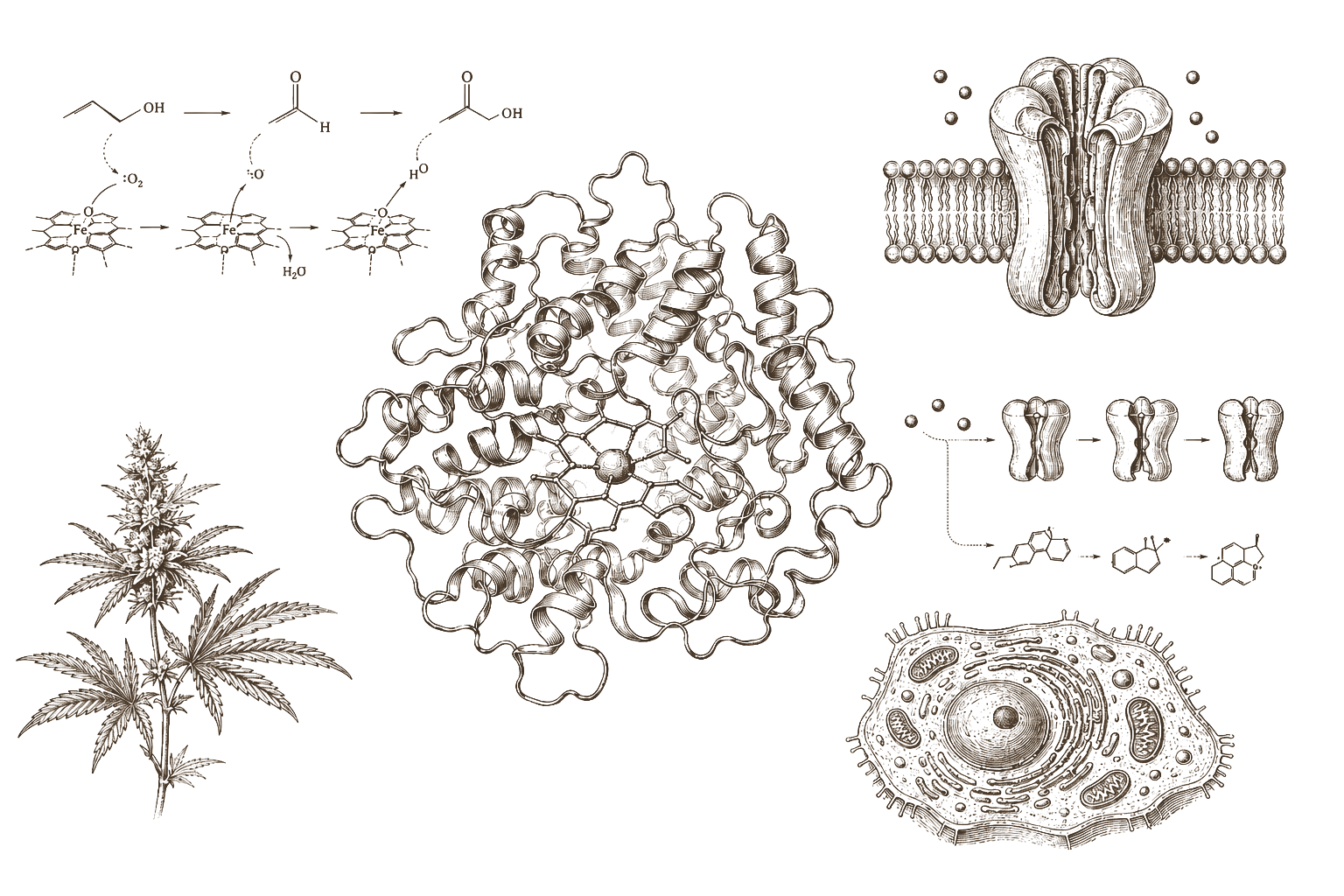
Alcohol is primarily metabolised by the liver enzyme alcohol dehydrogenase, but CYP2E1 — a cytochrome P450 enzyme — plays a significant role in alcohol metabolism, particularly at higher consumption levels. CBD inhibits CYP2E1. In principle, this means CBD could slow alcohol clearance, slightly prolonging its presence in the bloodstream.
Whether this is clinically meaningful at the doses of CBD in standard hemp preparations is not established. The CYP inhibition effects of CBD are most clearly documented for CYP2D6 and CYP3A4 — the pathways most relevant to prescription drug interactions. CYP2E1 inhibition by CBD at standard hemp preparation doses is plausible but not well-characterised in human studies. It is worth noting as a mechanism rather than overstating as a confirmed effect.
What about CBG specifically
There is essentially no published research on CBG and alcohol interaction. CBG's primary mechanisms — alpha-2 adrenoceptor activity, HPA axis modulation, partial CB2 agonism, PPAR-γ agonism — do not have an obvious direct relationship with alcohol's GABA-mediated effects. CBG is not strongly GABAergic. The CYP2E1 inhibition concern applies primarily to CBD; CBG's CYP inhibition profile is less characterised.
The most honest answer for CBG specifically is: we do not know. The absence of research is not evidence of absence of interaction, but there is no documented mechanism suggesting a significant concern for the occasional drinker using standard CBG preparations.
The liver consideration for regular drinkers
Both alcohol and CBD are processed by the liver. For the occasional drinker with healthy liver function, this is not a concern. For someone who drinks regularly and at significant volume — enough to be causing hepatic stress — the combined metabolic demand on the liver is worth being aware of. High-dose CBD has been associated with elevated liver enzymes in clinical trial populations, though typically at doses considerably higher than those in standard hemp preparations. The combination of regular significant alcohol consumption and ongoing CBD use at higher doses is a context where discussing with a physician makes sense.
This does not apply to the person having a glass of wine with dinner. It is a consideration for someone whose alcohol consumption is already a health concern.
Practical summary
For the person who drinks occasionally — a glass of wine with dinner, a drink at a social event — and uses a standard-dose CBD or CBG preparation: the existing evidence does not suggest a significant safety concern. The modest GABA overlap with CBD and the theoretical CYP2E1 interaction are worth knowing about, but they do not constitute a contraindication for occasional moderate alcohol use.
Three things worth keeping in mind regardless. First, do not use how you feel as your primary measure of impairment when driving — the 1979 data suggesting blood alcohol and subjective impairment may not track normally when CBD is present is old and limited but worth taking seriously in a safety context. Second, if you are using CBD or CBG at higher doses than standard hemp preparations — 100mg or more daily — the liver consideration becomes more relevant if you also drink regularly. Third, if you are using either preparation for stress or anxiety and find that alcohol is doing overlapping work, that pattern is worth examining on its own terms.
What this archive covers and does not cover
This article addresses the occasional drinker's practical question about combining cannabinoid preparations with moderate alcohol use. It does not address alcohol dependence, alcohol use disorder, or the use of cannabinoids as a harm reduction strategy for heavy drinking — those are clinical topics that require professional support, not a research archive article. If alcohol is a concern in your life, speaking with a healthcare provider is the appropriate first step.
These statements have not been evaluated by the Food and Drug Administration. J.P. Hemp Company products are not intended to diagnose, treat, cure, or prevent any disease.