Understanding — The Endocannabinoid System
Clinical Endocannabinoid Deficiency: The Research Hypothesis
Neurologist Ethan Russo has proposed that certain chronic conditions — migraine, fibromyalgia, and irritable bowel syndrome — may involve chronically low endocannabinoid tone. This article examines that hypothesis: what motivates it, what evidence supports it, and what it does not yet establish.
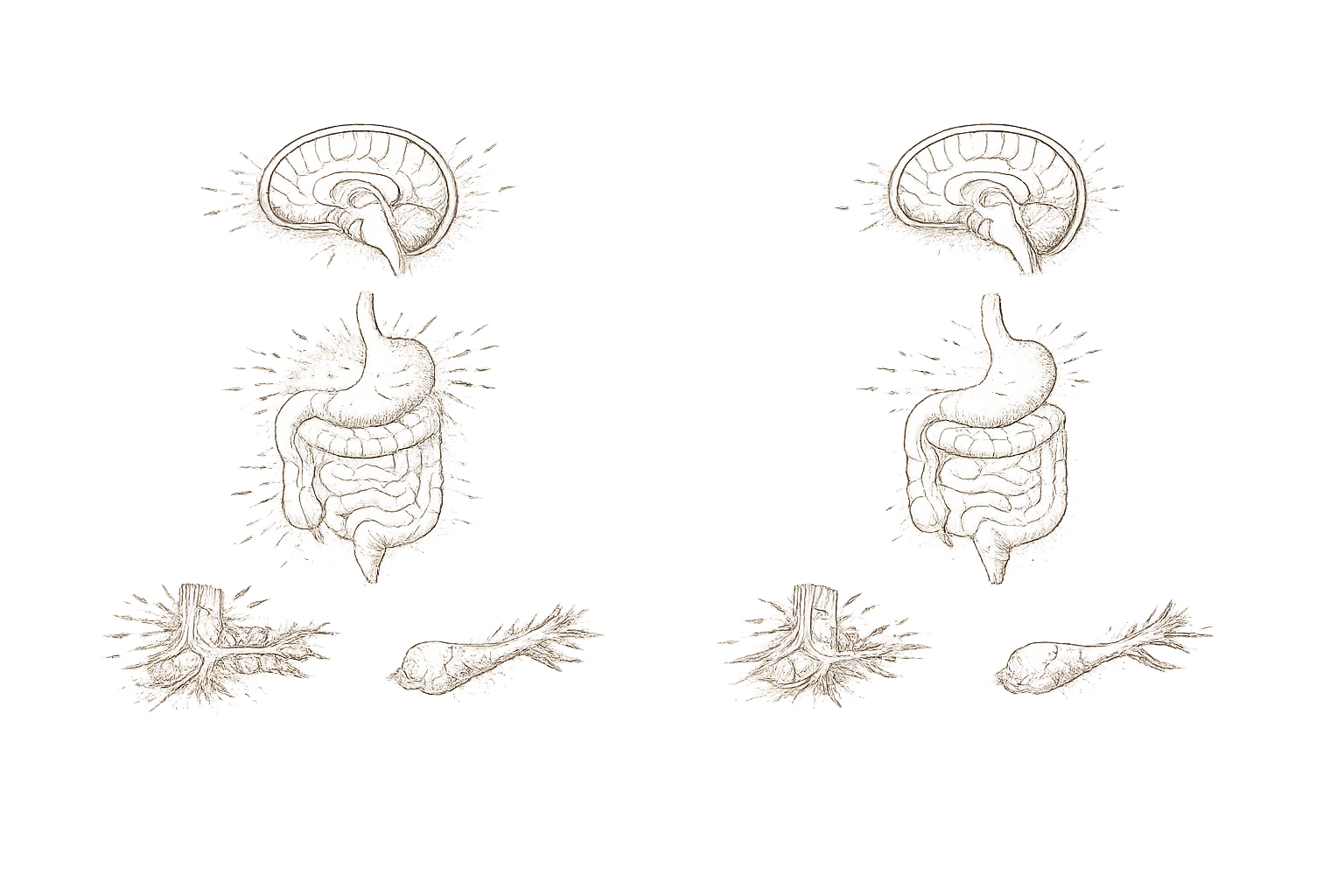
Some of the most common and most difficult-to-treat chronic conditions share a puzzling set of features. Migraine, fibromyalgia, and irritable bowel syndrome are each defined primarily by symptoms rather than by clearly understood pathophysiology. They co-occur at rates higher than chance — a person with migraine is substantially more likely to also have fibromyalgia or IBS than population prevalence would predict. They tend to respond poorly to treatments targeting single molecular pathways. And all three involve systems — nociception, central sensitivity, gut-brain signalling — in which the endocannabinoid system is known to play modulatory roles.
In 2001, neurologist Ethan Russo first proposed a framework to account for this pattern. He called it clinical endocannabinoid deficiency, or CED — the hypothesis that these conditions may involve chronically insufficient endocannabinoid tone, and that this insufficiency could be a contributing factor in their shared pathophysiology. He expanded and updated the hypothesis in a 2016 review in Cannabis and Cannabinoid Research, which remains the primary source document for understanding both the proposal and its evidentiary basis.
This article is written as a hypothesis article, not as an account of established science. The distinction matters and it is stated here at the outset so that a reader who encounters this material elsewhere — presented without appropriate caveats — has a clear reference point for what the evidence actually shows.


What the Hypothesis Proposes
The CED hypothesis draws an analogy to other well-established deficiency frameworks in medicine. Just as insufficient serotonin production is associated with certain mood disorders and forms part of the rationale for serotonergic pharmacotherapy, Russo proposes that insufficient endocannabinoid tone — lower than normal anandamide or 2-AG production, reduced CB1 receptor density, or impaired endocannabinoid signalling — could underlie a cluster of conditions whose aetiology remains poorly understood.
The hypothesis has three components. First, that the ECS plays a foundational modulatory role in the systems involved in these conditions — pain processing, gut motility and sensitivity, stress and inflammatory responses, and sleep architecture. Second, that measurable markers of ECS function — primarily cerebrospinal fluid anandamide levels — are reduced in at least some people with these conditions compared to controls. Third, that treatments which support endocannabinoid tone, including cannabinoid-based medicines, show efficacy signals in these populations that are consistent with a deficiency model rather than an incidental pharmacological effect.
The hypothesis is not that CED causes migraine, fibromyalgia, or IBS in the same way that a single gene mutation causes a Mendelian disorder. It is a more modest and more plausible proposal: that chronically low ECS tone is a contributing factor in the pathophysiology of these conditions in at least some affected individuals, and that this contribution may account for some of their shared features and their common treatment challenges.
The Correlational Evidence
The evidence Russo marshals for the CED hypothesis is correlational — it shows associations that are consistent with the hypothesis rather than causal proof of it. Understanding precisely what that evidence is, and precisely what it does not show, is essential to reading this hypothesis appropriately.
Cerebrospinal Fluid Anandamide
The most direct evidence comes from studies measuring anandamide levels in cerebrospinal fluid (CSF) — the clearest available window into central endocannabinoid availability. Russo cites studies showing reduced CSF anandamide in patients with migraine compared to controls, and other work showing altered endocannabinoid profiles in fibromyalgia. These findings are real and published in peer-reviewed literature. They are also limited: CSF anandamide measurement is technically demanding, sample sizes in the relevant studies are small, and the relationship between CSF anandamide levels and functional ECS tone at specific synapses is not straightforwardly interpretable. Correlation between low anandamide and the presence of a condition does not establish which is cause and which is consequence.
The Co-occurrence Pattern
Migraine, fibromyalgia, and IBS co-occur at elevated rates. A person with one of these diagnoses is significantly more likely to have one or both of the others than population prevalence would predict by chance. This is an epidemiological observation that requires explanation. The CED hypothesis offers one: that a shared underlying deficit in ECS function contributes to vulnerability across multiple systems simultaneously. This is a coherent and parsimonious explanation — but it is one of several possible explanations for the co-occurrence pattern, and the hypothesis cannot be distinguished from competing explanations on the basis of co-occurrence data alone.
Treatment Response Patterns
Russo also notes that cannabinoid-based treatments have shown efficacy signals across all three conditions in clinical research — at rates and with characteristics that are consistent with a deficiency model. Cannabis-based medicines have shown efficacy in migraine prevention in some studies, in fibromyalgia symptom management in observational and some controlled research, and in IBS symptom reduction in preliminary trials. If the CED hypothesis is correct, these responses reflect restoration of deficient endocannabinoid tone rather than incidental symptom suppression.
This reasoning is plausible but cannot confirm the hypothesis independently. Treatment response is consistent with CED but also consistent with the known modulatory roles of cannabinoids in pain, gut motility, and stress — roles that would be relevant regardless of whether an underlying deficiency is present.
Why the Hypothesis Merits Serious Attention
A Tier 3 hypothesis rating does not mean a hypothesis is speculative or poorly motivated. It means the evidence base is not yet sufficient to establish it as a clinical fact. The CED hypothesis earns serious attention for several reasons that are independent of its current evidence tier.
The conditions it addresses — migraine, fibromyalgia, IBS — are genuinely difficult. They affect large numbers of people, respond poorly to many standard treatments, and involve systems where the ECS is mechanistically involved at a documented level. Any coherent explanatory framework for these conditions that rests on established biology deserves careful examination, not dismissal.
The hypothesis was proposed by a credentialed neurologist and published in peer-reviewed venues. It draws on real measurable findings rather than theoretical speculation alone. The 2016 Russo review is a serious scientific document — careful, qualified, and explicit about the limits of its evidence base. Russo himself does not overstate the hypothesis, and the article reflects the same caution.
Finally, the hypothesis makes predictions that are testable. If CED is a real clinical entity, then direct measurement of endocannabinoid tone in affected populations should reliably show deficiency compared to controls, and cannabinoid-based interventions designed to restore that tone should show efficacy specific to the deficiency mechanism. Neither of these predictions has been tested with adequate methodology. The research infrastructure to test them — reliable biomarkers of ECS tone, standardised endocannabinoid measurement protocols, adequately powered clinical trials — is being developed but is not yet in place. The hypothesis is waiting for the tools to test it properly.
What This Means for the Archive
The CED hypothesis connects to multiple articles in this archive in ways worth making explicit. The ECS foundational articles — what the system is, what endocannabinoid tone means, how FAAH regulates anandamide availability — provide the biological basis on which the hypothesis rests. The aging ECS article documents one confirmed context in which ECS tone declines in ways that parallel what the CED hypothesis proposes as a pathological pattern. The anxiety-stress-sleep overlap article documents how ECS disruption contributes to a cluster of conditions that co-occur and share mechanisms — a conceptual parallel to the CED condition cluster.
CBD's FAAH inhibition and the resulting increase in anandamide availability are directly relevant to the CED framework: if the hypothesis is correct and certain conditions involve insufficient anandamide, then FAAH inhibition is precisely the mechanism that would address the proposed deficiency. This does not mean CBD treats migraine, fibromyalgia, or IBS — the clinical evidence for those specific claims is not adequate to support them. It means the mechanistic rationale for investigating cannabinoids in these populations is well-grounded, and that the investigation is worth following as the research develops.
Clinical endocannabinoid deficiency is a research hypothesis, not an established clinical entity. The correlational evidence supporting it — reduced CSF anandamide in migraine patients, the co-occurrence pattern across the three conditions, treatment response data — is real and published in peer-reviewed literature. The hypothesis is coherent, biologically grounded, and proposed by a credentialed researcher. It merits serious attention and continued investigation.
What is not established: CED has not been confirmed as a clinical diagnosis. No reliable biomarker for ECS deficiency has been validated. Causation between low ECS tone and the proposed conditions has not been demonstrated. The treatment response evidence is consistent with the hypothesis but does not confirm it. No clinical claim about migraine, fibromyalgia, or IBS management can be made on the basis of the CED hypothesis or the current cannabinoid evidence in these populations.
People living with migraine, fibromyalgia, or IBS are dealing with real conditions that warrant proper medical assessment and management. This hypothesis provides a research framework for understanding possible ECS involvement — it is not a treatment rationale or a basis for self-management decisions.
These statements have not been evaluated by the Food and Drug Administration. J.P. Hemp Company products are not intended to diagnose, treat, cure, or prevent any disease.