Understanding — How Cannabinoids Work
Terpenes, Cannabinoids, and Whole-Plant Phytochemical Interaction: What Research Has Found
The hemp plant produces hundreds of compounds alongside cannabinoids — terpenes, flavonoids, and other phytochemicals that have their own biological activities. What research has actually established about how they interact, and what remains an open question.
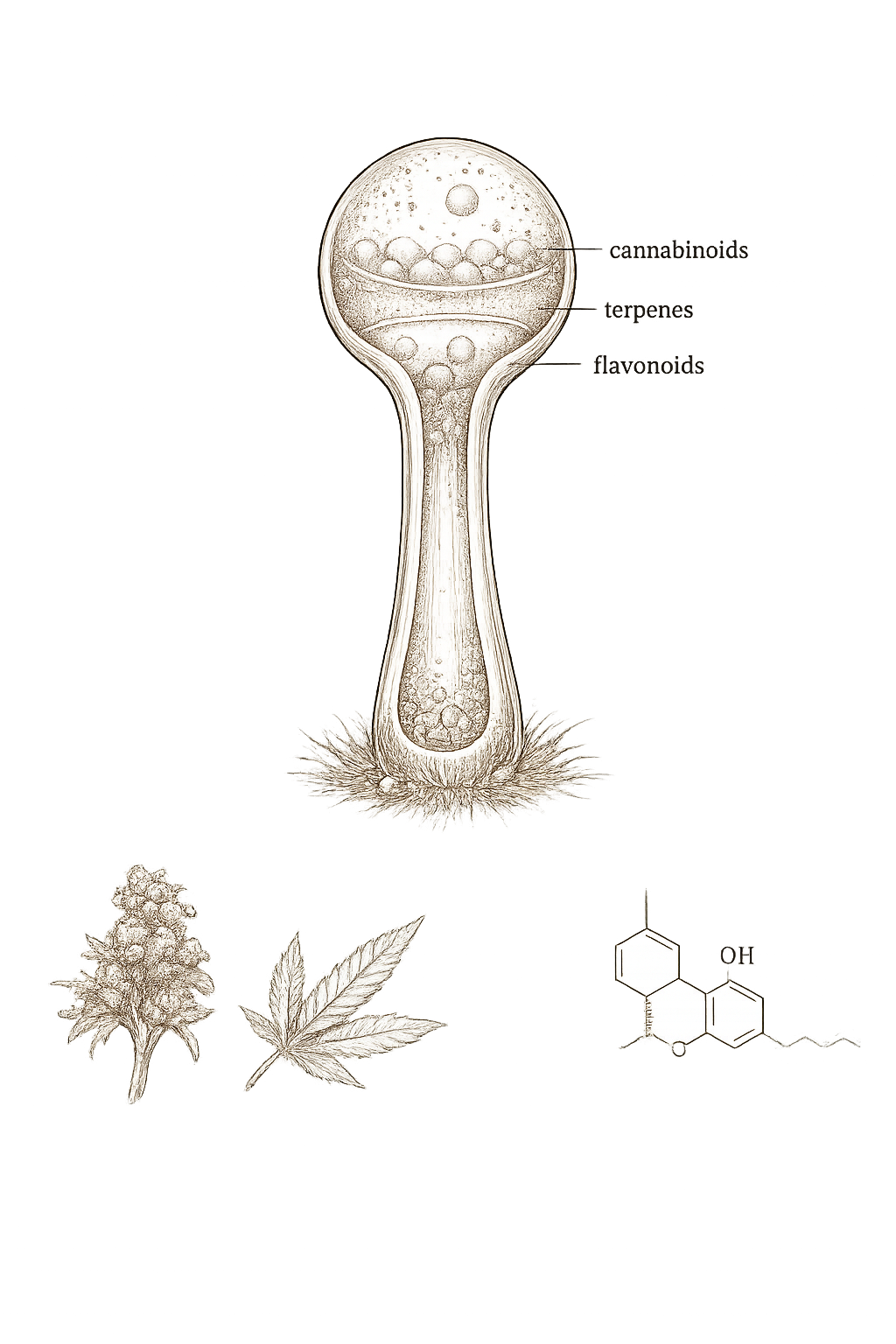
The idea that the compounds in a whole plant work better together than any single compound in isolation is not a marketing invention. It is a biological observation with a real scientific lineage — and a real body of research behind it, at least for some specific interactions. The problem is that the observation has been stretched, in the hemp and cannabis industry, well beyond what the evidence supports. Understanding where the evidence is solid, where it is early, and where it has been overclaimed is one of the more useful things a reader of this archive can do.


Where the Idea Came From — and What Happened to It
In 1998, Raphael Mechoulam and his colleagues published a paper introducing the term "entourage effect" to describe a specific pharmacological phenomenon: endogenous fatty acid compounds found alongside anandamide in the brain appeared to enhance anandamide's activity without binding to cannabinoid receptors themselves. The term described a precise, documented biochemical relationship — not a general claim about whole-plant preparations.
The term migrated into cannabis and hemp marketing over the following two decades and its meaning changed substantially in transit. By the time it became common in product copy, it had come to imply that full-spectrum hemp preparations produce superior effects compared to isolated cannabinoids because of synergistic interactions between cannabinoids, terpenes, and other phytochemicals. This broader claim — while not implausible — goes significantly further than the 1998 Mechoulam pharmacology it is frequently cited to support.
This archive avoids the term for three reasons. First, because the word now carries recreational cannabis marketing associations that sit outside the agricultural and apothecary register this archive operates in. Second, because using it as a positive descriptor implies a degree of synergy certainty that the research does not currently support for most claimed interactions. Third, because "whole-plant phytochemical interaction" more accurately describes what is actually happening in a whole-plant preparation and what the preparation philosophy here is grounded in.
When the term appears below, it is only in the context of discussing the history and limits of the concept — never as a label for what the research has established.
What Whole-Plant Phytochemical Interaction Actually Describes
Hemp produces its phytochemicals primarily in trichomes — the resinous glandular structures concentrated on the flower. Cannabinoids, terpenes, and flavonoids are all synthesised in these structures and are therefore co-present in any whole-plant preparation that preserves the full trichome profile. That co-presence is a botanical fact. Whether the co-presence produces meaningful biological interactions in the human body is a research question — and the answer varies significantly by compound and by interaction type.
Beta-Caryophyllene — The Clearest Documented Interaction
Beta-caryophyllene is the most thoroughly studied terpene in the context of cannabinoid system interaction. It is a sesquiterpene found in hemp, black pepper, cloves, and other botanicals, and it is the only terpene currently documented to act as a direct agonist at CB2 receptors. This was established by Gertsch et al. in a 2008 paper in the Proceedings of the National Academy of Sciences — a peer-reviewed finding in a high-quality venue, replicated in subsequent work.
CB2 receptors are expressed primarily in immune tissue and are involved in anti-inflammatory signalling. Beta-caryophyllene's CB2 agonism gives it biological activity through the same receptor system that CBG and CBD engage — though through a distinct compound acting at a specific receptor rather than through undefined synergy. This is a Tier 2 finding: a documented specific mechanism in preclinical research, without adequate human trial evidence to establish clinical efficacy.
What this means practically: a whole-plant preparation that preserves beta-caryophyllene — which a whole-flower alcohol tincture or oil infusion does, since terpenes are volatile and lost in some extraction processes — contains a compound with documented CB2 activity alongside the primary cannabinoids. That is a meaningful statement grounded in research. It is not the same as claiming that beta-caryophyllene and CBG or CBD produce synergistic effects greater than either alone — that more specific claim has not been tested.
Myrcene
Myrcene is one of the most abundant terpenes in hemp and cannabis. It has been studied for sedative-like effects in rodent models — specifically for its ability to enhance the sedative effects of barbiturates in certain paradigms. This has been the basis for popular claims that myrcene contributes to the sedating character of some cannabis preparations.
The evidence for myrcene's sedative effects in the relevant models is real but limited: primarily rodent studies using doses that may not correspond to what is present in hemp preparations used sublingually. The specific claim that myrcene enhances cannabinoid-mediated sedation through defined synergistic mechanisms has not been established in human research. Myrcene has also shown anti-inflammatory and analgesic activity in preclinical models through mechanisms that do not involve cannabinoid receptors — it appears to act through opioid receptor pathways in some models, which is a separate and incompletely understood mechanism. The evidence for myrcene is Tier 3 in the context of cannabinoid interaction.
Linalool
Linalool is a terpene found in lavender, hemp, and many other plants. It has documented anxiolytic effects in rodent models — the inhalation literature is particularly consistent, with linalool showing anxiety-reducing effects in elevated plus maze and open field paradigms at relevant doses. These effects appear to be mediated through GABA-A receptor modulation and through effects on glutamate systems, rather than through cannabinoid receptors.
The linalool research is more mechanistically coherent than the myrcene literature, but the human evidence is thin and the available studies are primarily in aromatherapy contexts — inhalation of lavender essential oil — rather than in oral hemp preparations where linalool concentrations and bioavailability would differ substantially. Whether linalool in an oral hemp preparation contributes meaningfully to any anxiolytic effect alongside CBD's documented 5-HT1A and FAAH-mediated mechanisms is an open question. Tier 3 in the interaction context.
What Research Has Not Established
Most specific synergy claims in the hemp and cannabis industry — the claim that compound A and compound B together produce effects greater than the sum of their individual effects — are not supported by human evidence. This is an important distinction to state directly, because the research gap is frequently obscured in industry communications.
There is one well-cited clinical study often invoked in support of whole-plant synergy claims: a 2015 paper by Blasco-Benito et al. examining tumour response in mouse models comparing CBD isolate to a whole-plant CBD-rich extract. The whole-plant extract showed a broader dose-response curve and activity at lower doses. This is a genuinely interesting finding — in a mouse tumour model, using a specific outcome measure. It does not establish that whole-plant hemp preparations produce superior effects in human wellness applications compared to isolated cannabinoids. The inferential leap from that specific preclinical finding to broad synergy claims in consumer products is one that the evidence does not support.
The honest position, which is also the defensible position, is this: specific terpene-cannabinoid interactions are a legitimate and active area of research. Some individual interactions have documented mechanistic evidence — beta-caryophyllene's CB2 agonism being the clearest example. Many others are biologically plausible based on the known activities of individual compounds. But the specific claim that whole-plant preparations produce superior effects through synergistic interactions — relative to any given isolated cannabinoid — is not established in human research for any condition.
Why the Whole-Plant Preparation Philosophy Is Grounded Differently
The preparation philosophy at J.P. Hemp Company — whole-flower alcohol maceration and oil infusion rather than extraction and formulation with isolated cannabinoids — is not based on specific synergy claims that exceed the evidence. It is based on two more conservative and more defensible commitments.
The first is botanical integrity. Traditional herbal preparations have historically worked with the whole plant rather than isolating specific constituents, on the practical reasoning that the full botanical profile — however its components interact — represents the plant as grown and harvested. This is an agricultural and apothecary tradition, not a pharmacological claim about superiority. It reflects a conviction about appropriate relationship with the plant rather than a specific efficacy claim about the extract.
The second is preservation of the documented phytochemical profile. A whole-flower preparation prepared by alcohol maceration or oil infusion at controlled temperatures preserves terpenes, minor cannabinoids, and flavonoids that are lost or destroyed in some extraction and refinement processes. That preservation is documented — a whole-flower tincture contains beta-caryophyllene, myrcene, linalool, and dozens of other terpenes alongside the primary cannabinoids. Whether those compounds interact synergistically in meaningful ways is a research question still being answered. That they are present, and that their presence is consistent with the documented biological activities of each compound individually, is not a claim that exceeds the evidence.
The specific synergy research will continue to develop. When it produces findings of adequate quality and relevance to warrant updating this article's evidence tier and claims, it will be updated. The preparation philosophy stands on its own ground — botanical integrity and whole-plant preservation — without requiring that research to support it.
Beta-caryophyllene's CB2 agonism is established in peer-reviewed preclinical research and is the strongest specific terpene-cannabinoid receptor interaction in the literature — Tier 2. Myrcene and linalool have documented biological activities in preclinical models through mechanisms that intersect with but are not identical to cannabinoid receptor systems — Tier 3 in the interaction context. The general concept of phytochemical co-presence and potential interaction is scientifically coherent.
What is not established: no adequately designed human trial has demonstrated that whole-plant hemp preparations produce superior clinical outcomes compared to isolated cannabinoids for any specific condition. Most specific synergy claims in hemp and cannabis marketing exceed the current evidence. The "entourage effect" as a general positive descriptor of whole-plant superiority is not an evidence-based claim in the current literature. This does not mean the interactions are not occurring — it means the research has not yet established them at a level that justifies confident therapeutic claims.
These statements have not been evaluated by the Food and Drug Administration. J.P. Hemp Company products are not intended to diagnose, treat, cure, or prevent any disease.