Understanding — How Cannabinoids Work
What to Expect in the First Few Weeks
For the person who just started a CBD or CBG preparation — a realistic timeline, the markers worth paying attention to, and how to run an honest experiment.
Most people who try a CBD or CBG preparation expect to feel something within hours of the first dose. When that doesn't happen, they often conclude it isn't working — and put it in a drawer.
This is a reasonable response to a category that has been badly marketed. The premise of most hemp product advertising is that you will feel something quickly, clearly, and unmistakably. The honest reality is that non-intoxicating cannabinoids work differently — gradually, subtly, and through markers that require some deliberate attention to notice. This article tells you what to actually look for and when.
The endocannabinoid system is a regulatory system — it works by modulating the activity of other systems rather than by producing dramatic standalone effects. CBD's most documented effects involve FAAH inhibition, which gradually raises anandamide levels over days and weeks. CBG's stress-reducing effects, documented in the Cuttler (2024) human trial, showed measurable results at a single dose — but the sustained benefit of consistent use builds differently than an acute pharmaceutical effect. These are compounds that restore regulatory capacity over time. The timeline reflects that.


A realistic timeline
Nothing noticeable is normal and expected. The system is not responding to a single dose the way a pharmaceutical would — it is beginning to interact with a regulatory network that has its own baseline state. Some people notice mild changes in sleep on the first night or two; most notice nothing at all. This is not failure. The experiment has barely started.
The one thing worth noting: if you experience anything unexpected — unusual fatigue, a change in the way a medication feels — see the drug interactions article and contact your prescribing clinician if you are on prescription medication.
Sleep is usually the first domain where subtle change appears, if it appears at all. Not necessarily longer sleep — more often a slightly different quality. Waking feeling marginally more rested than usual. The 3am waking that happens less reliably, or resolves more quickly when it does. These are quiet signals that are easy to miss if you are scanning for something more dramatic.
Some people notice their stress response feels slightly less immediate during this window — a stressful situation that produced the usual internal reaction, but the reaction resolved a bit faster than expected. Again: quiet, easy to miss, requires some deliberate attention.
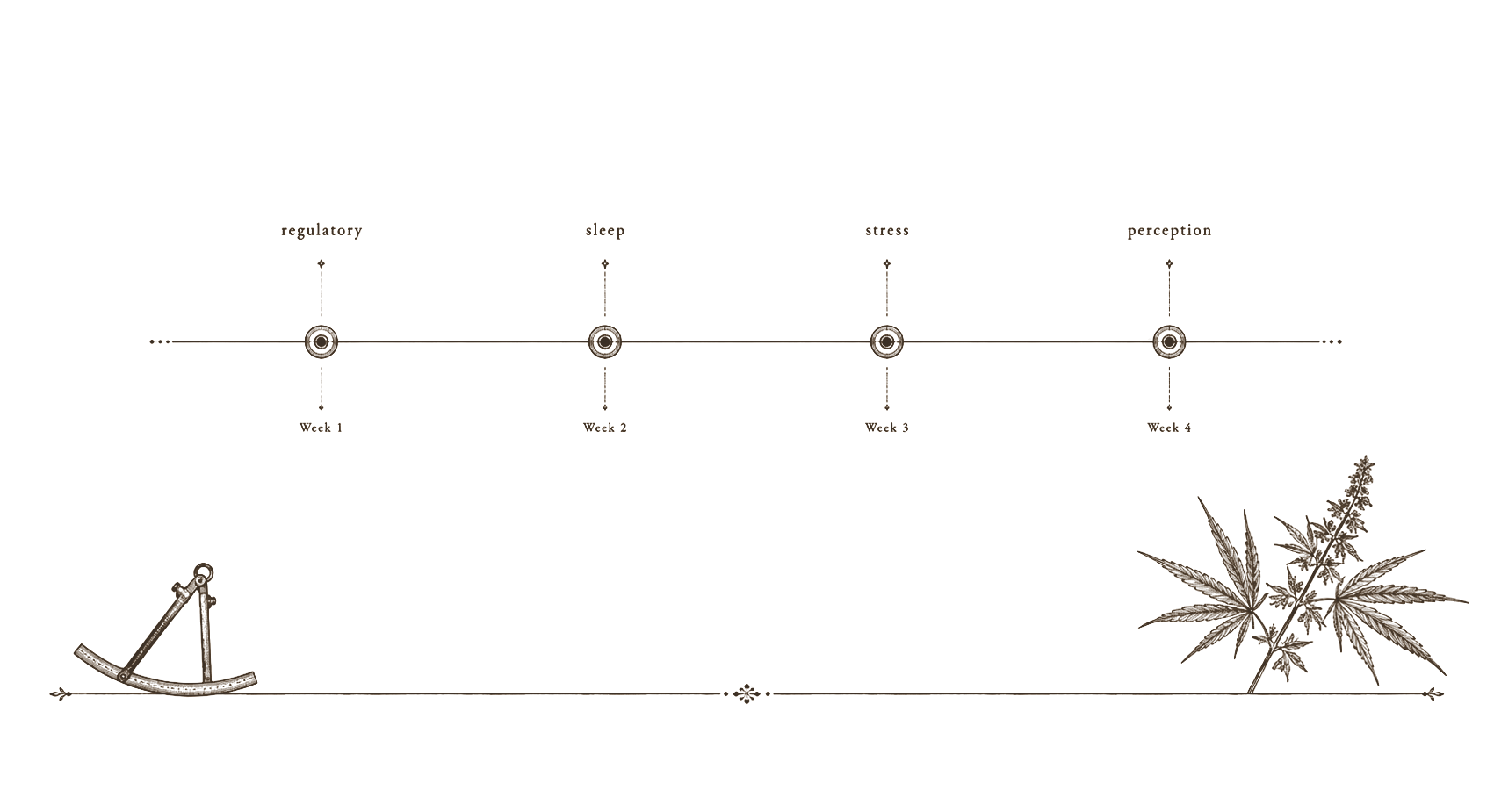
If a preparation is going to produce noticeable benefit, weeks two and three are most commonly when people first identify it clearly in retrospect — looking back and noticing that the last two weeks felt somewhat different from the previous two. The stress load felt slightly more manageable. Sleep was more consistently restorative. The reactive edge that usually appears by Thursday afternoon was less pronounced.
These are not dramatic transformations. They are directional shifts in regulatory function — and they are what the research documents. The Cuttler CBG trial measured stress and anxiety at 20, 45, and 60 minutes after a single dose. Consistent daily use over two to three weeks is a different and more sustained experiment than a single-dose trial, and the effects accumulate differently.
Four weeks of consistent use at an appropriate dose through the right route constitutes a fair trial. At this point you have enough information to make a genuine assessment — not based on whether you felt something in the first hour, but based on how the last four weeks compared to the four weeks before. If the answer is genuinely no different, that is useful information. The preparation may not be producing meaningful benefit for you, and that is worth knowing honestly.
If the answer is somewhat better — in any of the domains you were tracking — that is also useful information, and the question becomes whether continuing makes sense for you.
What markers are actually worth tracking
The most common mistake in self-assessment is scanning for a felt effect rather than tracking functional outcomes. Here are the markers that are most likely to reflect genuine cannabinoid activity — and are specific enough to distinguish from general life variation.
Sleep quality — not just duration
Not "did I sleep longer" but "did I wake feeling more rested." Notice whether the 3am waking is happening — and if it does, whether you return to sleep faster. Notice whether you are still tired an hour after waking, which is a sign of disrupted deep sleep. These are more specific markers than total hours slept.
Stress recovery speed — not absence of stress
CBG does not eliminate stress. The relevant marker is how quickly you recover from a stress event — whether the internal reaction to a difficult conversation, a deadline, or a frustrating situation resolves within an hour rather than persisting into the evening. This is a specific, trackable signal once you know to look for it.
Reactivity in the second half of the day
The late afternoon and early evening — when cortisol is naturally declining and accumulated stress from the day is most felt — is often the clearest window for noticing a change. A slightly wider margin before the reactive edge appears. A slightly shorter recovery from the point where everything feels too much. These are quiet but consistent signals.
The morning after difficult days
One of the more consistent things people report after several weeks of consistent CBG use is that they handle the aftermath of a hard day differently — waking the next morning with less residue from the previous day's stress. This is a longer-cycle marker that takes at least two weeks to notice, but once noticed it tends to be clear.
Three things that make the experiment more accurate
Consistency matters more than dose. Taking a preparation on some days and not others produces inconsistent endocannabinoid tone that is harder to assess and less likely to build the gradual regulatory shift that consistent use supports. The same time each day, with food, is the most reliable method for sublingual tinctures.
Keep other variables as stable as possible. Starting a new preparation during a period of unusual stress, travel, illness, or significant life change makes it nearly impossible to isolate its effect from everything else that is happening. The ideal experiment has reasonably stable baseline conditions on either side of it. If life is unusually chaotic right now, note that when you make your four-week assessment.
Write it down — even briefly. Memory is unreliable for subtle changes over weeks. A simple daily note — one sentence, sleep quality and stress level on a scale of 1–5 — gives you actual data to look back on at week four rather than an impression. The people who report the clearest sense of whether something worked are almost always the ones who tracked something, however informally.
If you are on prescription medication
CBD inhibits certain liver enzymes that process some medications — particularly SSRIs, blood thinners, and several other drug classes. If you are taking prescription medication and starting a CBD or CBG preparation, read the medications article in this archive and speak with your prescribing doctor or pharmacist before beginning. Do not adjust any prescription medication based on how you feel during the first few weeks of cannabinoid use.
These statements have not been evaluated by the Food and Drug Administration. J.P. Hemp Company products are not intended to diagnose, treat, cure, or prevent any disease.