Understanding — How to Read Research
What Is a Randomized Controlled Trial?
The gold standard of medical research — what it is, why it matters, and how to tell a well-designed trial from a weak one.
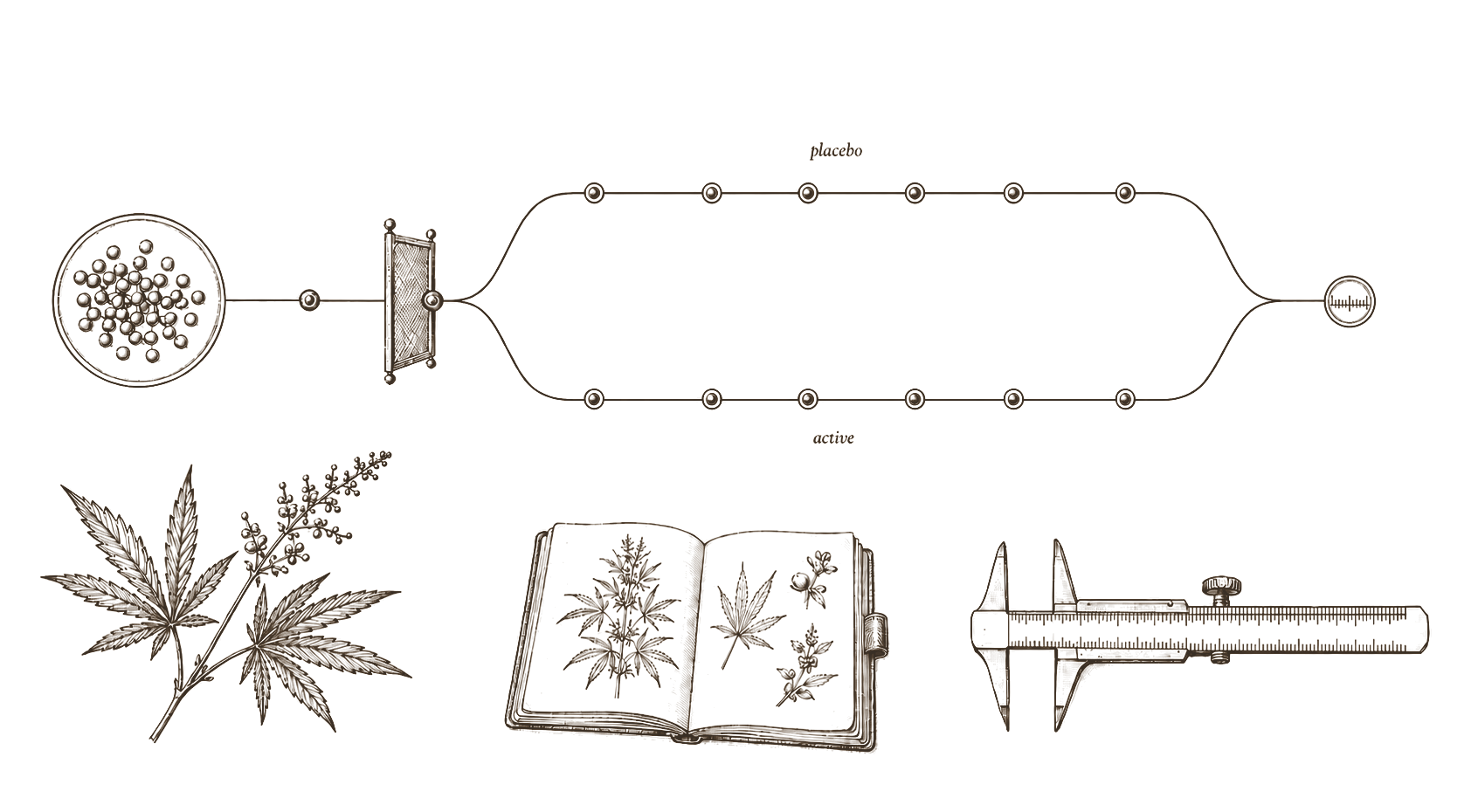
Research headlines regularly announce that a compound "reduces anxiety" or "improves sleep." What those headlines almost never tell you is how that finding was produced — how many people were studied, for how long, under what conditions, and against what comparison. The design of a study determines what its findings can and cannot mean. Without that context, even accurate summaries of real results can be misleading.
The randomized controlled trial is the research design most frequently cited when human evidence is claimed. Understanding how it works — and what it cannot establish even when it works well — is the prerequisite for reading claims in this archive accurately.


The Four Elements of an RCT
A randomized controlled trial is defined by four structural features that work together to reduce the sources of error that would otherwise make it impossible to know whether an intervention caused the outcomes observed.
Element 1
An Intervention Group
Participants who receive the active intervention — the compound, treatment, or procedure being studied. What happens to this group is what the trial is trying to measure.
Element 2
A Control Group
Participants who receive a placebo or an alternative intervention. The control group establishes what would have happened without the active intervention — the comparison that makes the intervention group's results interpretable.
Element 3
Randomization
Participants are assigned to groups by chance rather than by researcher selection or participant preference. This distributes pre-existing differences — age, health status, anxiety levels — more evenly between groups, reducing the likelihood that those differences explain the results rather than the intervention.
Element 4
Controlled Conditions
Standardized procedures, settings, doses, and measurement tools that are applied consistently across both groups. Controlled conditions allow the intervention to be the primary variable rather than one variable among many unmanaged ones.
Blinding: Why It Matters Particularly for Cannabinoid Research
Many RCTs are also blinded — meaning participants, researchers, or both are kept unaware of which group each participant is in until after data are collected. Blinding addresses the problem of expectation: knowing that you've received an active compound can itself change how you feel and what you report, independent of any pharmacological effect.
Type 1
Single-Blind
Participants don't know their group assignment. Researchers do. Reduces participant expectation effects but leaves researcher measurement potentially influenced by knowledge of group assignment.
Type 2
Double-Blind
Neither participants nor outcome assessors know group assignments until data collection is complete. The strongest standard for reducing expectation and measurement bias simultaneously.
Type 3
Triple-Blind
Extends blinding to data analysts as well. Less common but used in some large trials. Reduces the possibility that analytical decisions are unconsciously shaped by knowledge of which group is which.
Blinding matters especially in cannabinoid anxiety and stress research because the primary outcomes — self-reported anxiety, perceived stress, mood — are exactly the kind of measures that expectation effects influence most strongly. Placebo response rates in anxiety research are documented to be substantial. A well-blinded design is the mechanism by which a trial distinguishes a pharmacological effect from an expectation effect. When a cannabinoid trial reports statistically significant effects compared to placebo in a double-blind design, the blinding is a large part of why that result is meaningful.
The Crossover Design: Participants as Their Own Controls
A variant of the standard RCT worth understanding specifically is the crossover design, which appears frequently in cannabinoid research. In a crossover trial, each participant receives both the active intervention and the placebo — in separate sessions, in a randomized order, with a washout period between them to prevent one session from influencing the next.
How a Crossover Design Works
Session 1 (half of participants)
Active compound → Washout period
Session 2 (same participants)
Placebo → Outcomes compared
The other half of participants receive placebo first, then active compound — randomizing the order controls for order effects. Because each participant experiences both conditions, their own baseline is the control. This makes crossover designs efficient and powerful for detecting individual-level differences, particularly in small samples.
The Cuttler et al. (2024) CBG trial used a double-blind, placebo-controlled crossover design with 34 participants. Understanding this design is prerequisite for understanding what that trial found and what it didn't. Each participant's stress and anxiety scores on active CBG were compared to their own scores on placebo — which is why the trial could produce statistically significant findings with a modest sample size. It is also why the findings are specific to acute single-dose administration in healthy adults, not chronic dosing or clinical populations.
What RCTs Can Establish — and What They Cannot
When a well-designed RCT finds a statistically significant effect, it establishes that the observed difference is unlikely to be due to chance under the conditions studied. That is meaningful. It is also bounded — the finding applies to the specific population, dose, duration, and outcome measure used in that trial, and it does not automatically generalize beyond those parameters.
Statistical significance vs. clinical meaningfulness
A finding can be statistically significant — meaning unlikely to reflect chance — without being clinically meaningful in terms of real-world effect size. A 2-point reduction on a 100-point anxiety scale might be statistically significant in a large sample and genuinely unimportant in practice. Conversely, a larger effect in a small sample might not reach statistical significance even if the direction of the result is consistent and the effect size is real. Both questions — did the effect exceed chance, and was the effect large enough to matter — deserve separate consideration.
Questions to Ask When Reading Any RCT
When a study is cited in this archive or encountered elsewhere, these questions help place the finding in proportion.
Reading an RCT — Seven Questions
Where RCTs Fit in the Broader Evidence Picture
RCTs are not the only form of useful evidence and they are not infallible. Observational studies identify patterns across large populations that trials may not capture. Laboratory and animal research establishes mechanisms and generates hypotheses that trials then test. Systematic reviews and meta-analyses synthesize findings across multiple trials to assess consistency and effect size across the literature. Each design contributes something different, and each has its own limitations. An RCT is one piece of an evidence ecosystem, not the whole of it.
In cannabinoid research specifically, the RCT literature is early-stage across most domains. Most published trials are small, acute, and conducted in healthy adult volunteers. Understanding what that means — what those trials can establish and what questions they leave open — is the difference between reading the research accurately and either dismissing it or overstating it.
Reading a study well is a skill, not a credential. The questions above don't require a statistics background — they require only the habit of asking them before accepting a headline's summary of what a piece of research shows. That habit is what this pillar is trying to build.
Every study cited in this archive has been read against these questions. The tier system — Tier 1 for human RCTs, Tier 2 for preclinical, Tier 3 for very early findings — is the shorthand expression of that reading. This article is the longer form of what those tiers mean.
These statements have not been evaluated by the Food and Drug Administration. J.P. Hemp Company products are not intended to diagnose, treat, cure, or prevent any disease.