Understanding — How Cannabinoids Work
Bioavailability and Administration Routes
How much of a cannabinoid actually reaches the bloodstream depends on how it's taken — and that affects how research findings should be read and compared.
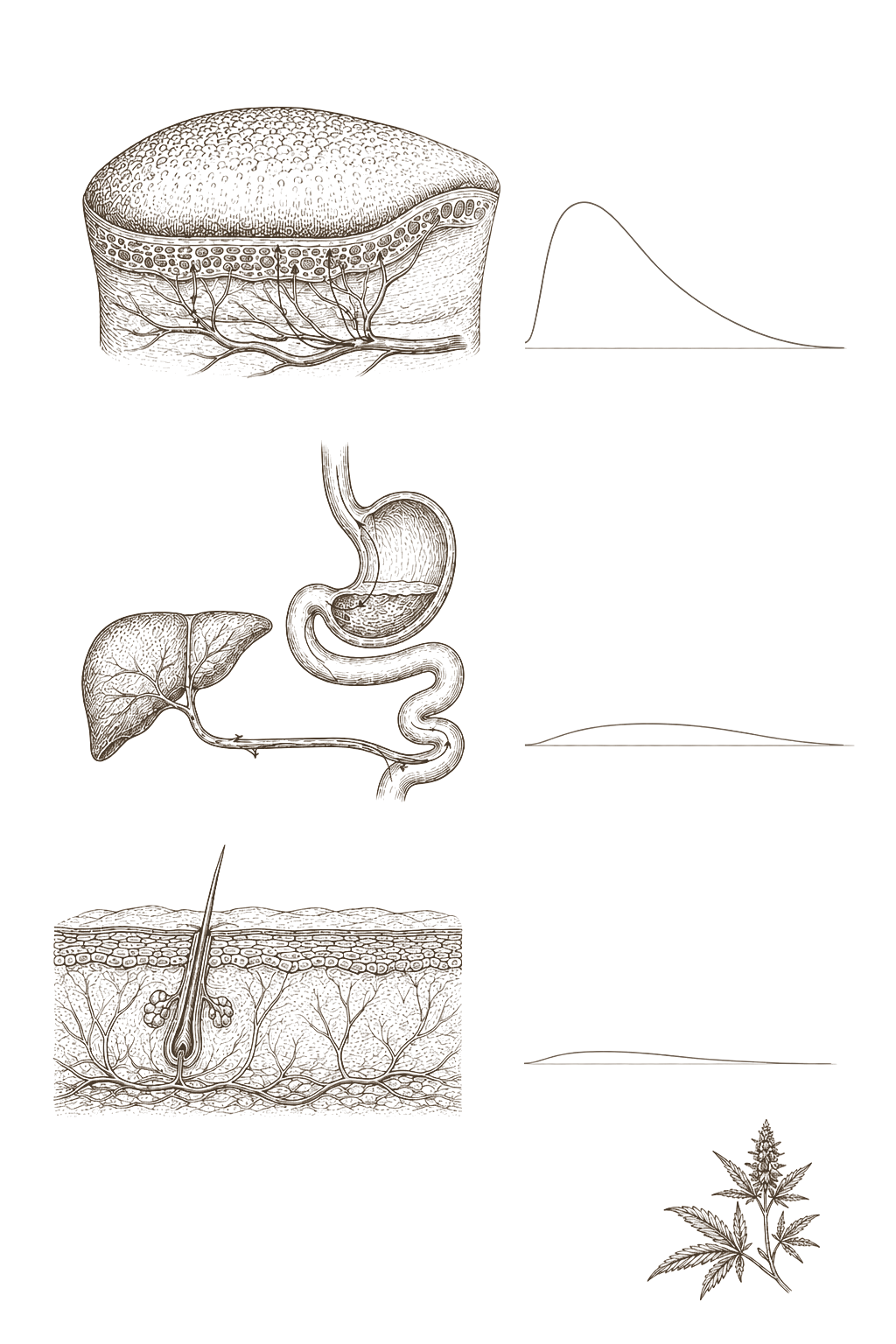
How a cannabinoid enters the body matters as much as how much of it enters. The same compound, at the same dose, can produce meaningfully different concentrations in the bloodstream depending on the route by which it was taken — and different concentrations mean different biological contexts, different onset windows, and different durations. Understanding why begins with a single concept: bioavailability.


What Bioavailability Means
Bioavailability refers to the proportion of an administered compound that reaches systemic circulation in an active form. A compound with low oral bioavailability may be metabolized extensively before it reaches the bloodstream — meaning a large portion of what was ingested never becomes available to tissues and receptors. A compound delivered in a way that bypasses early metabolism may arrive in circulation far more efficiently, at a higher effective concentration, from a smaller total dose.
For cannabinoids, this is not a minor technical detail. It helps explain why the same preparation can produce noticeably different responses depending on how it was taken, and why much of the published human research on cannabinoid dosing is difficult to generalize across administration routes. Most bioavailability data for cannabinoids comes from pharmaceutical-grade CBD or THC studied under controlled conditions — not from full-spectrum hemp preparations taken sublingually or orally in naturalistic settings. That distinction matters when interpreting research findings, and it is addressed in the articles that discuss specific studies.
First-Pass Metabolism
The most significant variable governing oral cannabinoid bioavailability is first-pass metabolism. When a compound is swallowed and absorbed through the gastrointestinal tract, it travels first to the liver before entering systemic circulation. The liver metabolizes a portion of that compound before it ever reaches the bloodstream — this is the first pass. For cannabinoids, first-pass metabolism is extensive. Oral bioavailability for CBD, for example, has been estimated in research at roughly six to nineteen percent under fasted conditions, with significant variability across individuals and formulations. The remainder is metabolized or excreted before reaching circulation.
Fat-soluble compounds — and cannabinoids are highly fat-soluble — absorb more efficiently when taken with food, particularly food containing fat. This is one reason why preparation method and carrier selection influence how a cannabinoid preparation behaves in the body. An oil-based preparation already embeds the cannabinoid in a fat matrix; the digestive process can proceed differently than it would for a water-based or dry capsule form.
A Note on Variability
Individual differences in liver enzyme activity, gut microbiome composition, body composition, and metabolic rate all influence how cannabinoids are absorbed and cleared. The same preparation, taken by two people under the same conditions, may produce different plasma concentrations. Research findings on bioavailability reflect population averages — they are a starting point for understanding, not a precise prediction for any individual.
Administration Routes
The four primary administration routes for hemp-derived cannabinoids each present a different relationship between dose, absorption, onset, and duration. The following summarizes what research has examined about each.
Tincture held under the tongue
Swallowed capsule, edible, or tincture
Vaporized or smoked
Applied to skin
What This Means for Reading Research
Administration route is one of the most consequential variables in cannabinoid research, and one of the most frequently underspecified in how findings are reported outside of academic contexts. A study examining oral CBD at 300mg is describing a different biological context than a study examining inhaled CBD at 20mg — even if both report effects on the same outcome measure. Bioavailability differences alone mean the effective plasma concentrations are not comparable.
When reading a cannabinoid study, the route of administration should be among the first things identified. The dosing, timing, and findings are all interpreted in that context. Articles in the Health Topics section of this archive note administration route for each study cited, for exactly this reason.
On Sublingual Use of Tinctures
Instructions to hold a tincture under the tongue for sixty to ninety seconds before swallowing are intended to allow some sublingual absorption before the preparation enters the digestive tract. Whether this produces a meaningfully different experience depends on the individual and the formulation. The research on sublingual bioavailability for full-spectrum hemp tinctures specifically — as distinct from pharmaceutical-grade isolated cannabinoids — is limited. What is established is the mechanism; what individual variation looks like in this specific context is less well characterized.
Carrier Oils and Absorption
Because cannabinoids are lipophilic — fat-soluble — their absorption is influenced by the lipid environment in which they are carried. Research has examined how different carrier oils affect cannabinoid absorption, with medium-chain triglyceride oils and long-chain triglyceride oils like olive oil behaving differently in the digestive process. MCT oil is absorbed rapidly through a pathway that partially bypasses the lymphatic system; olive oil and other long-chain fatty acid carriers follow a slower lymphatic absorption pathway. Whether these differences produce clinically meaningful differences in cannabinoid bioavailability in real-world use has not been definitively established in the hemp context. What is established is that the fat matrix matters, and that oil-based preparations consistently outperform aqueous or dry forms in bioavailability studies.
References
- Birnbaum, A.K., Karanam, A., Marino, S.E., et al. (2019). Food effect on pharmacokinetics of cannabidiol oral capsules in adult patients with refractory epilepsy. Epilepsia, 60(8), 1586–1592.
- Bruni, N., Della Pepa, C., Oliaro-Bosso, S., et al. (2018). Cannabinoid delivery systems for pain and inflammation treatment. Molecules, 23(10), 2478.
- Grotenhermen, F. (2003). Pharmacokinetics and pharmacodynamics of cannabinoids. Clinical Pharmacokinetics, 42(4), 327–360.
- Huestis, M.A. (2007). Human cannabinoid pharmacokinetics. Chemistry & Biodiversity, 4(8), 1770–1804.
- Millar, S.A., Stone, N.L., Yates, A.S., & O'Sullivan, S.E. (2018). A systematic review on the pharmacokinetics of cannabidiol in humans. Frontiers in Pharmacology, 9, 1365.
- Perucca, E., & Bialer, M. (2020). Critical aspects affecting cannabidiol oral bioavailability and metabolic elimination, and related clinical implications. CNS Drugs, 34(8), 795–800.
- Zgair, A., Wong, J.C., Lee, J.B., et al. (2016). Dietary fats and pharmaceutical lipid excipients increase systemic absorption of orally administered cannabis and cannabis-based medicines. American Journal of Translational Research, 8(8), 3448–3459.
These statements have not been evaluated by the Food and Drug Administration. J.P. Hemp Company products are not intended to diagnose, treat, cure, or prevent any disease.