Understanding — How Cannabinoids Work
Sublingual, Swallowed, and Topical: How Administration Route Affects How Cannabinoids Work
Where a cannabinoid enters the body determines everything about how quickly it acts, how much reaches the bloodstream, and whether it produces effects throughout the body or only at the site of application — three routes, three distinct mechanisms, and what each one means in practice.
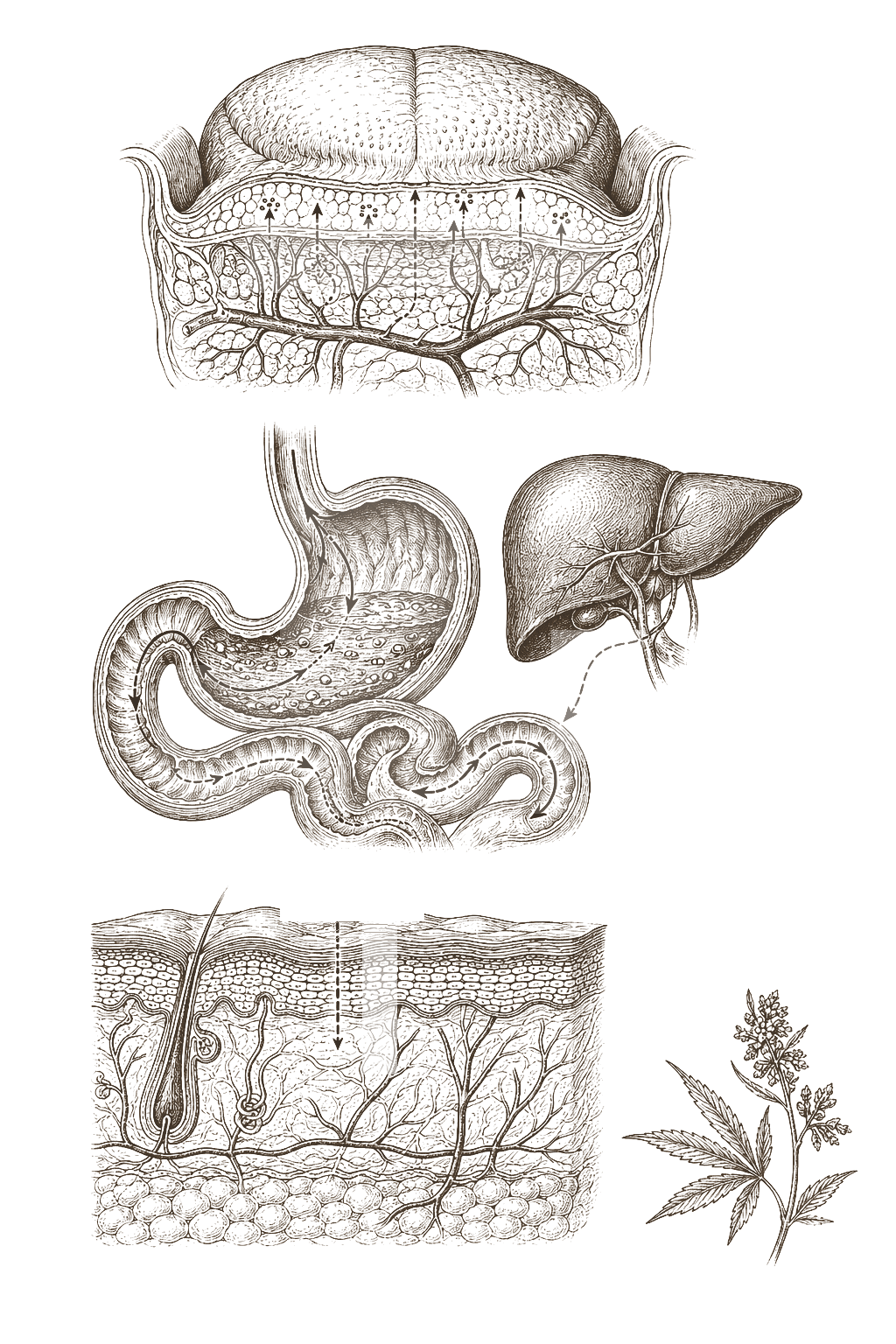
A cannabinoid preparation held under the tongue, swallowed, or applied to skin does not simply reach the same destination by different roads. Each route engages a fundamentally different set of biological processes, produces a different absorption profile, and in the case of topical application, doesn't produce systemic absorption at normal doses at all. Understanding the differences is not a technical detail — it changes what to expect from a preparation and how to read research that uses one route but not another.


Sublingual Absorption — The Mucosal Route
The underside of the tongue and the floor of the mouth are lined with a thin, highly vascularized mucous membrane — the sublingual mucosa. Blood vessels run close to the surface here, and compounds that are sufficiently lipophilic (fat-soluble) can cross this membrane and enter the bloodstream directly without passing through the gastrointestinal tract or the liver first. This is the sublingual route, and it is the reason that tincture preparations are designed to be held under the tongue rather than immediately swallowed.
The practical instruction to hold a tincture under the tongue for 60 to 90 seconds is grounded in this biology. During that hold time, absorption through the sublingual mucosa is occurring. The longer the preparation remains in contact with the mucosa, the greater the proportion that crosses directly into the bloodstream. What is swallowed after the hold time — and some always is — follows the digestive route described below, with its different absorption characteristics.
Swallowed — The Digestive Route
When a preparation is swallowed — whether that means swallowing after a sublingual hold, adding a tincture to a drink, or taking a preparation that was never intended for sublingual use — it enters the gastrointestinal tract and is absorbed through the intestinal wall into the portal circulation, which carries it directly to the liver before it reaches the general bloodstream. This is first-pass metabolism, and it significantly reduces the proportion of the original dose that reaches systemic circulation as unchanged cannabinoid.
For CBD specifically, first-pass metabolism in the liver also converts a portion of the compound to 11-hydroxy-CBD — a metabolite with its own pharmacological activity and a somewhat different duration profile than CBD itself. The swallowed route therefore delivers not only less of the original compound than the sublingual route but also a different metabolic mixture of it.
None of this makes swallowing an ineffective route — it simply means the dose-response relationship is different and the onset is slower. People add tinctures and oils to drinks, food, or simply swallow them without a sublingual hold, and cannabinoids are absorbed through the digestive route and reach systemic circulation. The pharmacokinetics differ from sublingual absorption; the destination — the bloodstream, and from there the tissues where cannabinoid receptors are expressed — is the same.
Why Research Route Matters for Reading Studies
The majority of human cannabinoid pharmacokinetic research has used either inhaled or oral capsule routes — neither of which is how most people use hemp tinctures. A study measuring CBD plasma concentrations after an oral capsule is documenting a fully swallowed, first-pass-metabolized absorption profile. A study using sublingual administration is documenting a different profile. Neither applies directly to a tincture held under the tongue for a variable duration and then partially swallowed. This is one reason why the Bioavailability article in this pillar emphasizes reading research route as a key variable — the same dose by a different route is not the same pharmacological event.
Topical — Local Action Without Systemic Absorption
Topical application — applying a preparation to the surface of the skin — is mechanistically distinct from both sublingual and swallowed routes. At normal application doses, cannabinoids applied topically do not meaningfully penetrate through the full thickness of the skin into the bloodstream. What they do instead is act locally, at the level of the skin tissue itself and the structures immediately beneath the skin surface.
This is not a limitation — it is a different mechanism with different applications. The skin expresses CB1, CB2, and TRPV1 receptors throughout its layers. Keratinocytes — the primary cells of the epidermis — express CB1 and CB2. Sebaceous glands express CB2 and TRPV1. Sensory nerve endings in the dermis express TRPV1 and CB1. Immune cells in the dermis express CB2. A topical cannabinoid preparation can engage all of these receptors locally without needing to reach the bloodstream.
Comparing the Three Routes
The three routes are not interchangeable versions of the same intervention — they serve different purposes and produce different biological events. Sublingual and swallowed routes both produce systemic cannabinoid exposure, differing primarily in the speed, magnitude, and metabolic profile of that exposure. Topical application produces local tissue exposure without meaningful systemic distribution at normal doses.
For reading research, this means that a clinical trial of CBD for anxiety using sublingual administration tells you something about systemic cannabinoid exposure and its central nervous system effects. A topical CBD trial for inflammatory skin conditions tells you something about local CB2 and TRPV1 activity in skin tissue. The two findings are not in the same conversation — they are documenting different mechanisms in different biological compartments.
References
- Atsmon, J., Cherniakov, I., Izgelov, D., et al. (2018). PTL401, a new formulation based on pro-nano dispersion technology, improves oral cannabinoids bioavailability in healthy volunteers. Journal of Pharmaceutical Sciences, 107(5), 1423–1429.
- Hammell, D.C., Zhang, L.P., Ma, F., et al. (2016). Transdermal cannabidiol reduces inflammation and pain-related behaviours in a rat model of arthritis. European Journal of Pain, 20(6), 936–948.
- Millar, S.A., Stone, N.L., Yates, A.S., & O'Sullivan, S.E. (2018). A systematic review on the pharmacokinetics of cannabidiol in humans. Frontiers in Pharmacology, 9, 1365.
- Palmieri, B., Laurino, C., & Vadalà, M. (2019). A therapeutic effect of CBD-enriched ointment in inflammatory skin diseases and cutaneous scars. La Clinica Terapeutica, 170(2), e93–e99.
- Pertwee, R.G. (2008). The diverse CB1 and CB2 receptor pharmacology of three plant cannabinoids. British Journal of Pharmacology, 153(2), 199–215.
- Stinchcomb, A.L., Valiveti, S., Hammell, D.C., & Ramsey, D.R. (2004). Human skin permeation of Δ8-tetrahydrocannabinol, cannabidiol and cannabinol. Journal of Pharmacy and Pharmacology, 56(3), 291–297.
- Zgair, A., Wong, J.C., Lee, J.B., et al. (2016). Dietary fats and pharmaceutical lipid excipients increase systemic exposure to orally administered cannabis and cannabis-based medicines. American Journal of Translational Research, 8(8), 3448–3459.
These statements have not been evaluated by the Food and Drug Administration. J.P. Hemp Company products are not intended to diagnose, treat, cure, or prevent any disease.