About — Philosophy
What We Believe and How We Work
The convictions behind the cultivation, the preparations, and the research — and why we believe all three are expressions of the same underlying principle.
The Founding Conviction
Physical health and the inner life are not separate systems. They are one system — and that understanding shapes everything we do.
The relationship between physical state and inner life has been observed across medical, botanical, and contemplative traditions for centuries. What modern research adds is a growing vocabulary for examining some of those relationships — including the endocannabinoid system, stress physiology, immune signaling, and communication between the gut and brain. In some areas, contemporary evidence supports longstanding observations. In others, it narrows them, complicates them, or shows how much remains unknown.
We began with the conviction that these relationships deserved serious attention — not with a product or a market. Science gave us a disciplined way to test what earlier observation and tradition had suggested. We value confirmation when it comes, but we also value evidence that limits what we are justified in saying. Both move the inquiry forward.
If the body and the inner life are genuinely connected, then what we grow and prepare deserves more care than an ordinary commodity. It carries an obligation: to be cultivated carefully, prepared faithfully, tested independently, and represented honestly. The person using it deserves to know what is in it, how it was made, and what the research can — and cannot — support.
A DISCIPLINE IN THREE FORMS
The field, the preparation, and the honest record of what the research shows — these are not three separate things. They are one discipline expressed in three forms.
AGRICULTURE LEADS · RESEARCH SUPPORTS · RESTRAINT GOVERNS
What We Believe
Agricultural
The preparation begins in the soil. Cultivation decisions cannot be compensated for at the extraction stage. What a plant expresses is shaped by the biological environment it grows in from germination forward.
Botanical
The whole plant matters. We prefer preparations that preserve the plant's native chemical complexity rather than reducing it to a single isolated compound. We do not use isolates.
Apothecary
The relationship between maker and preparation is direct. Every batch is prepared by the same hands that grew the plant. That relationship is not incidental to quality — it is constitutive of it.
Restraint
Research should inform what we say without becoming a reason to say more than the evidence supports. Preclinical findings are not clinical outcomes. Personal observations are not proof. Possibility is not certainty. Trust is built by preserving those distinctions.
On Preparation Methods
We do not use isolates. This is a philosophical position as much as a practical one.
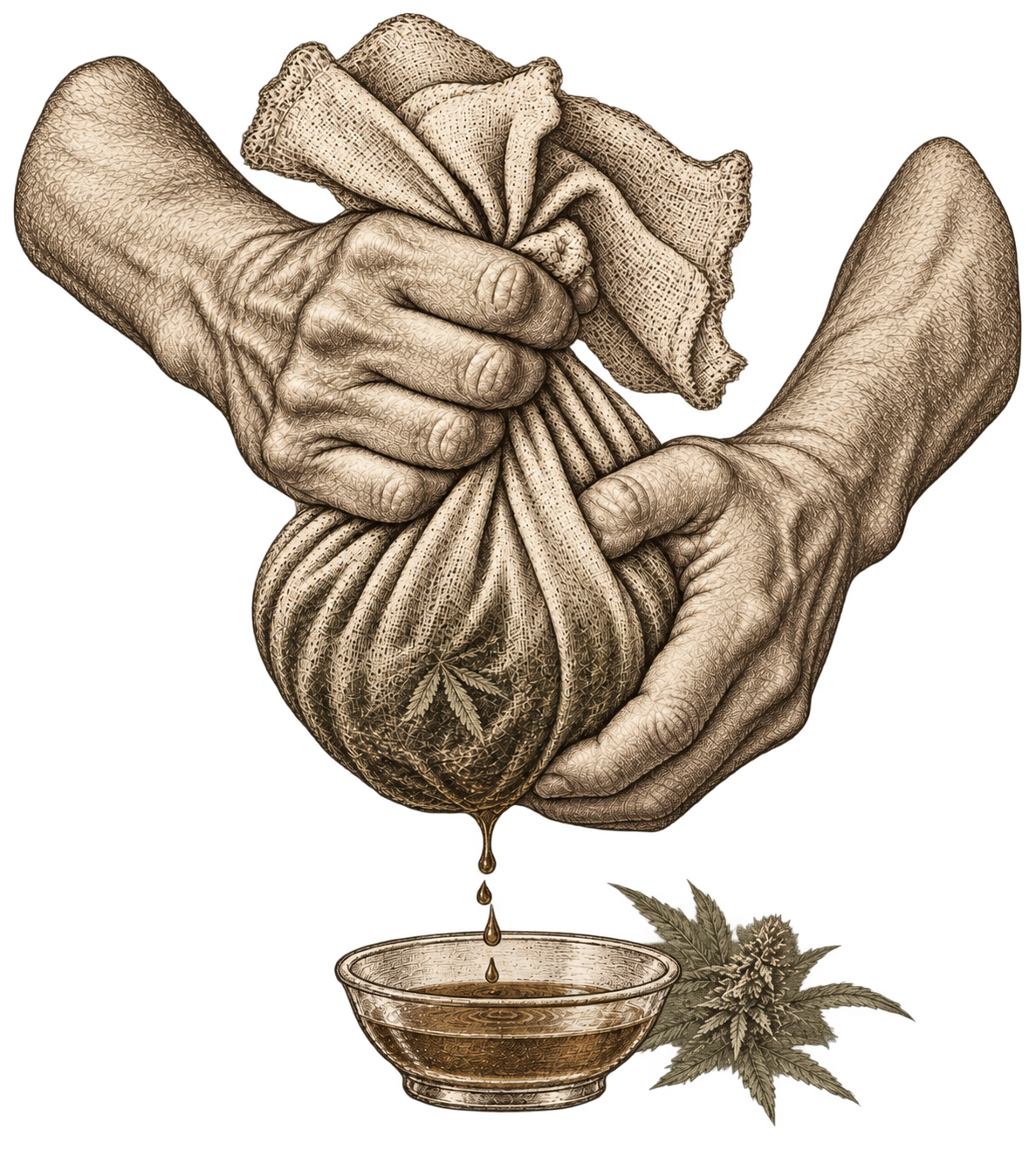
The hemp plant produces a complex mixture of cannabinoids, terpenes, flavonoids, and other constituents. Researchers continue to examine how those compounds may interact and whether whole-plant or full-spectrum preparations behave differently from isolated constituents. We prefer methods that preserve more of the plant's native chemical complexity rather than reducing the preparation to a single isolated compound. Our full-spectrum alcohol tinctures and traditional oil macerations are designed around that preference. They are slower and less amenable to mass production. That is not a problem we are trying to solve.
Alcohol tinctures have a long history in Western botanical practice. Ayurvedic and other traditional systems have likewise worked with multi-constituent botanical preparations rather than isolated compounds. We work within that broader tradition because it reflects something we believe to be true: the preparation method is not incidental to what ends up in the bottle. It is constitutive of it.
On Research and Language
The distance between what the science shows and what companies claim is often considerable. We have chosen to err on the side of less.
The Research Archive represents years of reading primary literature rather than relying on summaries of it. Cannabinoid science is still developing. Human trials remain limited in many areas. The distance between a promising preclinical finding and an established clinical outcome is real, and the archive is designed to preserve that distance rather than collapse it for persuasive effect.
We do not exaggerate findings. We do not claim that our preparations treat, cure, or prevent anything. Those are not legal disclaimers reluctantly added to otherwise ambitious promises. They are the expression of what we believe honest communication between a maker and the people who use what they make requires. A person who trusts information that turns out to be overstated has been harmed by that overstatement, even if the preparation itself is fine.
The Research Archive exists to help people understand what the science actually shows. That is a different objective from persuading someone toward a purchase — and we have tried to build something that serves only the first one.
Field-grown · Research-informed · Prepared with restraint