About — Founder
Why This Exists
For the person who is searching. For the professional who needs honest answers for their patients. For anyone who has been looking and not finding.
“Beloved, I pray that in all respects you may prosper and be in good health, just as your soul prospers.”
3 John 2
The Inquiry
Twenty years of trying to understand what that sentence actually means.
It started with a text, not a study. The ancient letter describes body and soul prospering together — not separately, not in competition, but as expressions of the same underlying condition. That idea did not feel like poetry. It felt like a question that deserved a serious answer: what is the relationship between physical health and the inner life, and how do you work with it rather than around it?
What followed was twenty years of inquiry across disciplines — not in a straight line, and not with a product in mind. Greek and Hebrew scholars who could explain what the original language said and what it did not. Medical professionals who approached body and mind as parts of one system. Practitioners working with botanical and traditional methods. People in soil science, plant biology, Ayurvedic medicine, and Western herbalism whose work kept intersecting in unexpected ways. And perhaps most of all: listening. Listening to people describe what they were experiencing in their bodies and their lives, over years, and beginning to notice connections among things that were often treated separately.
Science did not originate the inquiry. It gave us a more disciplined way to test what earlier texts, traditions, practitioners, and observation had suggested. Sometimes the evidence supported those observations. Sometimes it narrowed them. Sometimes it showed that what seemed convincing in experience had not yet been demonstrated under controlled conditions. That distinction matters. Research became not a way to prove what we already believed, but a way to keep refining what we were willing to say was true.
The Obligation
Two experiences that made the responsibility attached to this work impossible to ignore.
CBG entered this work through something personal. Someone close to us was living with anxiety and PTSD — experiences that affected the body as much as the inner life. We had grown the plant and prepared a tincture, and she chose to try it.
It got my body out of the way so I could deal with what needed to be dealt with.
We did not hear that as a diagnosis, a treatment claim, or proof of what CBG would do for someone else. We heard it as one person’s account of something that had changed enough for her to notice. More importantly, it sharpened the question that had been with us from the beginning: how do physical state and inner life interact, and what role might botanical preparations sometimes play in that relationship?
A second experience carried a different kind of weight. A family friend had a son who had sustained a brain injury. He was experiencing severe episodes of rage — sudden, intense, and increasingly difficult for the family to manage as he grew physically larger. His father heard us talking about CBG and asked if he could try the preparation.
What the father witnessed afterward was a shift he hadn't expected — a change in his son's presence that came quickly and that the family found significant. His father said, in essence, that what he had just seen might have saved his marriage. That reaction told us as much about what the family had been carrying as it did about the moment itself.
We do not present that experience as clinical evidence, and we do not use it to predict what another person will experience. But we also do not think honesty requires pretending it did not happen. It became one of the experiences that forced us to take the responsibility around this plant more seriously: if people were going to come to us with that level of need, observation could never be allowed to quietly become a promise.
Neither of these moments is a clinical finding. They are observations — the kind that careful people have been making about botanical preparations for centuries, and the kind that careful researchers are now beginning to investigate with the tools of modern science. We hold them as what they are: honest accounts of what happened, not proof of what will happen for anyone else.
But they were enough. If people were going to bring this level of need and hope to what we made, then every part of the work had to deserve that trust — the soil, the plant, the harvest, the preparation, the testing, and the words we used to describe it. That conviction is why we grow what we prepare, work slowly, use traditional whole-plant methods, test every batch independently, and refuse to say more than the evidence allows. The experiences did not give us proof. They gave us an obligation.
The Work
The conviction that started this work is the same conviction that governs it daily.
The work is slow because some things cannot be rushed. Soil biology has its own timeline. A northern growing season has its own calendar. A preparation made carefully takes the time it takes. These are not inconveniences we are trying to engineer around. They are part of the nature of the work, and learning to work within those limits rather than against them is part of what the work means.
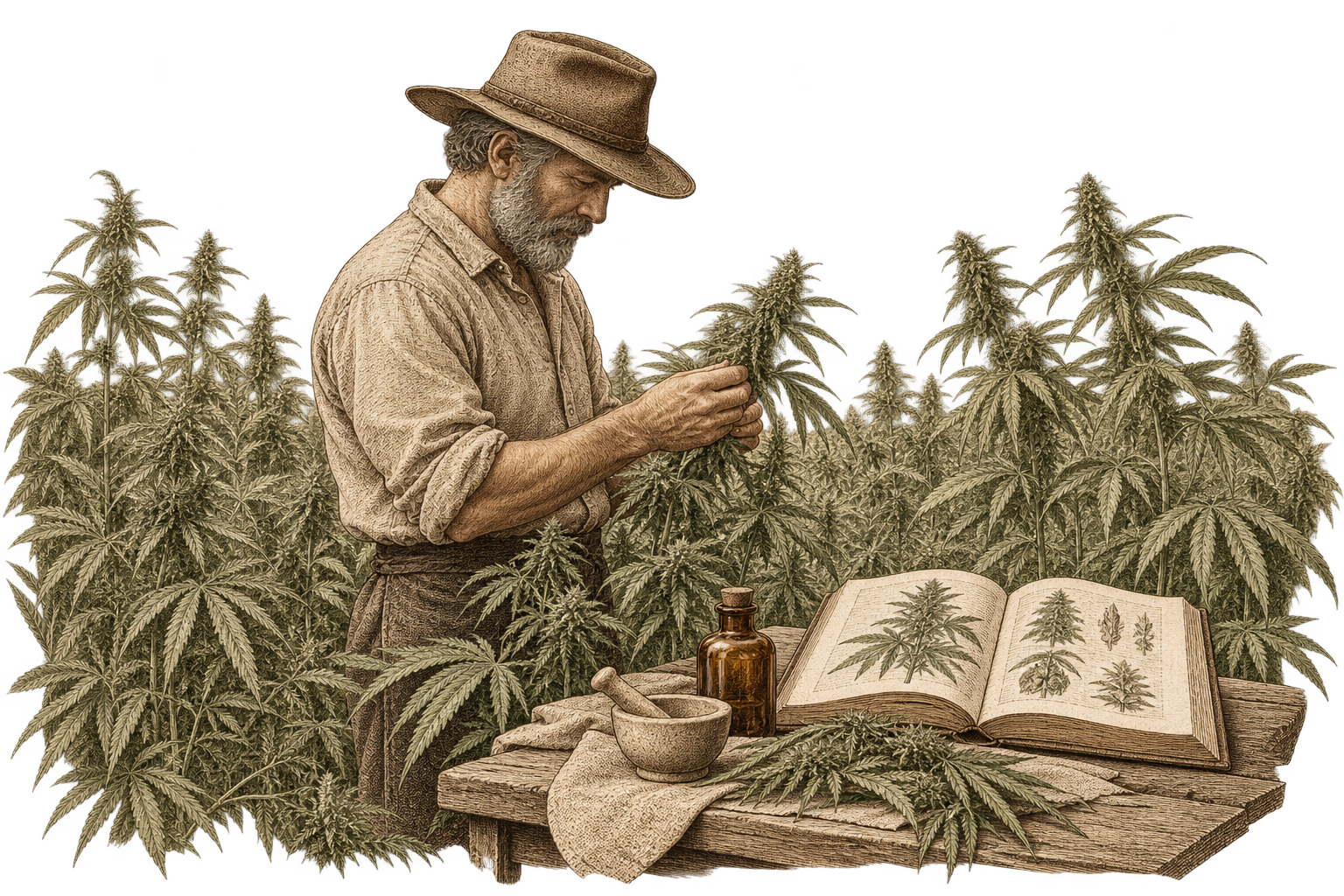
We grow CBG-dominant and CBD-dominant hemp outdoors in our field — walking the rows, responding to what the plants show, and preparing the harvest ourselves. Traditional alcohol maceration. Controlled low-heat olive-oil infusion. Methods shaped by generations of botanical preparation rather than industrial processing. The person who grew the plant is the person who prepares it. That relationship is not incidental to what ends up in the bottle. It is part of what the preparation is.
Every batch is tested independently before release. Every claim we make about the research is calibrated to what the evidence actually supports — including its limits. We do not use isolates. We do not outsource the preparation. We do not make claims the evidence does not support. These are not merely policies. They are the expression of the same conviction that started with a question about an ancient text and has not stopped since.
For the Practitioner
For the professional looking for honest answers for their patients.
If you see patients who are searching for plant-based alternatives and need a source that does not ask you to accept more than the evidence supports, the Research Archive was built with you in mind.
The archive distinguishes carefully among study types. In vitro findings are not presented as clinical outcomes. Animal-model results are not treated as human evidence. Human research is presented with study design, population, sample size, and limitations where those details are available. The purpose is not to persuade a practitioner to recommend a preparation. It is to make the underlying evidence easier to examine honestly.
The preparations themselves remain separate from those conclusions: whole-plant hemp, prepared by traditional methods, independently tested, and documented by batch.
Field-grown · Research-informed · Prepared with restraint