Understanding — Stress
Allostatic Load: How Chronic Stress Accumulates as Measurable Physical Burden
Why chronic stress makes you physically sick — the body keeps a running tab of every stress response it doesn't fully recover from, and researchers can now measure that tab in your blood, your heart rate, and your waistline.
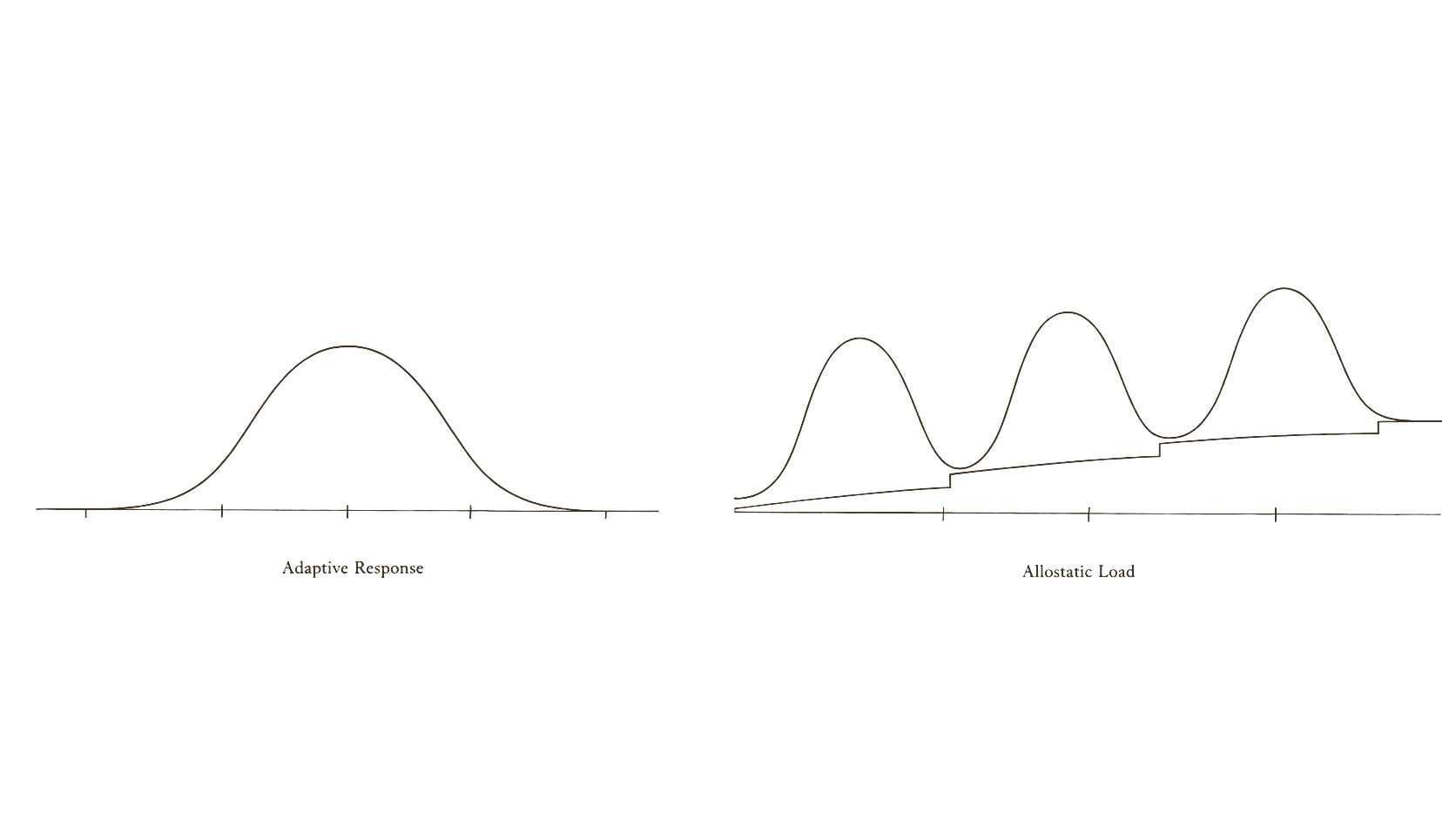
The body adapts to stress. It is designed to. What it is not designed for is adapting without end — mounting response after response to threats that never fully resolve, at a cost that accumulates silently across multiple biological systems simultaneously. Allostatic load is the name for that accumulated cost, and the research measuring it has made the connection between chronic stress and physical illness less metaphorical and more precise than it has ever been.


Allostasis and Its Costs
The concept of homeostasis — the body maintaining stable internal conditions — is foundational to biology. Allostasis, a term introduced by Sterling and Eyer in 1988 and developed by Bruce McEwen at Rockefeller University, describes something different: the body's ability to achieve stability through change. Where homeostasis is the stable state, allostasis is the active process of getting there. When a threat is detected, the allostatic response — HPA axis activation, cortisol release, sympathetic nervous system arousal, immune modulation — mobilizes resources to manage the challenge and return the body to stability.
Under normal conditions, the allostatic response fires, does its job, and subsides. Cortisol rises, then falls. Heart rate elevates, then returns to resting. Inflammatory cytokines increase at the site of injury or infection, then normalize. The cost of each response is real but temporary and fully recoverable.
Allostatic load, introduced by McEwen and Stellar in 1993, describes what happens when those costs are not fully recovered — when the allostatic response remains partially activated, fires too frequently, or fails to shut off efficiently after the stressor passes. The cumulative wear on the body's regulatory systems from years of imperfect stress responses is allostatic load. It is not a feeling. It is a measurable biological state with documented health consequences.
Four Patterns of Allostatic Overload
What Gets Measured — The Biomarker Panel
Allostatic load research operationalizes the concept through measurable biological markers across multiple systems. No single marker captures the full picture — the research strength of the framework is precisely that it integrates multiple systems simultaneously rather than focusing on any single pathway.
What Allostatic Load Predicts
The predictive power of allostatic load scores is the most clinically significant finding in this research tradition. Studies using composite allostatic load scores — combining markers across the four categories above — have documented associations with all-cause mortality, cardiovascular disease incidence, cognitive decline, depression onset, and physical functioning decline in aging that are independent of other established risk factors including age, socioeconomic status, and health behaviors.
The MacArthur Studies of Successful Aging, one of the primary epidemiological platforms for allostatic load research, followed a cohort of older adults over multiple years and found that baseline allostatic load scores predicted decline in cognitive and physical functioning, new cardiovascular disease events, and mortality over follow-up periods of seven to ten years. These were not self-report measures. They were composite scores built from blood and urine samples, blood pressure readings, and anthropometric measurements — objective biological data predicting objective health outcomes.
Why This Framework Matters for How We Think About Stress
The allostatic load framework resolves a conceptual problem that undermines a lot of popular health communication about stress. "Stress is bad for you" is both true and nearly useless as information — it tells people nothing about why, through what mechanisms, over what timescale, or what the actual biological consequences are. Allostatic load makes the claim specific: sustained activation of multiple stress response systems, measured across neuroendocrine, inflammatory, metabolic, and cardiovascular markers, predicts mortality and disease onset through documented biological pathways. That is a different kind of claim — more precise, more actionable, and more honest about what the research actually shows.
It also reframes the concept of recovery. The question is not only whether stress is present, but whether the body is achieving adequate recovery between stress exposures. Sleep, social connection, autonomic balance, and reduction in HPA activation are not wellness practices — they are the biological mechanisms through which allostatic load is reduced. Each has a documented relationship to the markers above.
The Endocannabinoid System and Allostatic Load
The endocannabinoid system intersects allostatic load at several of the marker categories described above. ECS tone — the baseline activity level of the system — is reduced by chronic stress through FAAH upregulation and reduced endocannabinoid synthesis, producing a state of endocannabinoid insufficiency that accompanies and may amplify allostatic burden. CB1 in the hippocampus is involved in the negative feedback regulation of the HPA axis — hippocampal CB1 activation reduces CRH release and limits cortisol elevation. Chronic stress-induced ECS tone depletion in the hippocampus may contribute to the failure-to-shut-off pattern of HPA dysregulation described above.
CB2's role in modulating inflammatory cytokine production is directly relevant to the IL-6 and CRP components of the allostatic load biomarker panel. Whether CBD's FAAH inhibition or CBG's HPA-modulating mechanisms produce measurable changes in allostatic load composite scores has not been studied. The mechanistic connections are documented; the endpoint research has not been conducted. This is Tier 2 throughout — documented mechanisms, not demonstrated outcomes.
The Honest Evidence Summary
Allostatic load is a validated biomarker composite reflecting cumulative stress system dysregulation across neuroendocrine, inflammatory, metabolic, and cardiovascular parameters. High allostatic load scores predict mortality, cognitive decline, and cardiovascular events independently in well-powered longitudinal studies. The framework gives the stress-illness relationship scientific precision that popular health communication rarely achieves.
The ECS intersects the allostatic load model through HPA axis regulation, inflammatory cytokine modulation, and hippocampal negative feedback. These connections are mechanistically documented. No study has measured allostatic load composite scores as an outcome in a cannabinoid trial. The mechanistic relevance is clear; the clinical evidence has not yet been generated.
References
- Juster, R.P., McEwen, B.S., & Lupien, S.J. (2010). Allostatic load biomarkers of chronic stress and impact on health and cognition. Neuroscience & Biobehavioral Reviews, 35(1), 2–16.
- McEwen, B.S. (1998). Stress, adaptation, and disease: Allostasis and allostatic load. Annals of the New York Academy of Sciences, 840(1), 33–44.
- McEwen, B.S., & Stellar, E. (1993). Stress and the individual: Mechanisms leading to disease. Archives of Internal Medicine, 153(18), 2093–2101.
- Seeman, T.E., Singer, B.H., Rowe, J.W., et al. (1997). Price of adaptation — allostatic load and its health consequences: MacArthur Studies of Successful Aging. Archives of Internal Medicine, 157(19), 2259–2268.
- Sterling, P., & Eyer, J. (1988). Allostasis: A new paradigm to explain arousal pathology. In S. Fisher & J. Reason (Eds.), Handbook of Life Stress, Cognition and Health. Wiley.
- Wulsin, L., Airhart, S., & Cozza, A. (2021). Allostatic load and psychiatric diagnoses. Frontiers in Psychiatry, 12, 641518.
- Hill, M.N., McLaughlin, R.J., Pan, B., et al. (2011). Recruitment of prefrontal cortical endocannabinoid signaling by glucocorticoids contributes to termination of the stress response. Journal of Neuroscience, 31(29), 10506–10515.
These statements have not been evaluated by the Food and Drug Administration. J.P. Hemp Company products are not intended to diagnose, treat, cure, or prevent any disease.