Understanding — Stress
The HPA Axis Explained
The hormonal pathway that controls your body's stress response — how it works, what goes wrong under chronic stress, and why it's central to cannabinoid research.
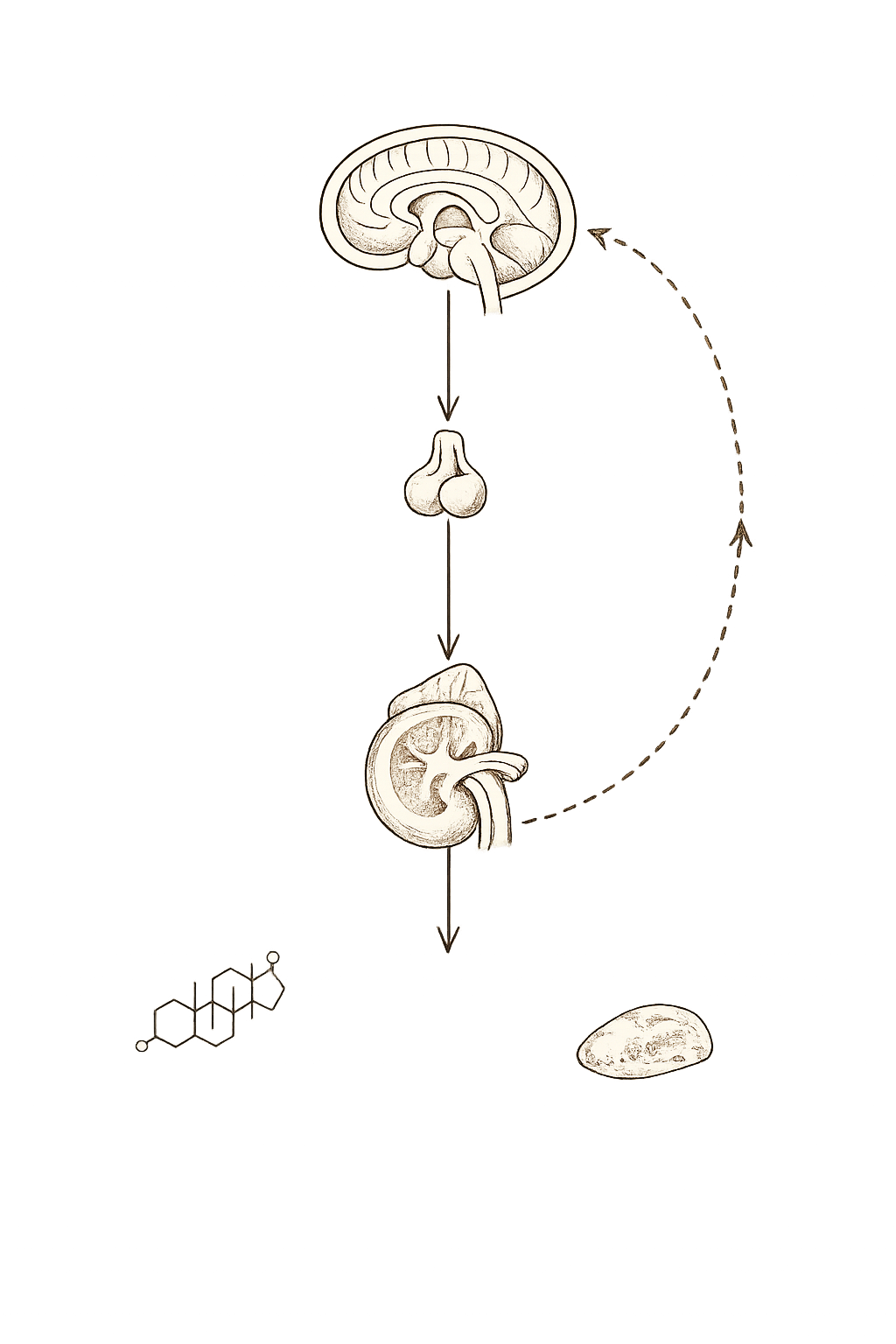
Every time the body perceives a threat — physical danger, psychological pressure, a sudden shock, or a sustained demand — it initiates a coordinated biological response. That response involves the brain, the endocrine system, and the adrenal glands working in a rapid sequence. Cortisol is the most visible output of that sequence. The hypothalamic-pituitary-adrenal axis is the system that produces it.
Understanding how this system works — and how it is designed to recover — is the foundation for understanding most stress research, including the cannabinoid research this archive covers.


Three Structures, One System
The HPA axis is named after the three anatomical structures it connects. Each plays a distinct role in the stress response cascade, and the chain moves in sequence — from the brain's detection of threat to the adrenal glands' release of cortisol into the bloodstream.
Structure 1
The Hypothalamus
Located deep in the brain. Receives threat signals and initiates the cascade by releasing corticotropin-releasing hormone (CRH).
Structure 2
The Pituitary Gland
Receives CRH and responds by releasing adrenocorticotropic hormone (ACTH) into the bloodstream. Often called the master gland for its coordinating role.
Structure 3
The Adrenal Glands
Located above the kidneys. Receive ACTH and release cortisol. The endpoint of the cascade and the source of the body's primary stress hormone.
The sequence takes seconds to minutes to complete. Once cortisol enters the bloodstream, it reaches target tissues throughout the body — the brain, muscles, immune cells, liver — and initiates the physiological changes associated with acute stress response.
What Cortisol Actually Does
Cortisol is widely described as the body's stress hormone, but that label understates its role. Cortisol is a glucocorticoid — a class of steroid hormones with broad regulatory functions — and it operates throughout the body in ways that extend well beyond acute stress mobilization.
Cortisol's Primary Functions
Raises blood glucose by stimulating gluconeogenesis — the liver's conversion of non-sugar substrates into glucose — making fuel available for immediate use.
Has both pro- and anti-inflammatory effects depending on context and duration. Suppresses certain immune responses acutely; chronic elevation has different and more complex effects.
Increases blood pressure and cardiac output in the short term, supporting the body's capacity to respond to physical demand.
Follows a daily rhythm independent of stress — peaking in the early morning to support wakefulness and declining across the day. Disruption of this rhythm is associated with sleep and metabolic effects.
At moderate levels, cortisol enhances encoding of emotionally significant events. At high levels or with chronic exposure, it can impair hippocampal function and memory retrieval.
Cortisol itself suppresses further CRH and ACTH production — the negative feedback loop that is designed to terminate the stress response once the threat has passed.
In short, appropriate amounts of cortisol at the right times are adaptive and necessary. The system is not designed to keep cortisol low — it is designed to release it when needed and withdraw it when the need has passed. The problem the research literature addresses is primarily the failure of that withdrawal: responses that persist, feedback loops that become less sensitive, and systems that remain activated when the original stressor is long gone.
Acute Stress and Chronic Stress
The distinction between acute and chronic stress is one of the most important in stress biology — and one of the most commonly collapsed in everyday discussions.
Acute stress activates the HPA axis for a defined period. The threat is perceived, cortisol rises, the body responds, the threat resolves, the feedback loop closes, and cortisol returns to baseline. This is the system working as designed. Most of the physiological changes associated with acute stress — elevated heart rate, sharpened attention, mobilized energy — are resolved once the stressor passes.
Chronic stress is a different condition. Repeated or sustained activation without adequate recovery can alter the sensitivity of the feedback loop over time. Some individuals under chronic stress show elevated baseline cortisol — the system is running high even in the absence of acute threat. Others show blunted responses — a system that has adapted to sustained demand by reducing its own reactivity, sometimes to the point where normal stress signals are dampened. These patterns are not uniform across individuals and depend on the nature, duration, and timing of the stressor, as well as individual biology.
It is in the chronic stress context — not the acute one — that most of the health consequences associated with dysregulated cortisol are observed: sleep disruption, immune suppression, metabolic effects, and the cognitive changes associated with prolonged glucocorticoid exposure.
The Wider Stress Network
The HPA axis does not operate in isolation. It is embedded in a broader neural and endocrine network whose other components shape how stress is detected, interpreted, and resolved. The amygdala drives threat detection and emotional salience — a highly active amygdala amplifies HPA axis activation. The hippocampus provides contextual memory that helps the brain distinguish genuine threat from resolved or irrelevant ones, and it is one of the primary sites of cortisol negative feedback. The prefrontal cortex exerts top-down regulation — the capacity to evaluate, contextualize, and moderate the emotional and physiological stress response. The autonomic nervous system runs a parallel fast-response track through the sympathetic nervous system and its own stress hormone, adrenaline, which activates more rapidly than the HPA axis but also resolves more quickly.
Stress research that examines any one of these systems in isolation is examining a part of the picture. The HPA axis is the most studied and the most clearly measured — cortisol is a relatively accessible biological marker — but its behavior reflects the state of the whole network, not just the three structures in its name.
Why this matters for cannabinoid research
CB1 receptors are expressed in the hypothalamus, amygdala, hippocampus, and prefrontal cortex — the core structures of the stress network described above. Endocannabinoid signaling participates in HPA axis feedback regulation and in the broader modulation of stress reactivity. Understanding the anatomy and physiology of the stress system is the prerequisite for understanding what cannabinoid research in this domain is actually measuring — and what it is not.
The HPA axis is a precisely engineered feedback system — built to mobilize the body under threat and return it to rest when the threat has passed. Cortisol is its most measurable output, but the system's health is better understood through the quality of its recovery than through any single cortisol reading.
When this archive discusses stress regulation, endocannabinoid tone, or the stress-related research behind specific cannabinoids, the HPA axis is the biological reference point. The articles in the Stress & Anxiety pillar and the ECS pillar both assume this foundation. This article is where it lives.
These statements have not been evaluated by the Food and Drug Administration. J.P. Hemp Company products are not intended to diagnose, treat, cure, or prevent any disease.