Understanding — Stress
Cortisol and the Stress Response
What cortisol is, what it does when stress activates it, and what happens when levels stay elevated for too long.
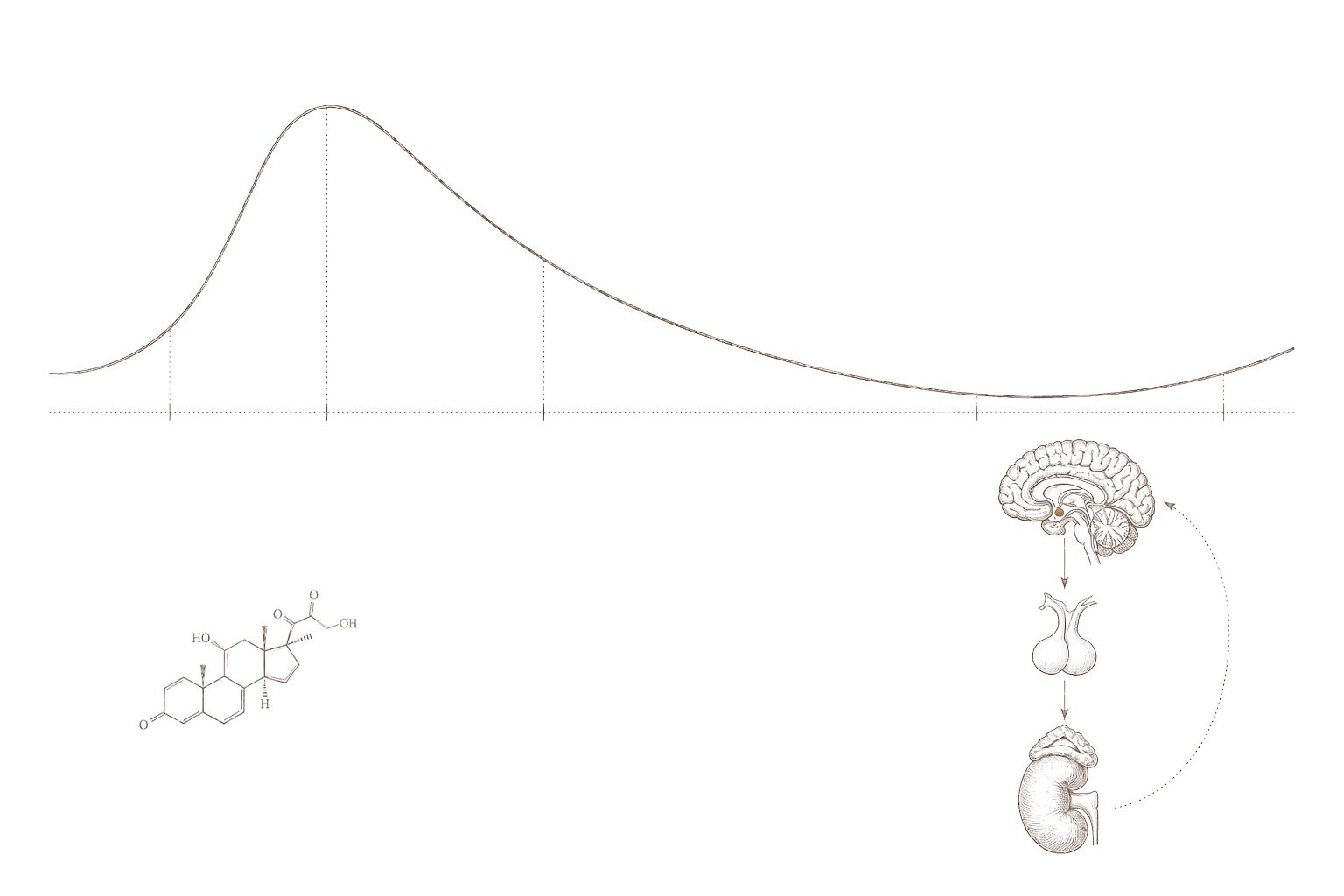
Cortisol is the most commonly measured marker of the stress response — and one of the most commonly misunderstood. Its reputation as the body's stress hormone is not wrong, but it captures only one dimension of a hormone whose daily rhythms, regulatory roles, and feedback functions are considerably more complex than that label implies.
Understanding cortisol accurately is necessary for reading stress research accurately. Almost every study in this domain measures it, is confounded by it, or is limited by not measuring it. What follows is a grounded account of what it does and how to interpret what it shows.


A Hormone With More Than One Job
Cortisol is a glucocorticoid — a class of steroid hormones produced by the adrenal cortex. It is released in response to signals from the HPA axis, but it operates throughout the body in ways that extend well beyond acute stress mobilization. The same molecule that prepares the body to respond to threat also governs daily wakefulness, modulates immune function, regulates blood glucose between meals, and participates in the consolidation of emotionally significant memories.
Function 1
Energy Mobilization
Stimulates gluconeogenesis — the liver's production of glucose from non-sugar substrates. Makes fuel available rapidly under demand.
Function 2
Immune Modulation
Anti-inflammatory in the short term, suppressing immune overactivation during acute stress. Prolonged elevation has more complex and often opposing effects on immune regulation.
Function 3
Cardiovascular Support
Raises blood pressure and cardiac output acutely, supporting the body's capacity to respond to physical and psychological demand.
Function 4
Memory Consolidation
At moderate acute levels, enhances encoding of emotionally significant events. At high or sustained levels, can impair hippocampal function and retrieval.
Function 5
Circadian Signaling
Follows a daily rhythm independent of stress — peaking shortly after waking to support alertness and declining across the day toward sleep.
Function 6
Feedback Termination
Cortisol itself suppresses further CRH and ACTH release — signaling the HPA axis to stand down once sufficient response has occurred. The negative feedback loop is as essential as the activation.
The Diurnal Rhythm
Cortisol does not wait for stress to occur before becoming active. It follows a circadian rhythm that operates every day regardless of external stressors, governed by the body's internal clock in coordination with light exposure and sleep-wake cycles.
The Daily Cortisol Curve — Typical Pattern
This pattern is broadly representative in healthy adults. Individual timing varies with chronotype, age, and sleep schedule. Chronic stress and sleep disruption can flatten or shift the curve.
The Cortisol Awakening Response
One of the most studied and diagnostically useful aspects of cortisol biology is the Cortisol Awakening Response — the sharp, rapid spike in cortisol that occurs in the first 30 to 45 minutes after waking. This surge, which can represent a 50–100% increase over baseline levels, is distinct from the gradual diurnal rise and is driven by the body's anticipatory preparation for the demands of the coming day.
The Cortisol Awakening Response (CAR)
The CAR is one of the most frequently used measures in stress research because it reflects HPA axis reactivity in a standardized, reproducible window. A robust CAR — a sharp, clear spike that resolves within the first hour — is generally associated with healthy HPA axis function. A blunted or absent CAR — where the spike is minimal or fails to materialize — has been observed in populations with chronic stress histories and is interpreted as one marker of dysregulated HPA axis feedback sensitivity.
Crucially, a blunted CAR does not mean low cortisol across the day. It is a specific feature of the awakening window and reflects the reactivity of the system, not its absolute output level. This is one of several reasons why single-point cortisol measurements — common in many published studies — are insufficient to characterize HPA axis function fully.
High, Low, and Why Neither Label Is Enough
Popular discussions of cortisol tend to frame the problem as simply too much or too little — high cortisol requires reduction, low cortisol requires support. The research picture is considerably more complex than this binary suggests.
In populations with chronic stress histories, researchers have observed both elevated baseline cortisol and blunted responses — sometimes in different individuals exposed to similar conditions, sometimes as sequential stages in the same individual over time. The high-then-blunted pattern, in which sustained HPA activation eventually produces a down-regulated system with reduced reactivity, has been documented across several research contexts and helps explain why long-term stress doesn't always look like what people expect.
Interpretation depends on time of day, measurement method, the acute vs. chronic stress context, hormonal status in women, individual biology, and whether the study is examining baseline levels, stress reactivity, or recovery dynamics. No single cortisol reading is diagnostic of anything on its own.
What this means for reading cortisol research
When a study reports cortisol findings, the most important questions are: when was cortisol measured, relative to what stimulus, by what method, in what population? A morning cortisol measurement, a CAR measurement, a post-stress recovery measurement, and a 24-hour urinary cortisol measurement are all measuring different aspects of a dynamic system. Treating them as interchangeable produces confusion that the original research never warranted.
Cortisol as a Feedback Signal
The most important conceptual shift in understanding cortisol is recognizing it not as a simple output of the stress system but as a regulator within it. Cortisol rises in response to stress. But rising cortisol also suppresses further CRH and ACTH production — it is the molecule that signals the system to stand down. The same hormone that initiates the physiological stress response is responsible for terminating it.
When this feedback loop remains sensitive and flexible, acute stress responses resolve efficiently. When chronic stress, sleep disruption, or other factors alter feedback sensitivity, the termination signal becomes less effective — which is one mechanism through which the acute stress system transitions into a chronic one. Endocannabinoid signaling, including CB1 receptor activity in the hypothalamus and hippocampus, participates in maintaining this feedback sensitivity — which is part of why the ECS is relevant to stress research beyond simple anxiety reduction.
Cortisol is not the enemy. It is a precisely regulated hormone doing several necessary jobs simultaneously — mobilizing energy, modulating immunity, anchoring the daily cycle of waking and sleeping, and providing the feedback signal that terminates its own production. The problems associated with cortisol are primarily problems of dysregulated rhythm and impaired feedback, not problems of the molecule itself.
Reading stress research with this in mind — asking when cortisol was measured, by what method, against what baseline — is the difference between interpreting findings accurately and drawing conclusions the data does not support.
These statements have not been evaluated by the Food and Drug Administration. J.P. Hemp Company products are not intended to diagnose, treat, cure, or prevent any disease.