Understanding — How Cannabinoids Work
Topical Cannabinoid Application: What Research Shows About Skin Delivery
The skin is not a passive barrier — it is an active endocannabinoid system organ. What that means for topical preparations, what stays local, and what the research does and does not establish.
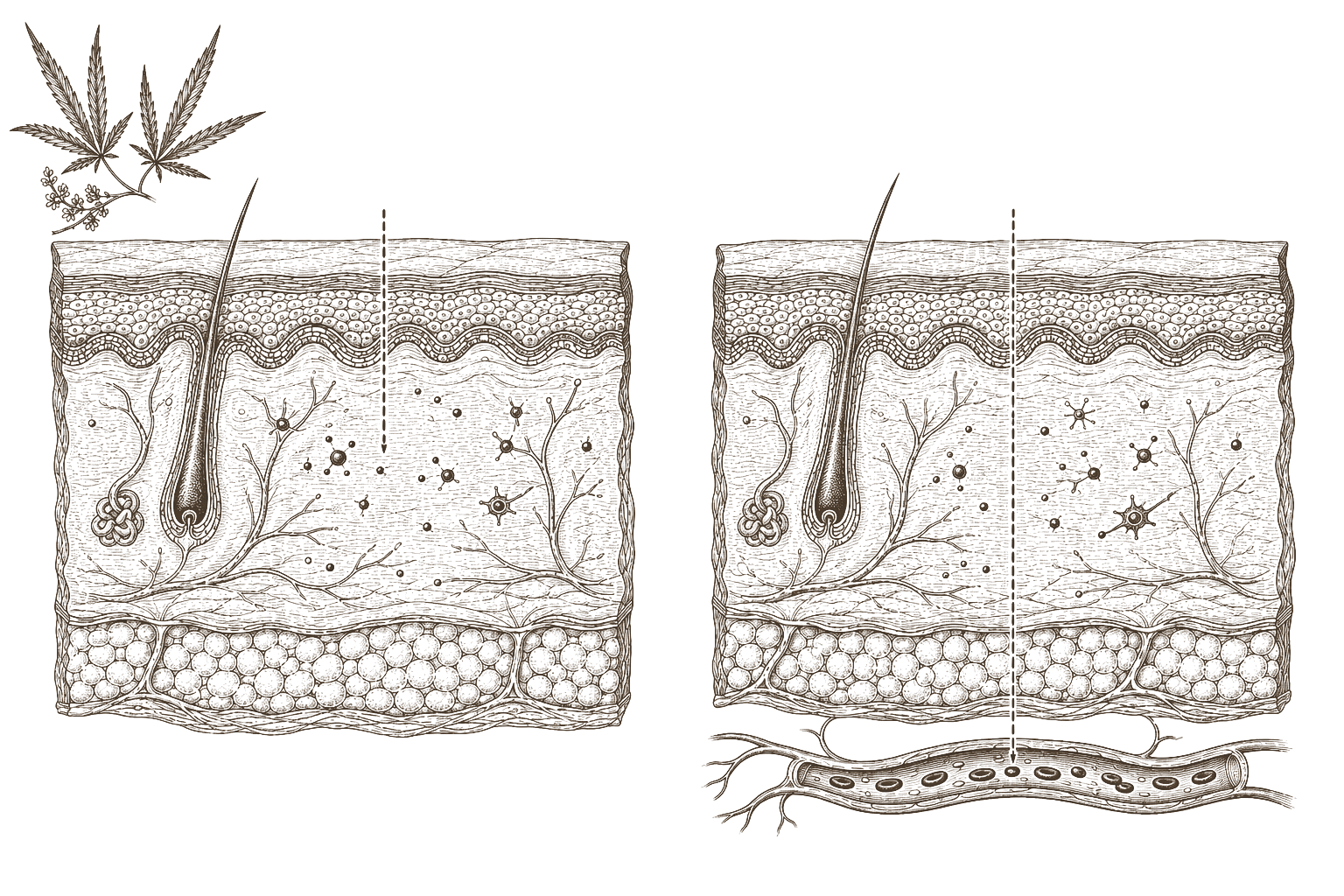
When a cannabinoid preparation is applied to skin, it enters a biological environment that is fundamentally different from the gut, the bloodstream, or the mucous membranes under the tongue. The skin is the body's largest organ, and it does not simply act as a wall between the outside world and the internal systems. It maintains its own endocannabinoid signalling network — expressed in the cells that form the skin's structure, the glands embedded within it, and the nerve endings that run through its layers. Understanding how cannabinoids interact with that network, and what those interactions do and do not produce, is essential for reading topical research honestly.


The Skin as an Endocannabinoid System Organ
The endocannabinoid system is not confined to the brain and central nervous system, as early research sometimes implied. Extensive work over the past two decades has established that the skin expresses CB1 receptors, CB2 receptors, TRPV1 ion channels, and PPAR-γ nuclear receptors — the same receptor and channel types that mediate cannabinoid activity in other organ systems. The cells that express these receptors in skin include keratinocytes, which make up the majority of the outermost skin layer; sebocytes, which produce sebum in the sebaceous glands; mast cells, which are part of the skin's immune response; hair follicle cells; and both sensory and autonomic nerve fibre terminals in the dermis.
This receptor distribution is not incidental. The endocannabinoid system in skin appears to play a role in regulating keratinocyte proliferation and differentiation, sebum production, local inflammatory response, and barrier function maintenance. These are active physiological processes — not passive structural features — and they respond to endocannabinoid signalling in ways that researchers are still characterizing.
What this means practically is that when a cannabinoid reaches skin tissue, it arrives at a receptor-expressing environment capable of responding to it. The question is not whether skin can respond to cannabinoids — the receptor evidence indicates it can — but what that response consists of, what concentrations are needed to produce it, and whether topically applied cannabinoids reach relevant skin layers in sufficient concentrations to engage those receptors meaningfully.
Skin Architecture and the Penetration Question
The skin is organized in distinct layers, each with different structural composition and different relevance to topical cannabinoid research. Understanding the layers clarifies what "topical" means mechanistically and why the distinction between topical and transdermal matters significantly for interpreting research.
| Layer | Structure | Cannabinoid Receptor Expression | Penetration Notes |
|---|---|---|---|
| Stratum corneum | Outermost layer — dead, flattened keratinocytes embedded in a lipid matrix. The primary physical barrier. | Minimal — cells are non-viable | The first barrier to penetration. Lipophilic compounds (including cannabinoids) penetrate more readily than hydrophilic ones, but concentration gradient and molecular size still limit passage. |
| Viable epidermis | Living keratinocytes in multiple sublayers (spinosum, granulosum, basale). Primary site of keratinocyte activity. | CB1, CB2, TRPV1, PPAR-γ — all expressed in keratinocytes | Cannabinoids that penetrate the stratum corneum reach viable keratinocytes. This is the primary site of documented topical cannabinoid activity in preclinical research. |
| Dermis | Connective tissue, blood vessels, nerve endings, hair follicles, sebaceous glands, sweat glands. | CB1 and CB2 in nerve fibers; CB2 in immune cells; receptors in sebaceous glands | Deeper penetration required. Hair follicles and sebaceous glands can act as pathways for delivery to dermal structures. Blood vessels here represent the gateway to systemic circulation. |
| Hypodermis | Subcutaneous fat and connective tissue. Below the dermis. | CB1 in adipocytes (fat cells) | Reached by transdermal patches and high-concentration oil vehicles under occlusion. Standard topical preparations generally do not reach this layer in significant concentrations. |
The distinction between topical and transdermal is frequently collapsed in consumer product language and even in some research reporting. A topical preparation acts locally in the skin layers where it penetrates — primarily the epidermis and superficial dermis. A transdermal preparation is specifically designed and tested to deliver cannabinoids across the skin barrier and into systemic circulation in pharmacologically meaningful concentrations. These are different mechanisms with different research evidence bases and different regulatory classifications.
When research or product language describes a topical preparation as producing "systemic effects," it is making a claim that requires transdermal evidence — evidence that cannabinoid concentrations in the bloodstream were measured and found to be pharmacologically meaningful after topical application. Most topical preparations, including oil-based balms, creams, and serums, have not been tested for systemic bioavailability. The absence of this testing does not mean systemic effects don't occur — it means the claim cannot be made from the evidence available. At J.P. Hemp Company, topical preparations are described by their local action and composition. Systemic mechanism claims are not made for topical products.
How Cannabinoids Penetrate Skin
Cannabinoids are lipophilic — they dissolve readily in fats and oils but poorly in water. This chemical property works in their favour for skin penetration, since the stratum corneum's lipid-rich matrix is more permeable to fat-soluble molecules than to water-soluble ones. CBD and CBG are highly lipophilic, with octanol-water partition coefficients (log P values) that predict moderate to good skin penetration — better than many pharmaceutical compounds that have been developed specifically for topical delivery.
The primary penetration routes are intercellular (between the lipid layers that surround the corneocytes in the stratum corneum), transcellular (directly through the corneocytes), and via appendageal pathways — through hair follicles and sebaceous glands, which bypass the stratum corneum entirely and allow direct access to the dermis. The appendageal route is particularly significant for cannabinoid delivery because sebaceous glands express cannabinoid receptors and respond to cannabinoid signalling in ways that have been examined in acne and sebum regulation research.
The carrier system — the oils, waxes, emulsifiers, and other ingredients that make up the preparation — significantly affects penetration. Jojoba oil, whose composition resembles skin sebum more closely than most plant oils, may facilitate penetration via the appendageal route. Occlusive preparations (thick balms and creams that form a barrier on the skin surface) increase hydration of the stratum corneum and generally enhance penetration by maintaining a higher concentration gradient. Carrier choice is not incidental to a topical cannabinoid preparation — it is part of the delivery mechanism.
What Research Has Measured
The most directly relevant human skin penetration data comes from in vitro skin permeation studies — experiments using excised human skin samples in diffusion chambers, which measure how much of a compound crosses the skin over time. These studies have consistently shown that CBD penetrates human skin in measurable amounts, that penetration is concentration-dependent, and that formulation significantly affects penetration rate. A 2019 study by Millar et al. reviewing CBD skin penetration data concluded that formulation factors — particularly the presence of permeation enhancers and the lipophilic carrier — are more determinative of skin penetration than cannabinoid concentration alone.
The Hammell et al. (2016) study, conducted in rats using transdermal CBD gel patches, measured both skin penetration and systemic plasma concentrations. This is one of the few studies that specifically tested the transdermal delivery question — whether topically applied CBD reaches measurable systemic concentrations. In the rat model, significant plasma concentrations were achieved with the gel patch formulation, and inflammation and pain behaviour in an arthritis model were reduced. However, the gel patch used in this study was specifically engineered for transdermal delivery using chemical permeation enhancers, which differ substantially from standard topical oil preparations.
Human studies of topical cannabinoids have primarily examined skin conditions — acne, psoriasis, atopic dermatitis — in observational and small pilot trials rather than controlled trials with systemic bioavailability measurement. This evidence base supports the biological plausibility of topical cannabinoid action in the epidermis and dermis but does not resolve the systemic delivery question for standard topical oil preparations.
What research supports: Cannabinoids penetrate human skin. They reach the viable epidermis and, in some formulations and conditions, the dermis. The skin expresses CB1, CB2, TRPV1, and PPAR-γ receptors that are biologically capable of responding to cannabinoid binding. Preclinical and some observational human data suggest that topical cannabinoids can produce local effects in skin tissue.
What research does not establish for standard topical preparations: That topical application of oil-based cannabinoid preparations produces meaningful systemic cannabinoid concentrations. Transdermal delivery — measurable blood levels after topical application — has been demonstrated primarily with engineered patch formulations containing chemical permeation enhancers, not with standard oil-based preparations. The absence of systemic delivery evidence is not a limitation of topical preparations — it is a different mechanism with different applications.
What this means for product claims: A topical preparation is accurately described by its local activity in skin tissue and by the receptor environment it acts within. It is not accurately described as producing the same effects as a sublingual preparation taken systemically. These are different delivery routes with different mechanisms, and the research evidence base for each is distinct.
Implications for Reading Topical Research
Topical cannabinoid research varies significantly in what it actually measures, and those differences matter for interpreting findings accurately. A study measuring topical CBD's effect on acne (a sebaceous gland and keratinocyte process occurring in the epidermis and upper dermis) is examining local skin tissue effects — the mechanism is plausible and the research context is appropriate. A study claiming that a topical preparation reduces systemic inflammation or produces whole-body effects without measuring blood cannabinoid concentrations is making a claim that exceeds the evidence for standard topical delivery.
The administration route article in this archive establishes the general principle that route of administration determines everything about onset, bioavailability, and mechanism. For topical preparations specifically, the relevant questions when reading a study are: Was penetration measured, or assumed? Was systemic bioavailability measured, or was the study design confined to local tissue effects? What carrier and formulation was used — engineered patch or standard topical oil? These questions determine whether a finding is relevant to evaluating a standard topical cannabinoid preparation.
What This Means for J.P. Hemp Company Topical Preparations
The massage oil, warming balm, and CBG face oil in the J.P. Hemp Company range are topical preparations — they act locally in the skin and underlying tissue at the site of application. The cannabinoid components in these preparations reach the viable epidermis and, depending on formulation and application method, layers of the dermis. The skin's endocannabinoid receptor system is the biological context within which they act.
None of these preparations are described as producing systemic effects, replacing ingestible cannabinoid preparations, or acting through mechanisms beyond topical local action. The research supports local cannabinoid activity in skin tissue. It does not support systemic delivery claims for standard oil-based topical preparations. Both the products and the archive language reflect this distinction consistently.
References
- Bíró T, Tóth BI, Haskó G, Pacher P, Bhattacharya SK. The endocannabinoid system of the skin in health and disease: novel perspectives and therapeutic opportunities. Trends in Pharmacological Sciences. 2009;30(8):411-420.
- Hammell DC, Zhang LP, Ma F, et al. Transdermal cannabidiol reduces inflammation and pain-related behaviours in a rat model of arthritis. European Journal of Pain. 2016;20(6):936-948.
- Millar SA, Maguire RF, Yates AS, O'Sullivan SE. Towards better delivery of cannabidiol. Pharmaceuticals. 2020;13(9):219.
- Oláh A, Tóth BI, Borbíró I, et al. Cannabidiol exerts sebostatic and antiinflammatory effects on human sebocytes. Journal of Clinical Investigation. 2014;124(9):3713-3724.
- Peyravian N, Deo S, Daunert S, Bhatt DL. The anti-inflammatory effects of cannabidiol (CBD) on acne. Journal of Inflammation Research. 2022;15:2795-2801.
- Sheriff T, Lin MJ, Dubin D, Khorasani H. The potential role of cannabinoids in dermatology. Journal of Dermatological Treatment. 2020;31(8):839-845.
- Tóth KF, Ádám D, Bíró T, Oláh A. Cannabinoid signaling in the skin: therapeutic potential of the "C(ut)annabinoid" system. Molecules. 2019;24(5):918.
These statements have not been evaluated by the Food and Drug Administration. J.P. Hemp Company products are not intended to diagnose, treat, cure, or prevent any disease.