Health Topics — Stress & Anxiety
The Endocannabinoid System and Stress Response
The body has its own cannabinoid system specifically because it needs to regulate stress — what that system does, where it operates in the stress circuit, and what happens when chronic stress depletes it.
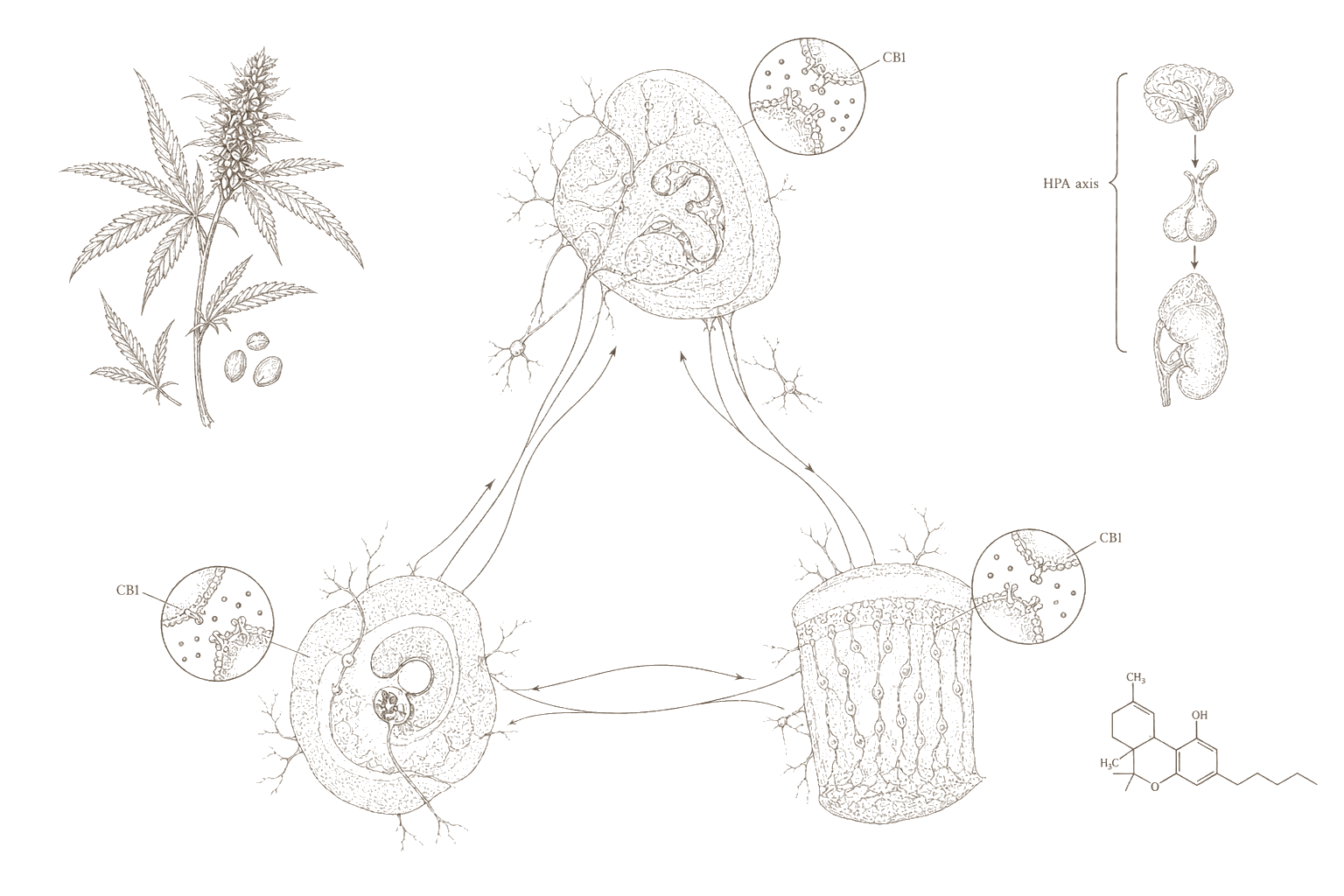
The endocannabinoid system does not initiate the stress response. The HPA axis does that — detecting threat, releasing cortisol, mobilizing the body's resources for the challenge at hand. What the ECS does is regulate how that response unfolds and, critically, when it stops. It operates as a brake on a system that evolved to activate fast and hard, helping restore equilibrium after the threat has passed.
Understanding this regulatory relationship is the mechanistic foundation for reading cannabinoid stress research accurately. The research doesn't ask whether cannabinoids cause stress — it asks whether compounds that interact with the ECS influence how the stress response is regulated, and what that means for the people experiencing it.


Two Systems in Conversation
The hypothalamic-pituitary-adrenal axis and the endocannabinoid system are not parallel, independent systems that happen to affect mood. They are anatomically and functionally intertwined, with ECS components densely expressed at the key nodes of HPA axis activity — the hypothalamus, the hippocampus, and the prefrontal cortex.
System 1
The HPA Axis
The primary stress response system. Detects threat via the hypothalamus, triggers CRH release, activates pituitary ACTH secretion, drives cortisol production from the adrenal glands. Fast-activating, physiologically broad — mobilizes energy, suppresses non-essential functions, prepares the body for acute demand.
Primary function: activate stress response
System 2
The ECS
A retrograde signaling system densely expressed at HPA axis nodes. CB1 receptors in the hypothalamus and hippocampus modulate the sensitivity of HPA axis feedback, helping to terminate the cortisol response once the stressor has passed. Endocannabinoid tone — the baseline availability of anandamide and 2-AG — shapes how readily the stress response activates and how efficiently it resolves.
Primary function: regulate and terminate stress response
The relationship is bidirectional: acute stress triggers endocannabinoid release, and endocannabinoid signaling helps contain the stress response from escalating beyond what the situation requires. Chronic stress, by contrast, can deplete endocannabinoid tone over time — reducing the system's capacity to perform this regulatory function. This depletion pattern is one of the more consistent findings in preclinical stress biology and one of the mechanistic rationales for studying whether compounds that support endocannabinoid signaling might influence stress regulation.
Where ECS Components Are Expressed in the Stress Circuit
The stress relevance of the ECS is partly a matter of anatomy. CB1 receptors — the primary cannabinoid receptor — are among the most densely expressed G-protein-coupled receptors in the brain, with particularly high concentrations in regions directly involved in stress regulation and emotional processing.
Anandamide, 2-AG, and Stress Buffering
The two primary endocannabinoids — anandamide and 2-AG — play distinct roles in stress regulation that are worth distinguishing. Anandamide functions more as a tonic signal, maintaining a baseline level of CB1 activity that influences mood and stress reactivity across time. Acute stress rapidly suppresses anandamide levels in stress-relevant brain regions — a pattern documented in rodent models and associated with increased HPA axis activity. The FAAH enzyme, which degrades anandamide, becomes more active under stress conditions, accelerating anandamide breakdown at precisely the moment when its stress-buffering function is most needed.
2-AG functions more as a phasic signal — released on demand in response to strong stimulation rather than maintaining tonic baseline activity. During acute stress, 2-AG is rapidly mobilized in the hypothalamus and serves as an immediate retrograde signal that limits further CRH release, acting as a real-time brake on the HPA axis activation that is underway. This 2-AG mobilization is one of the most clearly documented endocannabinoid stress responses in preclinical research.
Why endocannabinoid tone matters for chronic stress
The distinction between acute and chronic stress in ECS terms is partly a story about depletion. In acute stress, endocannabinoids are mobilized, perform their regulatory function, and are replenished. In chronic stress — sustained activation without adequate recovery — this replenishment cycle is disrupted. Anandamide tone becomes chronically suppressed. CB1 receptor density in the hippocampus may decrease. The system's capacity to perform its stress-terminating function is progressively diminished. This chronic depletion pattern is preclinically well-documented and is the mechanistic context for asking whether supporting endocannabinoid signaling might be relevant to stress regulation. It is not an established clinical mechanism in humans — but it is a coherent and well-grounded hypothesis.
What Cannabinoids Do in This System
Tier 2 — Preclinical Mechanism
Phytocannabinoids interact with the ECS stress circuit through several overlapping mechanisms. CBD's 5-HT1A agonism influences serotonin signaling in prefrontal and limbic circuits involved in stress appraisal — a mechanism distinct from direct CB1 activity and one that has been associated with anxiolytic effects in both preclinical and small human trial contexts. CBD also inhibits FAAH, the enzyme responsible for anandamide breakdown — an indirect mechanism that slows anandamide degradation and extends its stress-buffering activity rather than replacing it.
CBG's primary stress-relevant mechanisms operate through alpha-2 adrenoceptor agonism and GABA reuptake inhibition — both active in the arousal and stress regulation systems rather than at CB1 directly. Alpha-2 adrenoceptor agonism reduces noradrenergic output from the locus coeruleus, the brain's primary norepinephrine source and a key driver of the sympathetic stress response. GABA reuptake inhibition increases the availability of the brain's primary inhibitory neurotransmitter in relevant circuits. These mechanisms are documented in preclinical research and were part of the pharmacological rationale for the Cuttler et al. (2024) human trial.
Tier 1 — Human Trial Evidence
The Cuttler trial found statistically significant acute reductions in self-reported stress and anxiety following a single oral CBG dose in healthy adults under double-blind placebo-controlled conditions. It did not measure cortisol, endocannabinoid levels, or HPA axis markers — so it establishes a self-reported outcome without directly confirming the mechanistic pathway described here. The mechanistic picture is well-grounded in preclinical research. The human trial establishes that the outcome signal is real under controlled conditions. The connection between mechanism and outcome in humans remains an inference rather than a demonstrated chain.
The Preclinical-to-Human Gap
The ECS-stress interaction is one of the more thoroughly characterized cannabinoid mechanisms in preclinical research. Rodent models of acute and chronic stress have produced consistent findings about endocannabinoid mobilization, CB1 receptor regulation, and HPA axis modulation across dozens of independent studies. That consistency is meaningful — it is not a single anomalous finding but a reproducible pattern across multiple laboratories and model systems.
The human research directly examining ECS function under stress conditions is considerably thinner. Much of what is known about human ECS-stress interaction comes from indirect sources — genetic studies of FAAH variants, imaging studies of CB1 receptor density in stress-related conditions, and pharmacological studies using synthetic cannabinoids or FAAH inhibitors rather than plant cannabinoids. Direct human mechanistic evidence specifically for CBD and CBG in stress-related ECS pathways is limited. The clinical signal from human trials is real; the mechanistic chain connecting it to the preclinical biology has not been fully established in humans.
The endocannabinoid system's role in stress regulation is one of the best-characterized cannabinoid mechanisms in preclinical research and one of the most plausible biological rationales for studying plant cannabinoids in stress-related contexts. The preclinical picture is coherent and detailed. The human mechanistic evidence is thinner, and the clinical evidence — while consistent in direction — is early stage and limited to acute, healthy-adult populations. Holding those three layers of evidence clearly — preclinical mechanism, limited human mechanistic data, early human clinical signal — is what reading the stress and cannabinoid literature proportionately requires.
References
- Hillard, C.J. (2014). Stress regulates endocannabinoid-CB1 receptor signaling. Seminars in Immunology, 26(5), 380–388.
- Patel, S., Roelke, C.T., Rademacher, D.J., & Hillard, C.J. (2005). Inhibition of restraint stress-induced neural and behavioural activation by endogenous cannabinoid signalling. European Journal of Neuroscience, 21(4), 1057–1069.
- Hill, M.N., McLaughlin, R.J., Bingham, B., et al. (2010). Endogenous cannabinoid signaling is essential for stress adaptation. Proceedings of the National Academy of Sciences, 107(20), 9406–9411.
- Morena, M., Patel, S., Bains, J.S., & Hill, M.N. (2016). Neurobiological interactions between stress and the endocannabinoid system. Neuropsychopharmacology, 41(1), 80–102.
- Cascio, M.G., Gauson, L.A., Stevenson, L.A., Ross, R.A., & Pertwee, R.G. (2010). Evidence that the plant cannabinoid cannabigerol is a highly potent alpha-2-adrenoceptor agonist and moderately potent 5HT1A receptor agonist. British Journal of Pharmacology, 159(1), 129–141.
- Cuttler, C., Stueber, A., Cooper, Z.D., & Sexton, M. (2024). Cannabigerol (CBG) reduces anxiety and stress: a randomized, double-blind, placebo-controlled crossover study. Scientific Reports.
- Hill, M.N., & Tasker, J.G. (2012). Endocannabinoid signaling, glucocorticoid-mediated negative feedback, and regulation of the hypothalamic-pituitary-adrenal axis. Neuroscience, 204, 5–16.
These statements have not been evaluated by the Food and Drug Administration. J.P. Hemp Company products are not intended to diagnose, treat, cure, or prevent any disease.