Understanding — The Endocannabinoid System
Endocannabinoid Receptors: CB1, CB2, and Beyond
How the body's cannabinoid receptors work, where they are found, and why their location matters for understanding cannabinoid research.
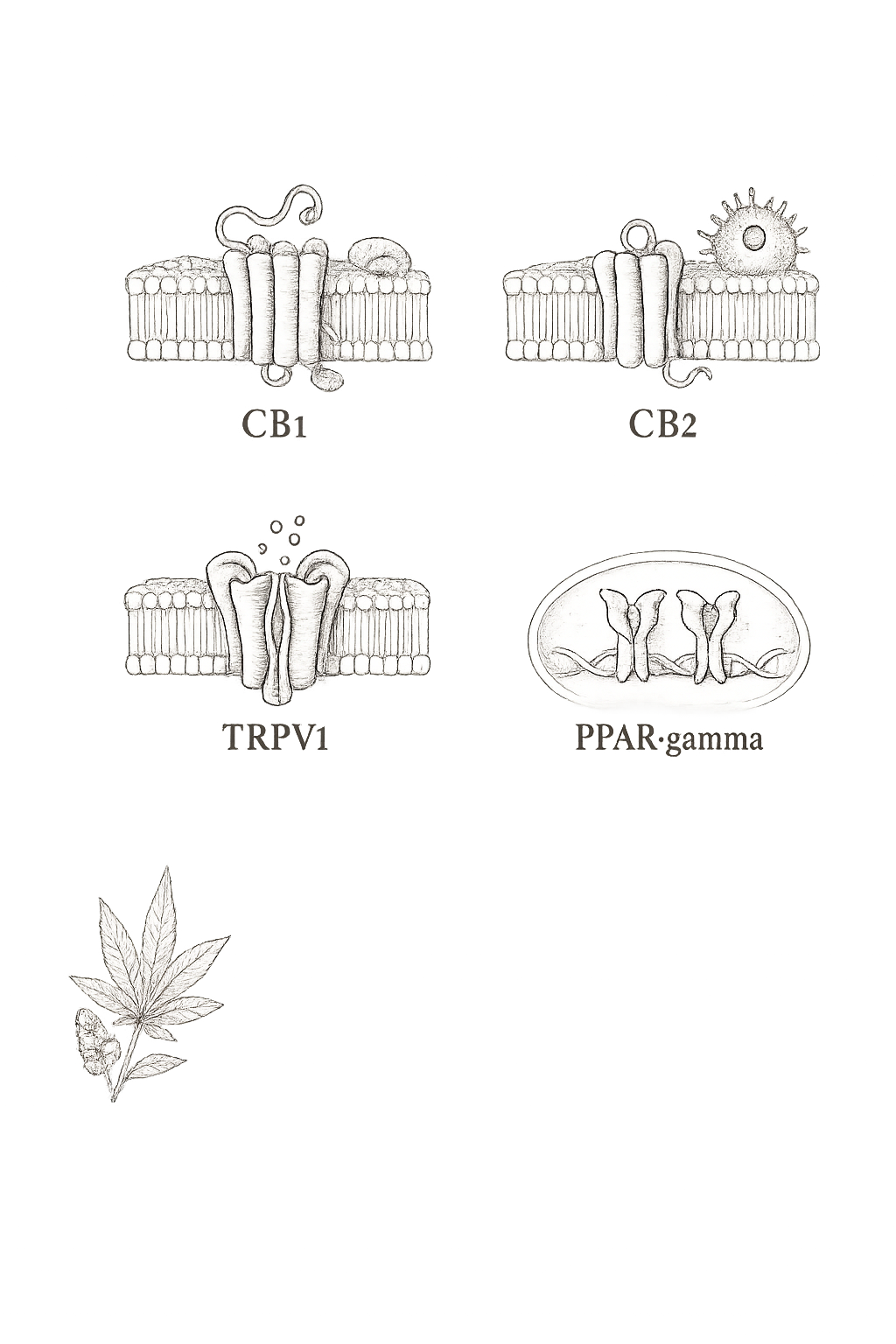
A receptor is a protein on the surface of a cell that receives a specific molecular signal and responds by changing what the cell does. Cannabinoid receptors are the sites where endocannabinoids — and plant-derived cannabinoids — deliver their signals to the body's cells.
Two receptors, CB1 and CB2, have been studied extensively since their identification in the late 1980s and early 1990s. But the receptor picture for the endocannabinoid system is broader than two proteins, and understanding what lies beyond CB1 and CB2 helps explain why cannabinoid research has developed the way it has.


What Receptors Do — and Don't Do
Before examining the specific receptors, the basic function of a receptor is worth stating clearly — because it is often misrepresented in casual discussions of cannabinoids. Receptors do not create signals, generate effects on their own, or switch systems on and off. They receive signals and translate them into changes in cellular activity. When an endocannabinoid binds to a cannabinoid receptor, it adjusts what that cell is already doing — modulating the strength or duration of ongoing processes rather than initiating entirely new ones.
This distinction matters for reading cannabinoid research honestly. A study that documents receptor binding is documenting one step in a complex chain. What happens downstream — in the cell, in the circuit, in the organism — depends on context, concentration, cell type, and the broader signaling environment.
CB1 and CB2: The Primary Receptors
CB1 and CB2 receptors share a structural family but differ substantially in their distribution and primary functional associations.
Primary Receptor
CB1
Central Nervous System — Dense
Concentrated in the cortex, hippocampus, amygdala, basal ganglia, and cerebellum. Involved in modulating neurotransmitter release, emotional regulation, stress response, memory processing, and motor coordination. Also present in peripheral tissues at lower density.
Primary Receptor
CB2
Immune and Peripheral Tissue — Dense
Concentrated in immune cells, the spleen, and the gastrointestinal tract. Involved in modulating immune signaling and inflammatory responses. Also expressed in the central nervous system, particularly under inflammatory conditions — the CNS/immune boundary is not clean.
The conventional shorthand — CB1 is the brain receptor, CB2 is the immune receptor — is useful as an orientation but incomplete as a description. CB2 expression in the central nervous system has been documented under conditions of neuroinflammation, injury, and disease, which is part of why CB2 has attracted research interest in neurological domains. And CB1 receptors in peripheral tissue, including the gastrointestinal tract, have their own functional relevance outside the central nervous system.
In stress research specifically, CB1 receptors are of primary interest because of their concentration in brain regions involved in the HPA axis stress response — the amygdala, hippocampus, and prefrontal cortex. CB2 receptors are relevant to the inflammatory dimension of stress biology, where immune activation and neuroinflammation intersect. Both are part of the picture.
Beyond CB1 and CB2
The endocannabinoid system's receptor picture extends beyond the two primary receptors. Several additional receptor systems have been identified as sites where endocannabinoids and phytocannabinoids act — and understanding them helps explain cannabinoid pharmacological profiles that CB1 and CB2 affinity alone cannot account for.
Additional Receptor
TRPV1
The transient receptor potential vanilloid 1 channel. Involved in pain signaling, body temperature, and inflammation. Both anandamide and CBD interact with TRPV1. CBG also shows TRPV1 activity.
Additional Receptor
GPR55
Sometimes called a candidate cannabinoid receptor. Involved in modulating pain and bone density. CBD antagonizes GPR55. Research into its role in the broader ECS continues.
Additional Receptor
Alpha-2 Adrenoceptors
Not a traditional cannabinoid receptor — but CBG is a highly potent alpha-2 adrenoceptor agonist (Cascio et al., 2010). These receptors regulate norepinephrine and the acute stress arousal response. CBG's activity here is part of what distinguishes its pharmacological profile.
Additional Receptor
5-HT1A
A serotonin receptor. Both CBD and CBG interact with 5-HT1A — CBD as an agonist, CBG as an antagonist. This receptor is involved in mood and anxiety regulation and is the target of several pharmaceutical interventions.
The presence of these additional receptor interactions explains something important about cannabinoid pharmacology: two cannabinoids can interact with the same endocannabinoid receptors at similar affinities and still produce meaningfully different effects — because their activity at these additional sites differs. CBG's alpha-2 adrenoceptor agonism, for instance, is not shared by CBD. It is one of the pharmacological properties that makes CBG's research profile in stress regulation distinct rather than simply redundant with CBD research.
Receptor binding is not a clinical outcome
Documenting that a compound binds to a receptor is the beginning of a research question, not the end of one. What matters — what requires human trial data to establish — is whether that binding produces a measurable effect in living people, at what doses, in what populations, and under what conditions. Receptor pharmacology provides the mechanistic rationale for designing those studies. It does not replace them.
How Plant Cannabinoids Fit the Receptor Picture
THC binds with high affinity to CB1 receptors — this is the primary mechanism of its psychoactive effects and the basis of most THC pharmacology. CBD's receptor interactions are more complex and more distributed: it interacts with CB1 and CB2 at low affinity, acts as a 5-HT1A agonist, antagonizes GPR55, and activates TRPV1, among other interactions. This distributed profile is part of why CBD research has proven difficult to reduce to a single mechanism.
CBG's receptor profile includes partial CB1 and CB2 agonism alongside its potent alpha-2 adrenoceptor agonism, GABA reuptake inhibition, TRPV1 activity, and 5-HT1A antagonism. This combination of interactions — particularly the alpha-2 and GABAergic mechanisms — distinguishes CBG from the cannabinoids that preceded it in research attention and provides the pharmacological basis for its investigation in stress-related domains.
In all cases, receptor binding in vitro or in animal models does not establish therapeutic efficacy in humans. These are the mechanisms that researchers follow when designing human trials. The Cuttler et al. (2024) trial — currently the only published randomized controlled trial of CBG — followed exactly this logic from pharmacology to human investigation.
CB1 and CB2 receptors remain the primary sites of endocannabinoid system signaling, and the research built around them is substantial. But the receptor picture has grown more complex as the pharmacology of individual cannabinoids has been characterized more carefully. TRPV1, GPR55, alpha-2 adrenoceptors, and the serotonin system each represent sites where cannabinoid activity has been documented and where the mechanistic story continues to develop.
Understanding this broader receptor landscape is what allows cannabinoid research to be read with the specificity it deserves — rather than as a single, undifferentiated story about "cannabinoids and the ECS."
These statements have not been evaluated by the Food and Drug Administration. J.P. Hemp Company products are not intended to diagnose, treat, cure, or prevent any disease.