Cannabinoid Monographs
CBG
A comprehensive research reference for cannabigerol — what it is, how it works, what the evidence shows across every domain studied, and where the gaps remain.
Full Name
Cannabigerol
Abbreviation
CBG
Classification
Non-psychoactive phytocannabinoid
Precursor Role
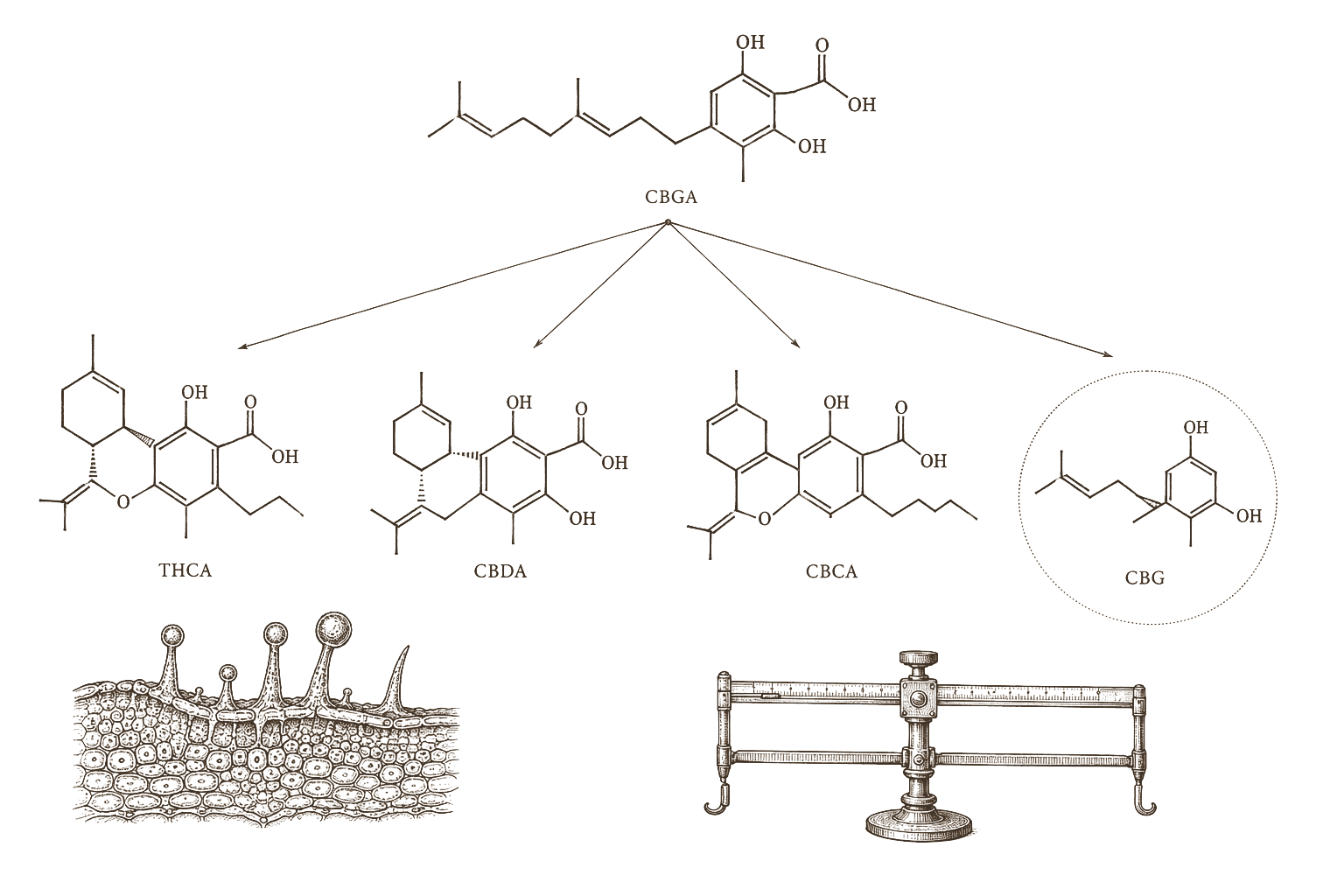
CBGA is biosynthetic precursor to THC, CBD, and CBC
Primary Receptors
CB1, CB2, alpha-2 adrenoceptors, TRPV1, 5-HT1A
Human Trial Status
One published RCT (Cuttler et al., 2024)
Cannabigerol is the compound from which much of hemp's pharmacological complexity originates — not metaphorically, but biochemically. CBGA, its acidic precursor, is the parent molecule from which the enzymatic pathways to THC, CBD, and CBC diverge. The plant produces CBG in relatively small concentrations in most cultivars, though selective breeding for CBG-dominant genetics has made higher-yield cultivation viable.
For most of the history of cannabinoid research, CBG received far less attention than THC and CBD. That has changed substantially in the past decade. The research base is growing, the pharmacological profile has become clearer, and in 2024 the first randomized controlled trial in humans was published. This monograph documents what that research currently shows — organized honestly by evidence level.


Compound Identity and Botanical Role
CBG is a non-psychoactive phytocannabinoid — it does not produce the intoxication associated with THC. It is present in the hemp plant in its acidic form, CBGA (cannabigerolic acid), which is enzymatically converted during plant maturation to THCA, CBDA, and CBCA — the acidic precursors of THC, CBD, and CBC respectively. What remains unconverted becomes CBG itself. In most hemp cultivars this is a small fraction of total cannabinoid content, typically under one percent. CBG-dominant cultivars, developed through selective breeding, accumulate higher CBGA concentrations by expressing lower levels of the converting enzymes.
CBG is harvested most efficiently earlier in the plant's maturation cycle, before the enzymatic conversion is complete. This creates a specific agricultural consideration for producers who grow both CBG-dominant and CBD-dominant cultivars — the timing and method of harvest for each will differ, and the plant's cannabinoid profile at harvest reflects the full arc of its growth season.
In preparations, CBG is present alongside other cannabinoids in full-spectrum extracts. Its behavior in full-spectrum preparations — including potential interactions with CBD, terpenes, and minor cannabinoids — is an area of ongoing investigation. The research reviewed in this monograph examines CBG primarily in isolation or as the primary variable; the full-spectrum context adds complexity that the current evidence base has not fully characterized.
Pharmacological Profile
CBG's pharmacological interactions distinguish it from CBD in ways that are clinically relevant to its research profile. Understanding these distinctions helps explain why CBG has attracted specific research attention in stress, neurological, and inflammatory domains.
Receptor Interactions
CBG acts as a partial agonist at CB1 and CB2 receptors — the primary receptors of the endocannabinoid system — though its affinity and efficacy at these receptors differ from THC. Unlike THC, CBG's CB1 activity does not produce intoxication. Its CB2 activity is of particular interest in inflammatory and immune research, as CB2 receptors are concentrated in peripheral immune tissue.
CBG is a highly potent alpha-2 adrenoceptor agonist (Cascio et al., 2010). Alpha-2 adrenoceptors regulate norepinephrine release and are directly involved in the acute arousal component of the stress response. This agonism is one of the mechanisms that distinguishes CBG's pharmacological profile from CBD and that has driven research interest in its stress-related effects.
CBG inhibits GABA reuptake, increasing GABAergic tone — the primary inhibitory signaling system in the central nervous system. It also acts as a 5-HT1A receptor antagonist and interacts with TRPV1 receptors, which are involved in pain signaling and thermoregulation.
What Distinguishes CBG from CBD
CBD does not act as an alpha-2 adrenoceptor agonist. CBD's primary mechanisms of action involve 5-HT1A receptor agonism, TRPV1 activation, and indirect endocannabinoid modulation through FAAH inhibition. The two compounds share some receptor territory but are pharmacologically distinct in ways that their different research profiles reflect. Where CBD research has concentrated heavily on anxiety, epilepsy, and pain, CBG research has developed additional threads in neurological protection, antibacterial activity, and gastrointestinal inflammation — domains where CBG's specific receptor profile may be more directly relevant.
Human Research
Tier 1 — Published Human Trial Evidence
One published randomized controlled trial of CBG exists as of March 2026.
Cuttler et al. (2024) — Anxiety, Stress, and Cognitive Effects
The first published randomized controlled trial of CBG's acute effects was conducted by Carrie Cuttler and colleagues at Washington State University and published in Scientific Reports in 2024. The trial used a double-blind, placebo-controlled crossover design. Thirty-four healthy adults each received a single 20mg oral dose of CBG and placebo in separate sessions under blinded conditions.
Primary outcomes included validated self-report measures of anxiety and stress at 20, 45, and 60 minutes post-dose. CBG produced statistically significant reductions in both anxiety and stress compared to placebo at all three time points. Effect sizes were meaningful in the context of an n=34 acute crossover design.
The trial also detected a statistically significant improvement in verbal word recall compared to placebo. The lead author explicitly noted this was an unexpected secondary finding and called for replication before conclusions could be drawn. No significant adverse effects were reported at the 20mg dose.
Mandatory framing for the verbal memory finding
The verbal memory finding from Cuttler (2024) is genuine — it appeared in the data — and preliminary. The lead author's own framing must be preserved whenever this finding is referenced: an unexpected result, flagged for replication before strong conclusions. Any framing that presents this as established cognitive enhancement is a misrepresentation of the published evidence.
The Cuttler trial establishes a meaningful Tier 1 human signal for CBG in acute stress and anxiety in healthy adults. It does not establish efficacy in clinical anxiety disorder populations, does not address chronic or repeated dosing, and does not examine cortisol or other biological stress markers directly. These remain open research questions.
Trials in Development
A clinical trial examining CBG's effects in menopausal women is reported to be in development at Washington State University as of 2024. No data from this trial has been published. It may not be cited as current evidence. When it publishes, the menopausal stress and anxiety domain will move to Tier 1 and relevant articles in this archive will be updated accordingly.
Preclinical Research
The preclinical research base for CBG is substantially broader than its human trial data. The domains below represent Tier 2 evidence — strong preclinical signal with active ongoing investigation — unless noted as Tier 3, which designates early or limited findings requiring more cautious framing.
Tier 2 — Strong Preclinical Signal
All findings below are from animal models or in vitro studies unless otherwise noted. They document biological activity and establish mechanistic plausibility. They are not clinical evidence of efficacy in human populations.
Neurological
CBG has been examined in several neurological disease models with results that have sustained research interest. In Huntington's disease models (R6/2 mice and 3-nitropropionate-lesioned mice), CBG produced improvements in motor function and upregulation of neuroprotective gene expression (Valdeolivas et al., 2015). A CBG derivative, VCE-003.2, showed neuroprotective effects in Parkinson's disease models. CBG has demonstrated neuroprotective properties in models of ischemic stroke — protecting blood-brain barrier integrity under conditions of oxygen and glucose deprivation. Microglial modulation and neuroinflammatory cytokine reduction have been documented across multiple preclinical models.
Pain and Inflammation
CBG showed greater analgesic effect than THC in some nociception models. Preclinical data on chemotherapy-induced peripheral neuropathy has shown signal. The compound's GABA reuptake inhibition and alpha-2 adrenoceptor agonism provide mechanistic basis for pain-relevant effects that preclinical models have documented. A CBG derivative, HUM-223, showed effects comparable to dexamethasone in an arthritis model — though the derivative distinction is important and must be preserved when referencing this finding.
Gastrointestinal
Borrelli et al. (2013) demonstrated a protective effect of CBG on experimentally induced colitis in mice, with reductions in nitric oxide production, lipid peroxidation, and disease activity index. Penn State researchers published supporting data in 2024. Gut microbiome normalization has been observed in colitis models. Appetite stimulation in animal models has also been documented.
Antibacterial
Farha et al. (2020) demonstrated CBG's activity against methicillin-resistant Staphylococcus aureus (MRSA) in vitro. This is an in vitro finding. The gap between in vitro antibacterial activity and clinical antibacterial efficacy is substantial, and this finding must not be represented as evidence that CBG treats bacterial infections in humans.
Ocular and Bladder
Colasanti (1990) and subsequent work established that CBG reduced intraocular pressure in feline and rodent models — a finding relevant to glaucoma research, though no human trials have examined this. Pagano et al. (2015) found CBG the most effective of five cannabinoids tested in reducing bladder contractility in preclinical models of bladder dysfunction.
Skin
CBG has shown inhibitory effects on keratinocyte proliferation in models relevant to psoriasis. Anti-inflammatory effects in skin inflammation models have been documented alongside the broader inflammatory signaling research.
Tier 3 — Early and Emerging
Tier 3 — Preliminary Investigation Only
Metabolic syndrome and adipogenesis: PPARα/γ agonism, weight gain prevention in animal models (HUM-234). Colorectal cancer cell lines: in vitro antiproliferative effects. Glioblastoma: in vitro activity, particularly in combination with CBD. Additional cancer cell lines (breast, prostate, bladder): in vitro only. Blood pressure: alpha-2 adrenoceptor agonism provides mechanistic basis; no clinical evidence. ALS: very limited preclinical signal. Cachexia: rat model data only.
All Tier 3 findings are early-stage and require cautious framing. In vitro findings do not predict clinical outcomes. No Tier 3 domain should be presented as an established research direction without explicit qualification.
Evidence Summary by Domain
Open Research Questions
What the research has not yet answered
- Does CBG produce measurable effects on cortisol or HPA axis activity in humans? The Cuttler trial measured subjective stress — not biological stress markers.
- Do CBG's acute anxiety effects in healthy adults translate to clinical anxiety disorder populations? These are different research questions.
- What do repeated dosing studies show? All human data is currently from single-dose acute trials.
- Does sex, hormonal status, or menstrual cycle phase moderate CBG's effects? The existing trial did not examine these variables.
- Does full-spectrum CBG behave differently from isolated CBG in human studies? No comparative trial has been published.
- What are CBG's effects in the menopausal transition? The WSU trial in development will begin to answer this when it publishes.
- Do the preclinical neurological findings — Huntington's, Parkinson's, neuroprotection — translate to human disease contexts?
- What dose-response relationships exist across different domains and populations?
References
- Borrelli, F., Fasolino, I., Romano, B., Capasso, R., Maiello, F., Coppola, D., Orlando, P., Battista, G., Claro, E., Diamond, M., & Izzo, A.A. (2013). Beneficial effect of the non-psychotropic plant cannabinoid cannabigerol on experimental inflammatory bowel disease. Biochemical Pharmacology, 85(9), 1306–1316.
- Cascio, M.G., Gauson, L.A., Stevenson, L.A., Ross, R.A., & Pertwee, R.G. (2010). Evidence that the plant cannabinoid cannabigerol is a highly potent alpha-2 adrenoceptor agonist and moderately potent 5-HT1A receptor antagonist. British Journal of Pharmacology, 159(1), 129–141.
- Colasanti, B.K. (1990). A comparison of the ocular and central effects of delta 9-tetrahydrocannabinol and cannabigerol. Journal of Ocular Pharmacology, 6(4), 259–269.
- Cuttler, C., Stuber, L., St. Pierre, M., & Theiss, S. (2024). Acute effects of cannabigerol on anxiety, stress, and mood: a double-blind, placebo-controlled, crossover study. Scientific Reports, 14. https://doi.org/10.1038/s41598-024-57363-2
- Farha, M.A., El-Halfawy, O.M., Gale, R.T., MacNair, C.R., Carfrae, L.A., Zhang, X., Jentsch, N.G., Magolan, J., & Brown, E.D. (2020). Uncovering the hidden antibiotic potential of cannabis. ACS Infectious Diseases, 6(3), 338–346.
- Pagano, E., Montanaro, V., Di Gioia, A., Navarra, G., Capasso, R., Borrelli, F., Izzo, A.A., & Aviello, G. (2015). Effect of non-psychotropic plant-derived cannabinoids on bladder contractility: focus on cannabigerol. Natural Product Communications, 10(6), 1009–1012.
- Pertwee, R.G. (2008). The diverse CB1 and CB2 receptor pharmacology of three plant cannabinoids: delta9-tetrahydrocannabinol, cannabidiol and delta9-tetrahydrocannabivarin. British Journal of Pharmacology, 153(2), 199–215.
- Valdeolivas, S., Navarrete, C., Cantarero, I., Bellido, M.L., Muñoz, E., & Sagredo, O. (2015). Neuroprotective properties of cannabigerol in Huntington's disease: studies in R6/2 mice and 3-nitropropionate-lesioned mice. Neurotherapeutics, 12(1), 185–199.
These statements have not been evaluated by the Food and Drug Administration. J.P. Hemp Company products are not intended to diagnose, treat, cure, or prevent any disease.