Cannabinoid Monographs
CBD — Cannabidiol: A Research Monograph
A comprehensive research reference for cannabidiol — mechanisms, evidence tiers, human trial data, and an honest accounting of what is and isn't established.
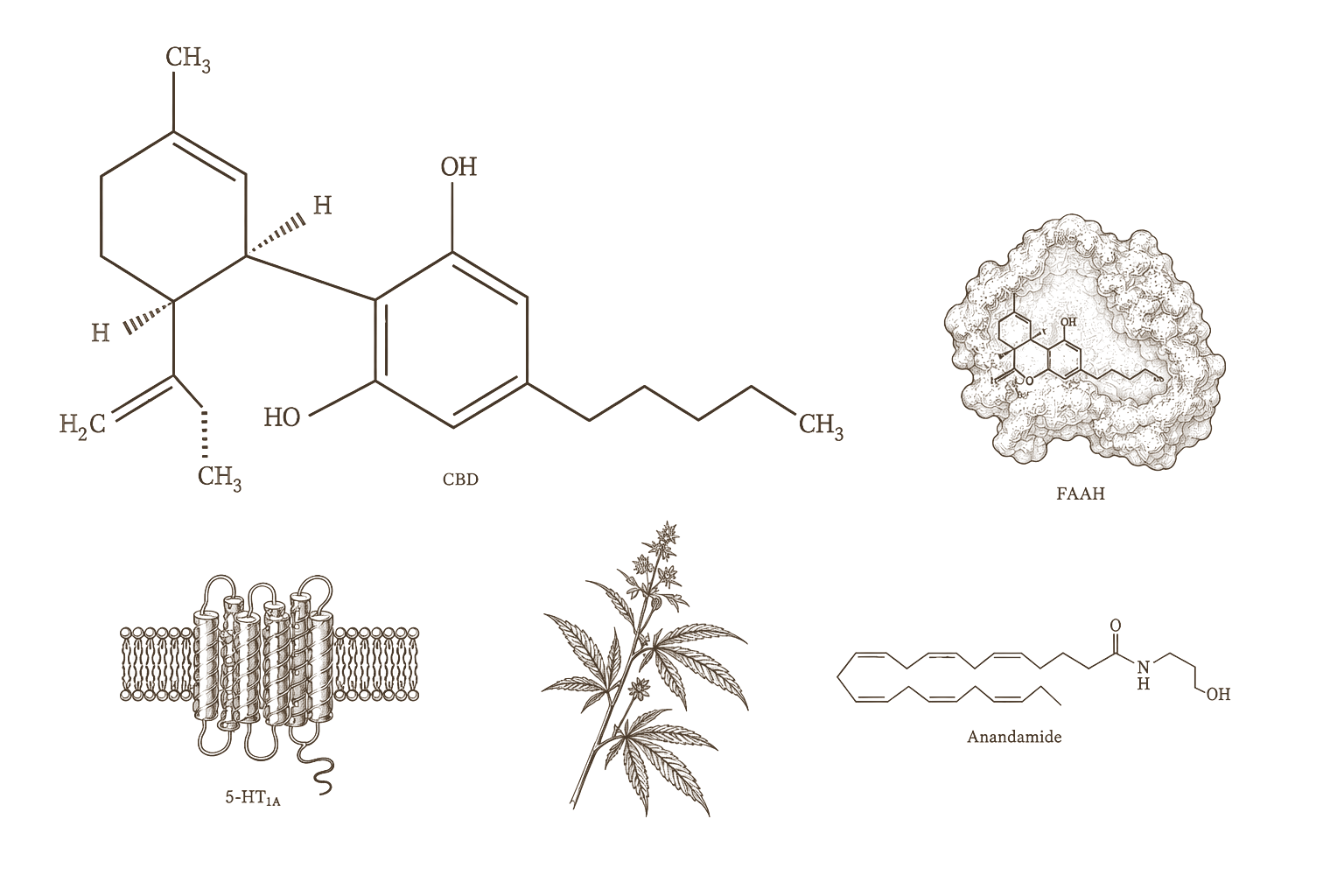
Full Name
Cannabidiol
Abbreviation
CBD
Classification
Non-psychoactive phytocannabinoid
Biosynthetic Origin
CBGA → CBDA → CBD (via decarboxylation)
Primary Receptors
CB1 (low affinity), CB2, TRPV1, 5-HT1A, GPR55
Human Trial Status
Multiple published RCTs across several domains
Section I


Compound Identity and Botanical Role
CBD originates as cannabidiolic acid (CBDA) — the acidic precursor produced during plant maturation from cannabigerolic acid (CBGA), the biosynthetic parent of the cannabinoid family. Enzymatic conversion during growth produces CBDA alongside THCA and other acidic cannabinoids. Decarboxylation — triggered by heat, time, or processing — converts CBDA to CBD. In most domesticated hemp cultivars, CBD is the dominant cannabinoid by concentration, which is why early cannabinoid research, and the majority of the hemp industry, oriented around it.
In a full-spectrum hemp preparation, CBD is typically the most abundant non-psychoactive cannabinoid present. It coexists with minor cannabinoids including CBG, CBC, and CBN, as well as terpenes and other botanical compounds. How these constituents interact in combination — the entourage effect hypothesis — remains under investigation and is not established as a predictable or consistent clinical phenomenon.
Section II
Pharmacological Profile
CBD's pharmacology is distinctive for its breadth and its indirect character. It does not bind strongly to CB1 receptors — the primary site of THC's psychoactive activity — and does not produce intoxication. Instead, CBD interacts with a distributed set of receptor systems, each relevant to a different physiological domain.
Receptor Interaction 1
CB1 — Low Affinity Partial Agonist / Negative Allosteric Modulator
CBD binds CB1 at low affinity and may act as a negative allosteric modulator — altering how THC and endocannabinoids bind without strongly activating the receptor itself. This is one proposed mechanism of CBD's ability to attenuate THC's psychoactive effects.
Receptor Interaction 2
TRPV1 — Agonist
CBD activates transient receptor potential vanilloid 1 channels, which detect inflammatory pain and thermal stimuli. Sustained TRPV1 activation can desensitize the channel, potentially reducing its contribution to pain signaling over time.
Receptor Interaction 3
5-HT1A — Agonist
CBD acts as a 5-HT1A serotonin receptor agonist at relevant concentrations. 5-HT1A agonism is associated with anxiolytic and antidepressant effects and is the mechanism of several established pharmaceutical anxiolytics. This is considered one of CBD's primary anxiety-relevant mechanisms.
Receptor Interaction 4
GPR55 — Antagonist
CBD antagonizes GPR55, a candidate cannabinoid receptor involved in modulating pain signaling and bone density. The functional significance of this antagonism across domains is still being characterized.
Receptor Interaction 5
FAAH — Inhibitor
CBD inhibits the enzyme FAAH, which degrades anandamide. By slowing anandamide breakdown, CBD indirectly elevates endocannabinoid tone and extends CB1 engagement via the body's own signaling molecules. Magnitude of this effect at typical oral doses in humans is not fully established.
Receptor Interaction 6
Inflammatory Pathways
CBD has demonstrated effects on cytokine signaling and oxidative stress in preclinical models. Anti-inflammatory activity documented across multiple tissue types in vitro and in animal models. Human translation variable across conditions.
What distinguishes CBD pharmacologically from CBG is the 5-HT1A agonism and GPR55 antagonism — mechanisms not shared by CBG. CBG's distinguishing properties, by contrast, are its potent alpha-2 adrenoceptor agonism and GABA reuptake inhibition, which CBD does not share. They are pharmacologically distinct compounds that happen to coexist in the same plant, and reading research on one as applicable to the other is a common error.
Section III
Human Research
Tier 1 — Human Trial Evidence
CBD has the most extensive human trial record of any cannabinoid outside of THC. The depth and quality of that record varies substantially by domain. Epilepsy represents the strongest evidence base, anchored by large randomized controlled trials and regulatory approval. Anxiety has a moderate evidence base from multiple small RCTs. Pain evidence is complicated by the predominance of THC/CBD combination trials. Sleep research is early and inconsistent.
The FDA-approved prescription formulation Epidiolex — purified CBD — received approval in 2018 for Dravet syndrome and Lennox-Gastaut syndrome, two severe treatment-resistant epilepsy syndromes. This represents the only regulatory approval of isolated CBD for any medical indication globally and is supported by large, well-designed RCTs with objective seizure outcome measures. The epilepsy evidence is categorically stronger than CBD evidence in any other domain.
In anxiety research, multiple small RCTs using simulated public speaking paradigms and other laboratory stress models have documented CBD-associated reductions in self-reported anxiety compared to placebo. Bergamaschi et al. (2011) and Crippa et al. (2011) are the most cited, both in social anxiety contexts. Findings are consistent in direction but limited by sample size, acute design, and reliance on self-report. Large-scale, long-duration trials in diagnosed anxiety disorder populations have not been completed.
Section IV
Preclinical Research by Domain
Tier 2 — Preclinical Evidence
CBD's preclinical evidence base spans more domains than any other cannabinoid. Selected domains with the most developed research:
Neuroprotection: CBD has demonstrated neuroprotective effects in animal models of ischemia, neuroinflammation, and oxidative stress. Mechanisms involve anti-inflammatory cytokine modulation and antioxidant activity. Relevance to human neurological conditions under investigation.
Pain and inflammation: Multiple rodent models have documented CBD's anti-inflammatory and analgesic effects, including the Philpott et al. (2017) osteoarthritis study. TRPV1 desensitization and inflammatory mediator modulation are the primary proposed mechanisms. Human translation variable.
Anxiety: Animal anxiety models consistently show CBD-associated anxiolytic effects. 5-HT1A agonism is the primary mechanism studied. Results in rodent models have been consistent with the small human trial findings, which is one reason the anxiety research trajectory is considered the most promising outside epilepsy.
Antipsychotic effects: CBD has been examined as a potential antipsychotic adjunct in schizophrenia research, with one notable RCT (McGuire et al., 2018) finding CBD-associated improvements in positive symptom severity as an add-on therapy. This is early research with significant limitations but a genuine human signal in a domain where most cannabinoid research has no human data at all.
Section V
Evidence Summary by Domain
Section VI
Open Research Questions
CBD and CBG in this archive
CBD's larger evidence base provides essential comparative context for reading CBG research. Where CBD has human trial evidence, CBG often has preclinical evidence and a single acute RCT. The two compounds share some receptor territory but are pharmacologically distinct. Findings from one should not be generalized to the other, and the research trajectories — while parallel — are at different stages of development. This archive covers CBD as context. CBG is the founding research focus.
References
- Bergamaschi, M.M., Queiroz, R.H.C., Chagas, M.H.N., et al. (2011). Cannabidiol reduces the anxiety induced by simulated public speaking in treatment-naïve social anxiety disorder patients. Neuropsychopharmacology, 36(6), 1219–1226.
- Crippa, J.A.S., Derenusson, G.N., Ferrari, T.B., et al. (2011). Neural basis of anxiolytic effects of cannabidiol in generalized social anxiety disorder: a preliminary report. Journal of Psychopharmacology, 25(1), 121–130.
- Devinsky, O., Cross, J.H., Laux, L., et al. (2017). Trial of cannabidiol for drug-resistant seizures in the Dravet syndrome. New England Journal of Medicine, 376(21), 2011–2020.
- McGuire, P., Robson, P., Cubala, W.J., et al. (2018). Cannabidiol (CBD) as an adjunctive therapy in schizophrenia: a multicenter randomized controlled trial. American Journal of Psychiatry, 175(3), 225–231.
- Philpott, H.T., O'Brien, M., & McDougall, J.J. (2017). Attenuation of early phase inflammation by cannabidiol prevents pain and nerve damage in rat osteoarthritis. Pain, 158(12), 2442–2451.
- Pertwee, R.G. (2008). The diverse CB1 and CB2 receptor pharmacology of three plant cannabinoids: Δ9-tetrahydrocannabinol, cannabidiol and Δ9-tetrahydrocannabivarin. British Journal of Pharmacology, 153(2), 199–215.
- Ibeas Bih, C., Chen, T., Nunn, A.V.W., et al. (2015). Molecular targets of cannabidiol in neurological disorders. Neurotherapeutics, 12(4), 699–730.
These statements have not been evaluated by the Food and Drug Administration. J.P. Hemp Company products are not intended to diagnose, treat, cure, or prevent any disease.