Cannabinoid Monographs
CBC — Cannabichromene
CBC is often the fourth cannabinoid named after CBG, CBD, and CBN — and the one with the most modest research portfolio. A shorter monograph is not a shortcoming; it is an accurate reflection of where the science stands.
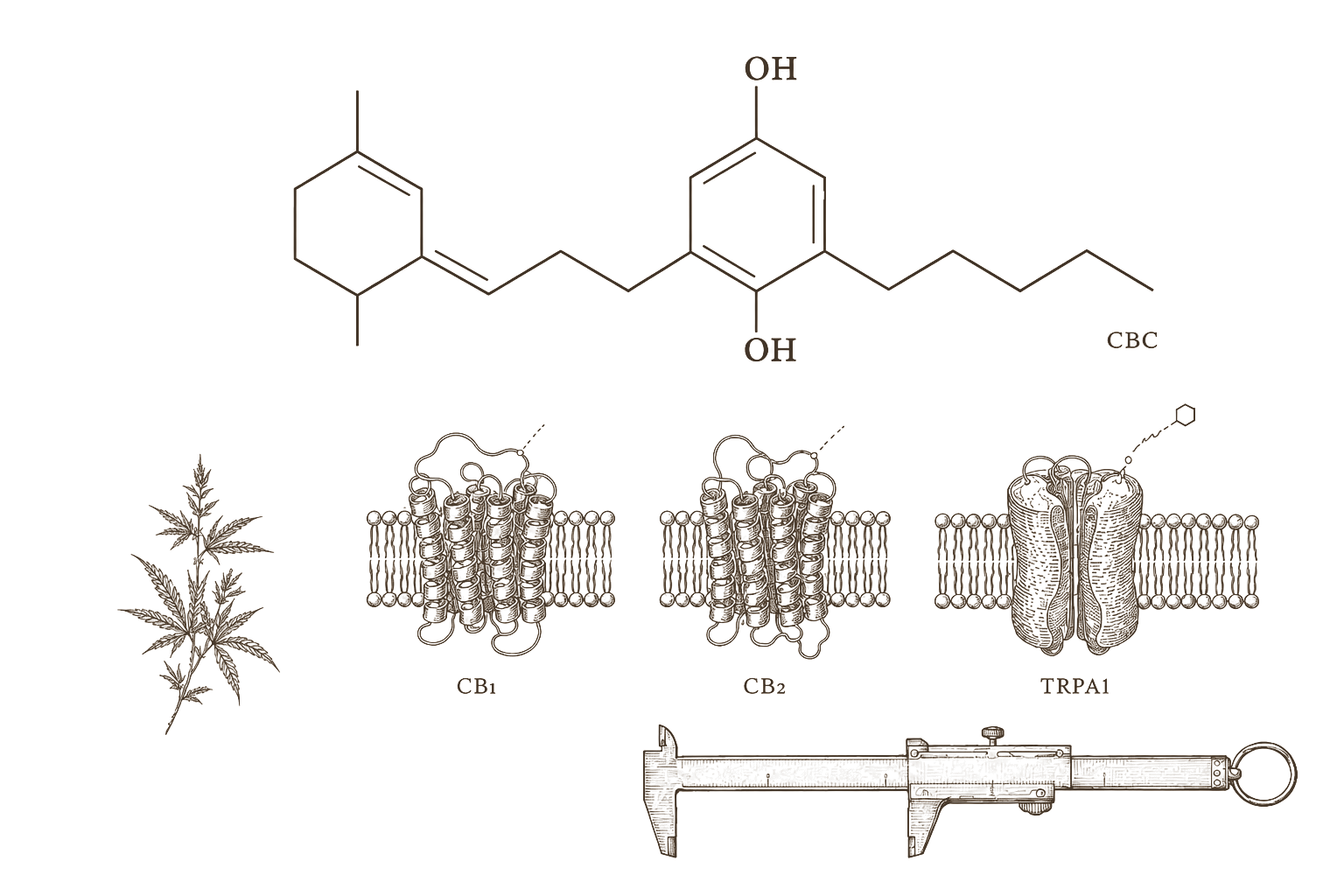
Cannabichromene shares biosynthetic origins with CBG and CBD — all three descend from CBGA, the parent cannabinoid compound — but diverges from them in its receptor pharmacology and its research depth. It is non-psychoactive, present in meaningful concentrations in some hemp varieties, and has generated genuine preclinical interest in several domains. It has generated no human clinical trial data.


Compound Identity and Botanical Role
CBC is synthesized in the cannabis plant through a distinct enzymatic pathway from CBGA: CBCA synthase converts CBGA to cannabichromenic acid (CBCA), which decarboxylates to CBC through heat or light exposure. It is one of the major phytocannabinoids present in cannabis and hemp, though typically at lower concentrations than CBD in most cultivated hemp varieties. Some landrace cannabis strains from equatorial regions carry higher CBC concentrations, which has made them subjects of selective breeding programs for minor cannabinoid research.
Like CBG and CBD, CBC is non-psychoactive — it does not produce intoxication at any dose encountered in commercial preparations. Unlike CBG and CBD, it has minimal binding affinity at CB1 and CB2 receptors at typical concentrations. CBC's documented pharmacological activity is primarily through non-cannabinoid receptor mechanisms.
Pharmacological Profile
Preclinical Research — What Has Been Found
CBC's preclinical research profile is built primarily around three areas: anti-inflammatory activity, neurogenesis, and combined activity with other cannabinoids.
The anti-inflammatory work draws on CBC's TRPA1 activity. In rodent models, CBC has shown anti-edema effects and reduced inflammatory mediator production through a mechanism partially dependent on TRPA1. The Wilkinson 2007 keratinocyte proliferation study — cited in the Immune & Antimicrobial pillar for CBG — also tested CBC, finding antiproliferative effects comparable to CBG in that model. Neither finding has advanced to clinical investigation.
The neurogenesis signal is one of CBC's more frequently cited preclinical findings. Shinjyo and Di Marzo (2013) found that CBC increased the viability of neural progenitor cells — the cells that generate new neurons — in mouse hippocampal cultures. Neural progenitor cell proliferation is associated with adult neurogenesis, a process linked to mood regulation and cognitive function. This is a cell culture finding that generated interest in CBC's potential relevance to mood and brain health, but it has not been followed by animal model neurogenesis studies or any human research.
CBC in Combination — The Entourage Context
Several studies have noted that CBC's effects are enhanced or modified in combination with other cannabinoids — particularly CBD and CBG. This is consistent with the broader entourage hypothesis and with what is known about synergistic cannabinoid interactions at overlapping receptor systems. What it means practically is that CBC's contribution to full-spectrum preparations may be more significant than its effects as an isolated compound. Isolating CBC's contribution in clinical outcomes research — were such research to exist — would face the same attribution challenges as other minor cannabinoid-in-combination research.
Evidence Summary by Domain
Open Research Questions
The most interesting open question for CBC is whether its TRPA1 mechanism — which is distinct from the CB1/CB2 and PPAR-γ mechanisms that dominate CBG and CBD research — generates genuine clinical signals in inflammatory pain or neurogenic inflammation conditions where TRPA1 is functionally relevant. TRPA1 is expressed in unmyelinated sensory fibers involved in chemical irritant detection and neurogenic inflammation — a pain phenotype that is not well-served by all existing analgesic classes. If CBC's TRPA1 activity translates meaningfully to anti-inflammatory analgesic effects in living systems, it could occupy a distinct pharmacological niche from its better-studied family members.
The neurogenesis finding — single cell culture study, unconfirmed at the animal model level — warrants follow-up research more than most single cell culture findings because adult hippocampal neurogenesis is a tractable endpoint in animal models and because the mood regulation and cognitive implications of neurogenesis-promoting compounds are significant. Whether this represents a genuine biological signal or a cell culture artifact that does not survive living system complexity has not been established.
The Honest Evidence Summary
CBC is a non-psychoactive phytocannabinoid with a pharmacological profile centered on TRPA1 and TRPV channel activity rather than cannabinoid receptors. Its preclinical research portfolio is the least developed of the four cannabinoids in this monograph series — anti-inflammatory signals, a single notable neurogenesis cell culture finding, antifungal in vitro activity, and keratinocyte antiproliferative effects. None has advanced to human clinical evidence.
A shorter monograph is not a shortcoming — it reflects where the science actually stands. CBC is present in full-spectrum preparations, may contribute to entourage effects through its distinct TRP channel mechanisms, and has mechanistic properties worth continued investigation. It is Tier 2 across all domains, with no primary research claim warranting strong promotional language of any kind.
References
- Appendino, G., Gibbons, S., Giana, A., et al. (2008). Antibacterial cannabinoids from Cannabis sativa: A structure-activity study. Journal of Natural Products, 71(8), 1427–1430.
- Cascio, M.G., Gauson, L.A., Stevenson, L.A., et al. (2010). Evidence that the plant cannabinoid cannabigerol is a highly potent alpha-2-adrenoceptor agonist. British Journal of Pharmacology, 159(1), 129–141.
- De Petrocellis, L., Ligresti, A., Moriello, A.S., et al. (2011). Effects of cannabinoids and cannabinoid-enriched Cannabis extracts on TRP channels and endocannabinoid metabolic enzymes. British Journal of Pharmacology, 163(7), 1479–1494.
- Izzo, A.A., Borrelli, F., Capasso, R., et al. (2009). Non-psychotropic plant cannabinoids: New therapeutic opportunities from an ancient herb. Trends in Pharmacological Sciences, 30(10), 515–527.
- Romano, B., Borrelli, F., Fasolino, I., et al. (2013). The cannabinoid TRPA1 agonist cannabichromene inhibits nitric oxide production in macrophages and ameliorates murine colitis. British Journal of Pharmacology, 169(1), 213–229.
- Shinjyo, N., & Di Marzo, V. (2013). The effect of cannabichromene on adult neural stem/progenitor cells. Neurochemistry International, 63(5), 432–437.
- Wilkinson, J.D., & Williamson, E.M. (2007). Cannabinoids inhibit human keratinocyte proliferation through a non-CB1/CB2 mechanism. Journal of Dermatological Science, 45(2), 87–92.
These statements have not been evaluated by the Food and Drug Administration. J.P. Hemp Company products are not intended to diagnose, treat, cure, or prevent any disease.