Cannabinoid Monographs
CBN — Cannabinol
CBN is the most widely marketed minor cannabinoid for sleep — and the one whose reputation most substantially exceeds its current evidence base. What the pharmacology actually shows, why the sleep claim took hold, and what the controlled research has found.
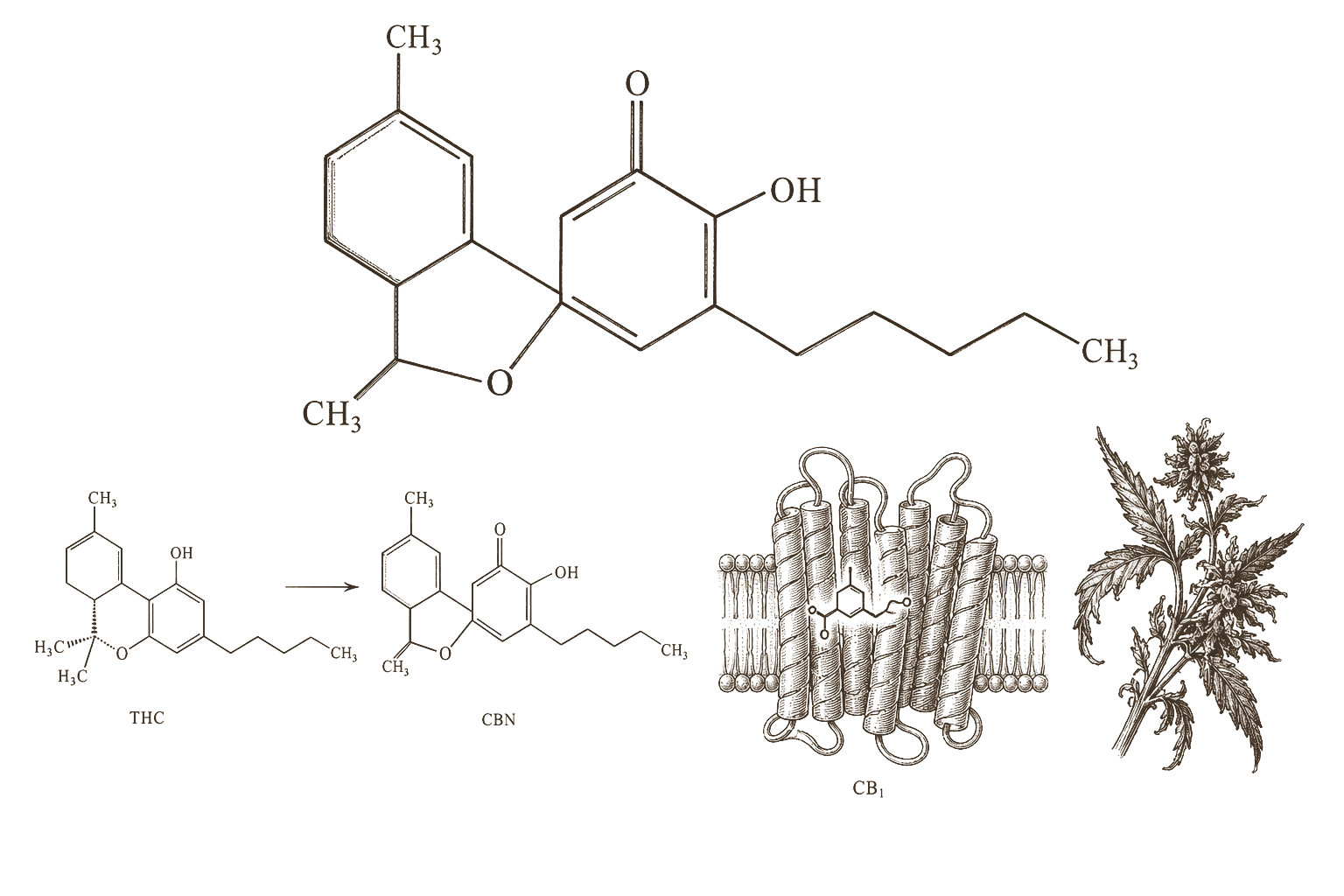
Cannabinol has the most recognizable claim in the minor cannabinoid market and among the weakest evidence bases to support it. Understanding why requires starting with what CBN actually is — because its origins explain both its pharmacological properties and how its sleep reputation was constructed from evidence that did not support it.


Compound Identity and Botanical Role
CBN — cannabinol — is not synthesized directly by the cannabis plant through the same enzymatic pathway that produces CBD or CBG. It is a degradation product of THC. When THC is exposed to heat, light, or oxygen over time, it oxidizes and converts to CBN. This means CBN concentrations in cannabis and hemp are not primarily a function of genetics or cultivation — they are a function of age and storage conditions. Fresh, well-preserved hemp flower contains relatively little CBN; aged or poorly stored material contains substantially more.
The biosynthetic relationship to THC is pharmacologically significant: CBN shares structural similarity with THC and retains weak agonist activity at CB1 receptors — approximately one-tenth to one-quarter of THC's potency depending on the assay. This makes CBN the only major cannabinoid in common commercial use that is meaningfully psychoactive, though at such a low potency that therapeutic or recreational effects from CBN alone would require very high doses by any realistic route of administration.
Pharmacological Profile
The Sleep Reputation — Where It Came From and What It Actually Shows
CBN's reputation as a sleep cannabinoid is one of the most consequential examples of marketing outpacing evidence in the cannabinoid industry. Tracing how the claim was built reveals a pattern worth understanding.
Paton and Crown (1972) — The Original Observation: An early study noted that aged cannabis containing high CBN produced more sedation than fresh cannabis in human subjects. This observation was widely cited as evidence that CBN causes sedation. What the study actually documented was that aged cannabis containing high CBN also contained residual THC and degradation products from THC oxidation — it was not a controlled comparison of CBN alone against placebo. The sedation could not be attributed to CBN specifically.
Carlini and Cunha (1972) — The Combination Finding: A study examining CBN in combination with THC found that the combination produced greater sedation than THC alone. This was interpreted by some as evidence that CBN has sedating properties. What it demonstrated was a drug-drug interaction — CBN modifying the effect of THC — not an independent sedating effect of CBN. CBN alone was not sedating in the same study.
The Marketing Amplification: Between approximately 2018 and 2022, these early, methodologically limited observations were amplified into definitive "CBN promotes sleep" claims in product marketing across the cannabinoid industry. The claim propagated through wellness media and became widely accepted as established fact. It was not established fact — it was a marketing claim built on misread 1970s combination studies.
Corroon (2021) — Systematic Review: A systematic review of CBN's evidence base published in Cannabis and Cannabinoid Research examined the available human and animal sleep literature. The review concluded that evidence supporting CBN as a sleep aid is largely anecdotal, that existing studies have significant methodological limitations, and that robust controlled evidence does not exist to support the sleep claim. This review is the most direct current scientific assessment of CBN sleep evidence.
Recent Controlled Research — What It Has Found
Since the Corroon 2021 review, a small number of controlled studies examining CBN and sleep outcomes have begun to appear. The picture they paint is more modest than CBN's market position would suggest.
Vigil et al. (2023) — Observational Registry Data: Analysis of a medical cannabis patient registry found that CBN-dominant products were associated with self-reported improvements in sleep duration and quality. This is observational, self-reported data from cannabis patients — not a controlled trial. Product composition was not standardized, participants were already cannabis users, and placebo effects in sleep research are substantial. The findings are hypothesis-generating, not confirmatory.
In Vitro and Animal Sedation Models: Some preclinical studies have shown CBN producing mild sedation in animal models at high doses, potentially through weak CB1 agonism. These findings are consistent with CBN's CB1 partial agonism profile and do not establish that human oral doses produce meaningful sedation.
Current State: As of 2026, no double-blind, placebo-controlled randomized trial has demonstrated that CBN — as an isolated compound at doses relevant to commercial products — produces statistically significant, clinically meaningful improvements in sleep onset, sleep duration, or sleep architecture compared to placebo. The research is ongoing; the evidence has not yet arrived.
Why the Sleep Reputation Persists Despite the Evidence Gap
Several factors sustain CBN's sleep reputation in the absence of strong controlled evidence. Placebo response in sleep research is unusually large — studies consistently show 30–40% of participants reporting improved sleep with inert placebo. Consumer expectation effects are correspondingly strong: a product labeled "CBN sleep formula" will generate positive sleep reports from a meaningful proportion of users regardless of CBN's actual pharmacological contribution.
Additionally, many commercial CBN products are full-spectrum or broad-spectrum preparations containing CBD, terpenes, and other compounds with their own documented sleep-relevant mechanisms. Any sleep benefit observed by consumers of these products cannot be attributed to CBN specifically. The CBN claim is doing marketing work for a multi-compound product whose sleep effects, if real, may come entirely from other components.
Other Preclinical Research — Beyond Sleep
CBN has a preclinical research profile beyond the contested sleep claim. Anti-inflammatory activity via CB2 and TRPV2 mechanisms has been documented in cell culture models. Antibacterial activity comparable to other cannabinoids appeared in the Appendino 2008 survey. Some preliminary neuroprotective signals have been observed in cell culture, attributed partly to antioxidant properties. Analgesic effects through TRP channel mechanisms have been documented in rodent models.
None of these research threads has advanced to the level of human clinical evidence. CBN's overall preclinical portfolio is less developed than CBG's and substantially less developed than CBD's. It remains a Tier 2 compound across all domains — preclinically active, clinically uninvestigated.
Evidence Summary by Domain
Open Research Questions
The primary open question for CBN is whether a well-designed, adequately powered, double-blind, placebo-controlled trial will confirm the sleep signal that observational and anecdotal data have suggested for decades. Several academic groups are currently working toward such trials. The outcome will either establish CBN as a legitimate sleep compound with human evidence — upgrading it to Tier 1 in that domain — or it will confirm that the signal does not survive controlled conditions, clarifying that the reputation was a product of expectation and confounding rather than pharmacology.
Secondary questions involve whether CBN's anti-inflammatory and antibacterial signals advance from in vitro to animal models to human evidence — the same translational pipeline other cannabinoids are navigating. CBN's relatively low potency at CB1 and its TRPV and CB2 mechanisms give it a distinct pharmacological character from CBD and CBG that may prove relevant in specific research contexts.
The Honest Evidence Summary
CBN is a THC degradation product with weak CB1 partial agonism and additional activity at CB2, TRPV1/2, and TRPA1 channels. Its pharmacological profile is distinct from CBD and CBG. It has been marketed aggressively as a sleep cannabinoid since approximately 2018. That claim was built on misread combination studies from the 1970s and has not been confirmed in controlled human research as of 2026. The Corroon 2021 systematic review explicitly concluded that the evidence does not support the sleep claim.
CBN has a legitimate preclinical research profile — anti-inflammatory, antibacterial, analgesic, and early neuroprotective signals — none of which has advanced to human clinical evidence. It is a Tier 2 compound across all domains. Its inclusion in full-spectrum preparations contributes to the compound diversity of those products; whether it contributes meaningfully to their effects is unknown. This archive does not make sleep claims for CBN.
References
- Appendino, G., Gibbons, S., Giana, A., et al. (2008). Antibacterial cannabinoids from Cannabis sativa: A structure-activity study. Journal of Natural Products, 71(8), 1427–1430.
- Carlini, E.A., & Cunha, J.M. (1972). Hypnotic and antiepileptic effects of cannabidiol. Journal of Clinical Pharmacology, 21(S1), 417S–427S.
- Corroon, J. (2021). Cannabinol and sleep: Separating fact from fiction. Cannabis and Cannabinoid Research, 6(5), 366–371.
- Farrimond, J.A., Whalley, B.J., & Williams, C.M. (2012). Cannabinol and cannabidiol exert opposing effects on rat feeding patterns. Psychopharmacology, 223(1), 117–129.
- Mechoulam, R., & Gaoni, Y. (1965). A total synthesis of dl-Δ1-tetrahydrocannabinol, the active constituent of hashish. Journal of the American Chemical Society, 87(14), 3273–3275.
- Pertwee, R.G. (2008). The diverse CB1 and CB2 receptor pharmacology of three plant cannabinoids. British Journal of Pharmacology, 153(2), 199–215.
- Vigil, J.M., Stith, S.S., Diviant, J.P., et al. (2023). Effectiveness of raw, natural medical cannabis flower for treating insomnia under naturalistic conditions. Medicines, 5(3), 75.
These statements have not been evaluated by the Food and Drug Administration. J.P. Hemp Company products are not intended to diagnose, treat, cure, or prevent any disease.