Understanding — How Cannabinoids Work
CBG or CBD — Which One, and When?
The most common question we hear from people trying to decide where to start — answered honestly, based on where the evidence is strongest for each compound, not marketing preference.
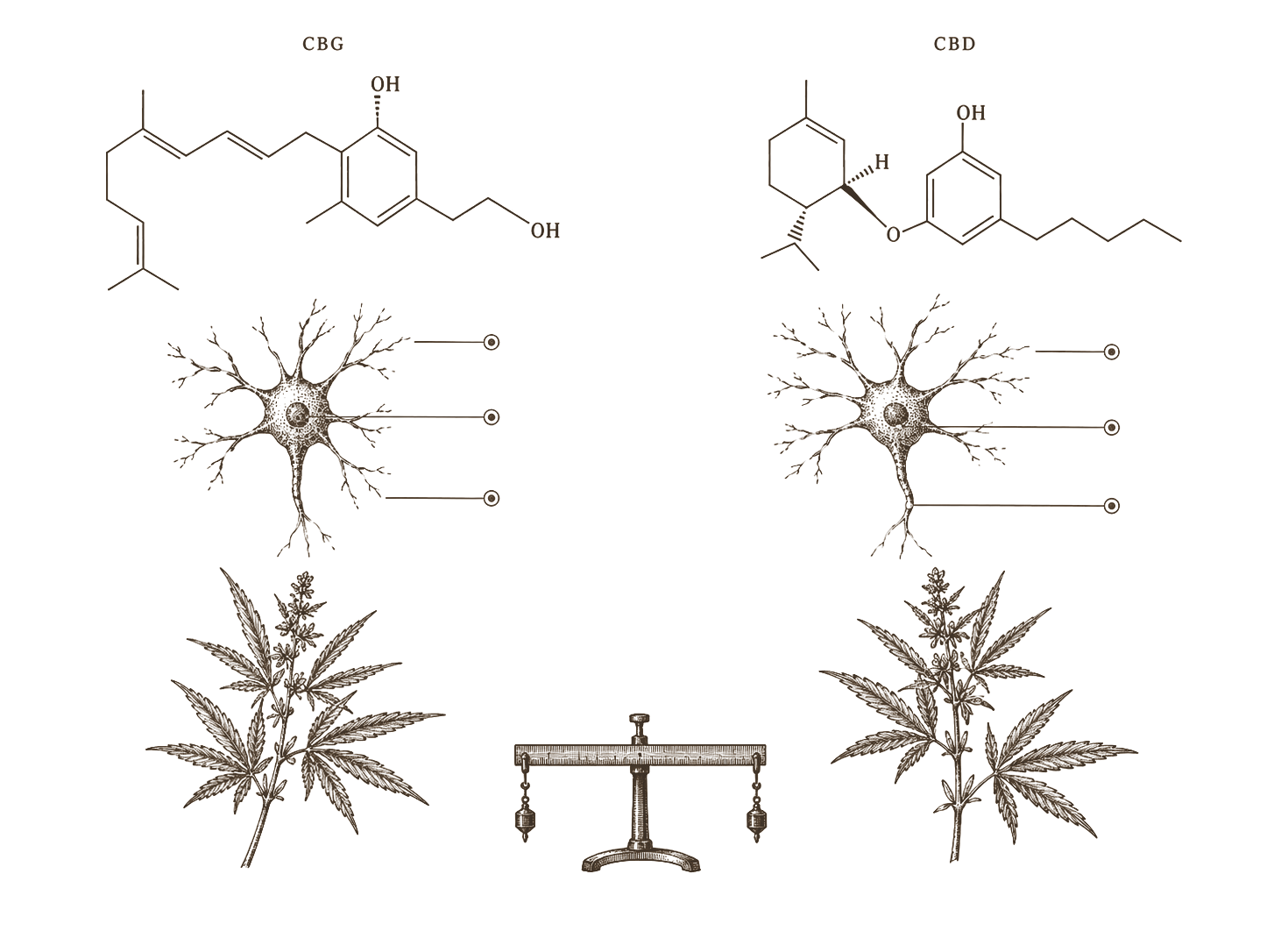
CBG and CBD are different compounds with different mechanisms and different research histories. Most hemp industry content either conflates them — treating all cannabinoids as roughly interchangeable — or positions one as superior to the other for marketing reasons. Neither approach serves you well when you are trying to make an informed decision.
This article gives you the honest version: what each compound does, where the human evidence is strongest for each, and a plain-language guide to choosing based on what you are actually trying to address.
The starting point that matters most: CBG has newer, more limited human research, but the research that exists is specific and meaningful. CBD has a larger and older human evidence base across more domains. Both are whole-plant preparations from the same plant — hemp — and in a full-spectrum preparation they work together alongside other phytochemicals. The question of which to prioritise is a question about which mechanism is most relevant to your situation, not which compound is categorically better.


What CBG does — and where the evidence sits
Human trial evidence: Cuttler et al. (2024) — stress and anxiety · Tier 1 for acute stress response
CBG acts on the stress response through two well-documented pathways. Its alpha-2 adrenoceptor activity reduces sympathetic nervous system output — the "fight or flight" activation that drives physical stress symptoms including elevated heart rate, muscle tension, and mental hyperarousal. Its HPA axis modulation helps regulate cortisol — the primary stress hormone — and supports the feedback mechanism that terminates the stress response after a threat has passed.
The Cuttler (2024) randomised controlled trial — the first and only published placebo-controlled human trial of CBG specifically — found statistically significant reductions in both stress and anxiety at a single 20mg oral dose. This is the strongest human evidence for either compound in the stress domain. The trial population skewed female, so direct extrapolation to all populations requires some caution — but the mechanism is not sex-specific.
If your primary concern is stress reactivity — the speed and intensity of your stress response, how quickly you recover from stress events, the physical symptoms of chronic stress load — CBG is where the most directly relevant human evidence sits. The alpha-2 and HPA mechanisms are upstream of many downstream consequences: disrupted sleep driven by cortisol, hormonal effects of chronic stress, the physical symptoms of sustained sympathetic activation.
What CBD does — and where the evidence sits
Human trial evidence: multiple trials across anxiety, sleep, and epilepsy · Broader evidence base, more domains
CBD's most documented mechanism is FAAH inhibition — slowing the breakdown of anandamide, the body's primary endocannabinoid, which raises anandamide availability throughout the brain and body. CBD also acts as a partial agonist at the 5-HT1A serotonin receptor — a receptor involved in anxiety, mood, and stress response modulation. These two mechanisms together give CBD particular relevance in anxiety and mood-related domains.
Multiple small randomised controlled trials have found CBD-reduced anxiety in simulated stress conditions — public speaking paradigms, social anxiety models. The sleep architecture research is notable: polysomnographic data documents CBD's effects on sleep stages, particularly on REM sleep. CBD's anti-epileptic evidence is the strongest in the entire cannabinoid literature — Epidiolex, the FDA-approved CBD drug, was approved based on large clinical trials. For general hemp preparation use, the anxiety and sleep evidence is most directly relevant.
If your primary concern is anxiety rather than stress reactivity — the persistent background anxiety that doesn't have a clear acute trigger, or anxiety that shows up in social contexts — CBD's 5-HT1A activity and broader anxiety evidence base are most relevant. If sleep architecture is the main concern — the quality and staging of sleep rather than just sleep onset — CBD's documented effects on sleep stages are the most specific evidence available. For skin and topical applications, CBD's anti-inflammatory and skin research is more developed than CBG's.
A plain-language guide by concern
The case for using both
CBG and CBD have complementary rather than redundant mechanisms. CBG's alpha-2 adrenoceptor activity reduces sympathetic output. CBD's FAAH inhibition raises anandamide, supporting endocannabinoid tone across the system. CBG modulates the HPA axis more directly; CBD's 5-HT1A activity addresses the serotonin-anxiety connection more directly. Where both stress reactivity and background anxiety are present — which is common — using both in a whole-plant context addresses more of the relevant biology than either alone.
This is also the rationale behind whole-plant full-spectrum preparations: the phytochemical combination produces interactions that single-compound preparations cannot replicate. Our preparations are formulated with this in mind. The question of CBG or CBD is most relevant when choosing which to prioritise as a primary tincture — not as an argument for excluding the other.
On medication interactions
Both CBD and CBG inhibit CYP450 liver enzymes — the pathways that process many prescription medications. If you are on prescription medication, the choice between CBG and CBD is less important than ensuring the interaction question is addressed first. Read the medications article in this archive before starting either preparation.
These statements have not been evaluated by the Food and Drug Administration. J.P. Hemp Company products are not intended to diagnose, treat, cure, or prevent any disease.