Understanding — Stress
Acute vs. Chronic Stress: What the Biology Shows
Short-term stress and long-term stress do very different things to the body — understanding the difference is essential for reading any research on stress and cannabinoids.
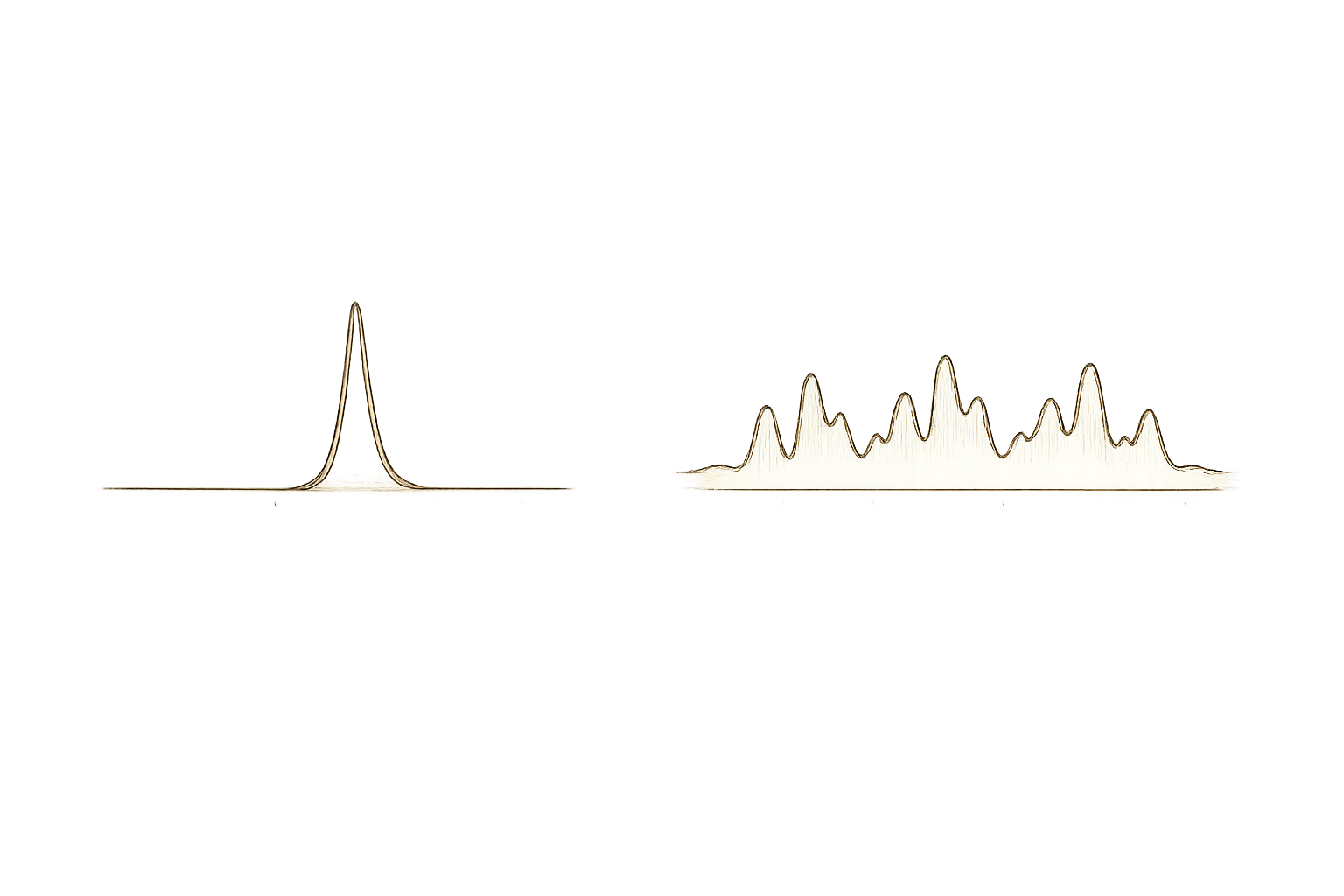
There is a kind of stress that sharpens you — that brings the body into focus, narrows attention to what matters, and resolves cleanly once the demand has passed. And there is a kind of stress that grinds, that accumulates without resolution, that the body cannot fully put down even when the original cause is gone.
The distinction between these two is not simply one of intensity. It is one of duration, recovery, and what the stress response system does when it cannot return to rest. Biology treats them differently because they are different.


The Defining Difference: Recovery
Stress is a biological response, not an inherent harm. The HPA axis — the body's central stress coordination system — is designed to activate under threat and to deactivate once the threat has passed. The activation is not the problem. The failure of deactivation is.
Acute stress and chronic stress are best understood not as points on a severity scale but as two different relationships between activation and recovery.
Type 1
Acute Stress
Short-duration activation in response to a specific, identifiable demand. Heart rate rises, cortisol is released, attention narrows. When the demand resolves, the feedback loop closes and the system returns to baseline. The physiological changes are reversible and often complete within hours.
Defined by: clear trigger → activation → recovery
Type 2
Chronic Stress
Sustained or repeated activation without adequate recovery between cycles. The stress system remains engaged over days, weeks, or months. Over time, this can alter the sensitivity of the feedback loop itself — changing not just how the body responds to stressors but how well it recovers from them.
Defined by: sustained activation → impaired recovery → altered baseline
What Acute Stress Does to the Body
An acute stressor — a near-miss while driving, a difficult conversation, an unexpected demand — triggers the HPA axis and the sympathetic nervous system in parallel. Cortisol rises within minutes. Adrenaline activates faster still, producing the immediate cardiovascular and attentional effects associated with what is commonly called the fight-or-flight response.
Fight-or-flight is a useful shorthand for the sympathetic arousal component of acute stress, though it understates the response's range. Contemporary stress research recognizes a broader repertoire: freeze responses involve immobility and dissociation of pain under extreme threat; tend-and-befriend responses involve social bonding and affiliation as a stress-buffering strategy, documented particularly in female stress responses. The specific pattern that emerges depends on the nature of the threat, its context, and individual biological factors.
In healthy acute stress, recovery is efficient. Cortisol's own negative feedback loop suppresses further HPA activation as levels rise, and the system begins returning to baseline once the stressor has resolved. For most everyday stressors, this cycle completes within hours. The physiological cost is real but bounded.
What Chronic Stress Does Over Time
Chronic stress is not simply more acute stress. It represents a qualitatively different condition — one in which the stress response system's regulatory logic begins to change rather than simply operating more frequently.
Some individuals under sustained stress show elevated baseline cortisol: the HPA axis is running at a higher set point even when no immediate stressor is present. Others show the opposite pattern — blunted cortisol responses, a system that has adapted to chronic demand by reducing its own reactivity. Neither pattern is universal; individual responses to chronic stress depend on the nature and timing of the stressor, prior stress history, genetic factors, and concurrent biological conditions.
Beyond cortisol, chronic stress is associated with shifts in immune function, disrupted sleep architecture, metabolic changes, and alterations in the neural circuits that regulate emotional processing and memory. These effects are not merely psychological — they are physiological changes in systems that the chronic stress state has reorganized around a new and less flexible equilibrium.
On the language of resilience
Researchers use the term "stress resilience" to describe the capacity of the stress response system to return to baseline efficiently after activation. It is a functional description — the flexibility of the system's recovery — not a moral one. A person with lower measured stress resilience is not weaker than one with higher. They may have experienced conditions that altered the system's calibration. The biology is descriptive. What it describes is alterable.
Recovery: What It Actually Involves
Recovery from stress is not simply the absence of a stressor. It is an active biological process — the nervous system returning to a state from which it can respond appropriately to new demands, rather than a state of sustained partial activation.
What Adequate Recovery Involves
Why the Distinction Matters for Stress Research
Stress and anxiety research — including cannabinoid research — frequently involves acute stress protocols: a stressor is administered, a response is measured, recovery is assessed. The Cuttler et al. (2024) trial of CBG, for example, examined acute stress reduction following a single dose. These are valid and informative research designs. They measure something real.
What they do not measure is the chronic stress question: whether repeated exposure to a compound, over time, alters the stress system's baseline sensitivity, improves recovery efficiency, or modifies the physiological reorganization that chronic stress produces. That research is harder to design, harder to conduct, and mostly still ahead of where the published literature currently stands — for cannabinoids and for most interventions studied in the stress domain.
Reading acute trial findings in a chronic stress context requires this distinction to be held clearly. A compound that reduces subjective stress acutely may or may not affect the chronic stress state. Those are separate questions, requiring separate evidence.
Acute stress is the body doing what it was built to do. Chronic stress is what happens when that system cannot rest. The difference is not one of degree but of kind — the biology of sustained activation is genuinely different from the biology of efficient acute response and recovery.
Understanding that difference is the prerequisite for reading stress research accurately, evaluating what any particular finding actually shows, and holding proportionately the distance between an acute trial result and the chronic stress experience that many people are actually trying to address.
These statements have not been evaluated by the Food and Drug Administration. J.P. Hemp Company products are not intended to diagnose, treat, cure, or prevent any disease.