Understanding — The Endocannabinoid System
Beyond CBD: The Phytocannabinoid Landscape
CBD is one of more than a hundred cannabinoids found in the hemp plant — what the others are, and what early research has begun to explore.
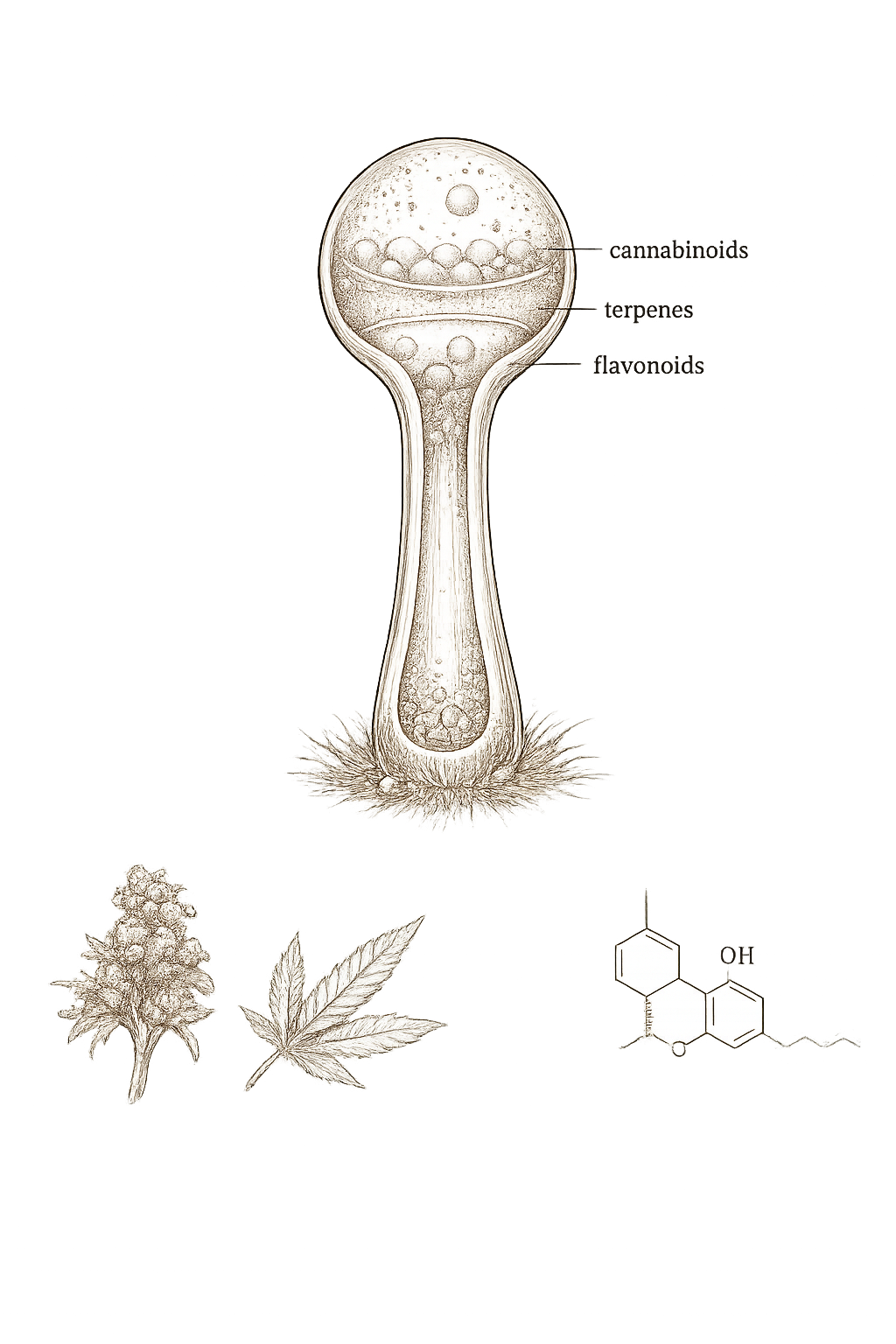
The hemp plant produces more than a hundred identified cannabinoid compounds. Most discussions focus on two — CBD and THC. The rest are described as minor cannabinoids, a term that refers to their abundance in the plant rather than their biological significance.
Research into these compounds has expanded substantially over the past decade, driven partly by cultivation advances that have made it possible to produce them in sufficient quantities to study. Several have moved from preclinical curiosity to active human research. This article maps the landscape briefly — as an entry point to the Monograph entries where each compound is covered in depth.


The Biosynthetic Origin: Why CBGA Is the Starting Point
All phytocannabinoids in hemp share a common biosynthetic ancestor: cannabigerolic acid (CBGA). During plant development, enzymatic processes convert CBGA into the acidic precursors of the major cannabinoid families — THCA, CBDA, and CBCA, which then decarboxylate into THC, CBD, and CBC respectively under heat or time. CBG itself is the neutral decarboxylated form of CBGA, present in trace amounts in mature plants because most CBGA has already converted forward.
Cannabinoid Biosynthesis — From One Parent Compound
CBGA is the biochemical precursor to all major cannabinoid families. CBG is its decarboxylated neutral form — which is why CBG is sometimes called the parent molecule of the cannabinoid family, and why it is present in low concentrations in most mature hemp plants.
This shared origin does not mean the compounds behave similarly. Each family produces molecules with distinct receptor interactions, pharmacological profiles, and research trajectories. The biosynthetic relationship is a useful orientation, not a guide to pharmacological equivalence.
The Compounds: Brief Profiles
What follows is a brief overview of the most researched phytocannabinoids beyond CBD and THC. Evidence tiers follow the archive's standard: Tier 1 indicates published human randomized controlled trials; Tier 2 indicates preclinical and mechanistic research without human trial confirmation; Tier 3 indicates very early or primarily in vitro findings.
Cannabigerol — Founding Research Compound
Tier 1
CBG is the decarboxylated form of CBGA, the cannabinoid family's biosynthetic parent. It interacts with CB1 and CB2 receptors at moderate affinity, but its pharmacologically distinctive properties are its potent alpha-2 adrenoceptor agonism — documented by Cascio et al. (2010) — and its GABA reuptake inhibition. These mechanisms are active in the stress and arousal signaling systems that make CBG the focus of this archive's research pillar.
CBG is the only minor cannabinoid with a published randomized, double-blind, placebo-controlled human trial in the stress and anxiety domain. The Cuttler et al. (2024) trial documented statistically significant acute reductions in self-reported stress and anxiety in healthy adults following a single oral dose. Participants did not report intoxication, and cognitive performance was stable. This distinguishes CBG's evidence tier from every other minor cannabinoid described on this page.
Read the CBG Monograph →Cannabidiol
Tier 1
CBD is the dominant non-psychoactive cannabinoid in most hemp cultivars and the most extensively studied cannabinoid after THC. Its pharmacology is distributed across several receptor systems — TRPV1, 5-HT1A, GPR55, and FAAH inhibition — rather than concentrated at CB1. The FDA-approved prescription formulation Epidiolex established CBD's strongest clinical evidence base in treatment-resistant epilepsy. Anxiety research has produced consistent acute signals from multiple small RCTs. Pain evidence is complicated by the predominance of THC/CBD combination trials. CBD is covered in full in the CBD Monograph.
Read the CBD Monograph →Cannabichromene
Tier 2
CBC is among the more abundant minor cannabinoids in certain hemp chemotypes. It interacts with TRPV1 and TRPA1 channels rather than binding strongly to CB1 or CB2 receptors, and has been studied in preclinical models examining inflammatory signaling and nociception. Some research has explored potential neurogenic effects in rodent hippocampal models. Human clinical data are absent. CBC is a Tier 2 compound — mechanistically interesting, clinically unstudied in humans.
Cannabinol
Tier 2
CBN is a degradation product of THC — it forms as THC oxidizes over time, which means its concentration in any preparation increases with age and improper storage. It has mild CB1 agonist activity, considerably weaker than THC. CBN is frequently marketed for sleep despite a thin and largely anecdotal evidence base. A small number of early human trials are beginning to examine this claim, but the evidence currently does not support strong conclusions about CBN-specific sleep effects. The popular reputation has run ahead of the research.
Tetrahydrocannabivarin
Tier 2
THCV has a pharmacological profile that differs significantly from THC. At low doses it acts as a CB1 antagonist — opposite to THC's agonism — and at higher doses shifts toward partial agonism. Preclinical research has examined metabolic effects, particularly in relation to appetite regulation and glucose metabolism, producing results that have generated research interest in cardiometabolic contexts. Human data are limited. No published RCTs in healthy adults analogous to the CBG stress trial exist for THCV.
On evidence tier differences within this list
CBG and CBD both have Tier 1 human trial evidence — the distinction is domain and depth. CBG's Tier 1 evidence is a single acute RCT in healthy adults for stress and anxiety. CBD's Tier 1 evidence includes regulatory approval for epilepsy and multiple anxiety RCTs. CBC, CBN, and THCV are Tier 2 — preclinically active, not yet tested in human RCTs in their primary research domains. Treating compounds from this list as equivalent because they share a plant would be a misreading of what their evidence tiers actually mean.
Why the Research Is Still Developing
Minor cannabinoids have been difficult to study historically because they were present in hemp at concentrations too low to produce in useful quantities for research. The same cultivar engineering that created high-CBD hemp — selecting for enzymatic expression at specific biosynthetic steps — has begun producing high-CBG and other minor cannabinoid-dominant cultivars, making compound-specific human research possible in ways it wasn't a decade ago.
This means the minor cannabinoid research literature is genuinely young, not simply incomplete. Most compounds are at the stage where preclinical mechanisms are documented and human trials are beginning rather than concluded. Reading this research accurately requires holding the preclinical signal and the absence of human confirmation simultaneously — neither dismissing the mechanistic findings nor treating them as established clinical evidence.
The phytocannabinoid landscape is more populated than most popular accounts suggest, and considerably less well-mapped than the enthusiasm around these compounds implies. The Monograph entries linked from this page go deeper into the two compounds — CBG and CBD — where the evidence is substantial enough to warrant it. The others are described here accurately and briefly: interesting, active in preclinical research, and awaiting the human trials that would move them to a different evidence tier.
These statements have not been evaluated by the Food and Drug Administration. J.P. Hemp Company products are not intended to diagnose, treat, cure, or prevent any disease.