Understanding — The Endocannabinoid System
FAAH and Enzyme Regulation
The enzyme that breaks down anandamide — what it does, why it matters for cannabinoid research, and how CBD interacts with it.
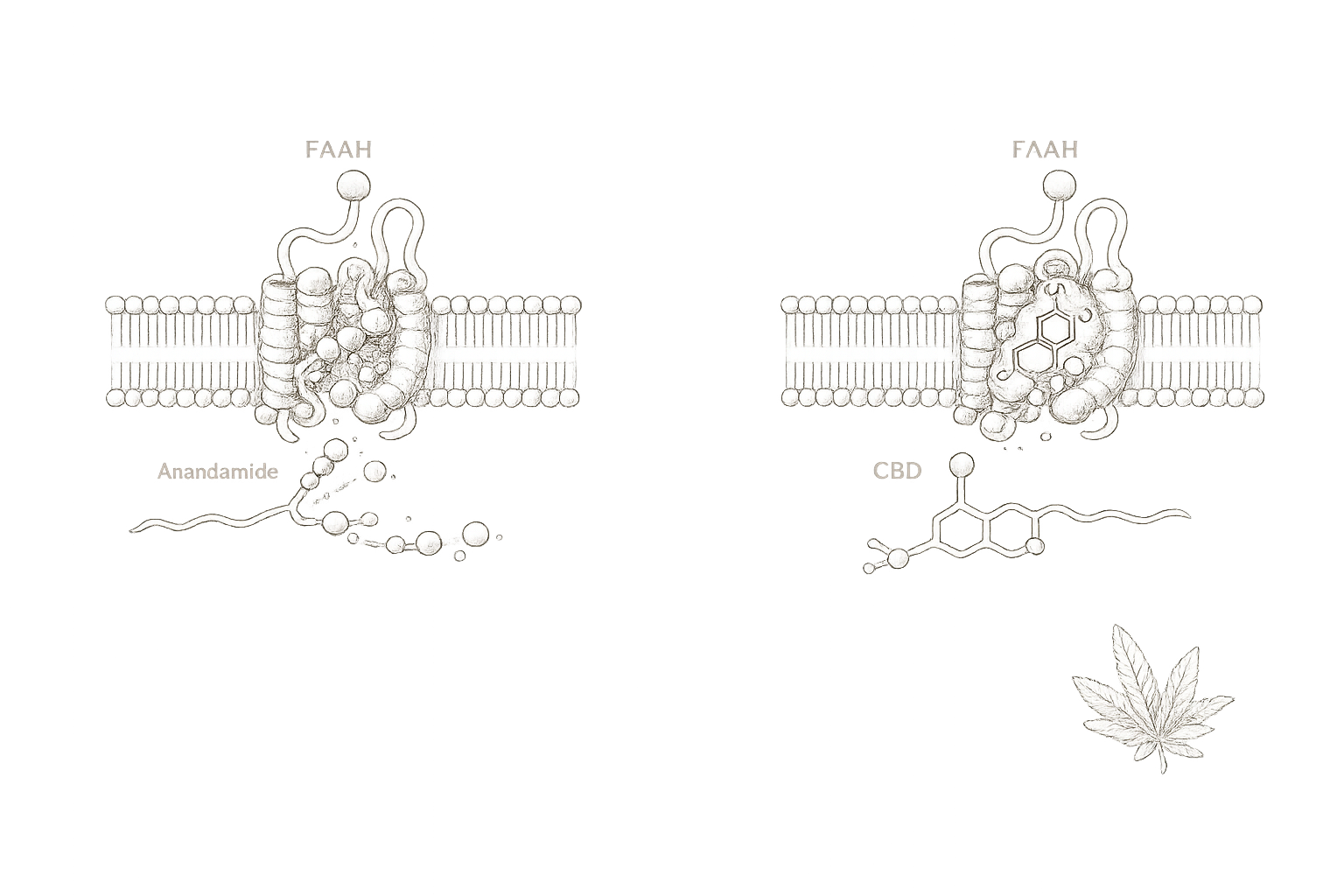
The endocannabinoid system does not work through receptors alone. Enzymes determine how long endocannabinoids remain active after they are synthesized — and therefore how strongly they influence the signaling they are carrying. Understanding enzymatic regulation is the third leg of the ECS architecture, alongside the molecules themselves and the receptors they bind.
FAAH — fatty acid amide hydrolase — is the enzyme most studied in this context, and the one most relevant to stress and anxiety research. What it does, what happens when it is inhibited, and what the attempt to inhibit it pharmacologically revealed about the risks of enzyme-level intervention: all of that is covered here.


The Two Primary Degrading Enzymes
The endocannabinoid system's two primary endocannabinoids — anandamide and 2-AG — are each terminated by a dedicated enzyme. The specificity of these degradation pathways is one reason the system can maintain localized, precise signaling: each molecule has its own termination mechanism, operating in the same cell or synapse where the signaling occurred.
Primary Degrading Enzyme
FAAH
Fatty Acid Amide Hydrolase
Degrades anandamide (AEA) through hydrolysis. Also processes other fatty acid amides. Located primarily in postsynaptic neurons. First characterized by Cravatt et al. (1996). The most studied enzyme in cannabinoid research outside of receptor systems.
Primary Degrading Enzyme
MAGL
Monoacylglycerol Lipase
Degrades 2-arachidonoylglycerol (2-AG). Located primarily in presynaptic neurons — the same location where 2-AG delivers its retrograde signal. Accounts for the large majority of 2-AG degradation in the central nervous system.
The localization of these enzymes is worth noting. FAAH acts primarily in postsynaptic neurons — where anandamide is synthesized and where receptor binding occurs. MAGL acts primarily in presynaptic neurons — the target of 2-AG's retrograde signaling. Both enzymes terminate signaling at or near its origin rather than in circulation, which is consistent with the endocannabinoid system's design principle of localized, on-demand regulation.
Endocannabinoid Tone and Why It Matters
Endocannabinoid tone describes the baseline level of endocannabinoid system activity — how much anandamide and 2-AG are available to bind receptors at any given moment, in any given tissue or circuit. Tone is not static. It varies across brain regions, across the day, across hormonal phases, and in response to acute and chronic stress.
How FAAH Activity Shapes Anandamide Availability
Endocannabinoid tone is one of the concepts that makes cannabinoid research more complex than receptor pharmacology alone can explain. Two people with identical receptor distributions can have very different ECS activity levels based on differences in enzyme function, synthesis rates, or the conditions that affect those variables. The FAAH genetic variant research — covered in the Anandamide and the Stress Response article — provides human evidence that naturally occurring differences in FAAH activity produce measurable differences in stress reactivity and amygdala response. Lower natural FAAH activity, higher anandamide availability, reduced threat reactivity: the relationship is documented in genetic association studies, which is some of the strongest human evidence available for endocannabinoid tone's role in stress biology.
How Cannabinoids Interact With FAAH
CBD has been documented in laboratory settings to inhibit FAAH activity — slowing anandamide breakdown and thereby increasing its availability at receptor sites. This is one of the proposed mechanisms through which CBD influences the endocannabinoid system, and it helps explain why CBD's pharmacological profile is different from direct CB1 agonism: rather than binding to CB1 receptors itself, CBD may extend the availability of the body's own anandamide. The extent and consistency of this effect at typical oral doses in human subjects remains under investigation. In vitro inhibition does not automatically translate to equivalent in vivo effects.
CBG's direct interaction with FAAH is less well characterized than CBD's. CBG's primary mechanisms in stress-relevant signaling — alpha-2 adrenoceptor agonism and GABA reuptake inhibition — operate independently of FAAH. Whether CBG has meaningful FAAH activity at typical doses in humans has not been established in published research.
The Pharmaceutical FAAH Inhibitor Experience
The most direct test of FAAH inhibition as a therapeutic strategy came from pharmaceutical development rather than plant cannabinoid research. FAAH inhibitors — compounds designed specifically to block the enzyme and elevate endocannabinoid tone — were developed as candidate anxiolytic and analgesic drugs on the strength of the preclinical evidence described above.
BIA 10-2474 — A Critical Safety Event
In 2016, a Phase 1 clinical trial of the FAAH inhibitor BIA 10-2474 in France resulted in one participant death and four others with serious neurological injuries. The event ended that compound's development and prompted substantial reassessment of the FAAH inhibitor class. Subsequent analysis suggested that BIA 10-2474 had off-target enzyme activity beyond FAAH that may have contributed to the toxicity, but the event established that FAAH inhibition carries risks that preclinical models had not predicted.
Pharmaceutical FAAH inhibitor development is not a currently active therapeutic pathway. This history is part of the honest picture of where FAAH research stands — and why the distance between "this enzyme is a plausible target" and "inhibiting this enzyme is safe and effective in humans" turned out to be larger than early research suggested.
The BIA 10-2474 experience does not imply that plant cannabinoids with possible FAAH-inhibiting activity are similarly risky — the mechanisms and selectivity profiles are different, and indirect or partial FAAH interaction is pharmacologically distinct from specific enzyme inhibition. What it does establish is that enzyme-level intervention carries its own complexity and risk profile, and that the pharmacological logic connecting preclinical findings to clinical outcomes is not as direct as receptor binding studies might suggest.
What Enzyme Regulation Adds to the ECS Picture
Understanding FAAH and MAGL completes the ECS regulatory cycle: synthesis on demand, receptor binding, enzymatic termination. Each stage has its own research literature and its own relevance to cannabinoid pharmacology. Endocannabinoid tone — the aggregate of all three — is the variable that connects the molecular biology to the lived experience of stress reactivity, mood stability, and recovery.
Completing the pillar sequence
This article is the final piece of the ECS pillar's foundational sequence: what the system is, what receptors it uses, what molecules carry its signals, how those molecules interact with the stress response, and how enzymes determine when signaling ends. Each article in this sequence is a prerequisite for reading the research in the Health Topics and Cannabinoid Monograph sections accurately. The ECS is not a backdrop to cannabinoid research — it is the system that cannabinoid research is investigating.
Enzymatic regulation is where the endocannabinoid system's moment-to-moment precision lives. FAAH and MAGL don't just clean up after signaling — they determine how much signaling occurred and for how long. Endocannabinoid tone, in large part, is a function of how active these enzymes are.
The pharmaceutical attempt to exploit this by directly inhibiting FAAH produced one of the more sobering clinical trial events in recent cannabinoid-adjacent research. The plant cannabinoid interactions with FAAH are softer, less specific, and less well-characterized. Both stories are part of the honest account of what this enzyme does and what happens when researchers try to manipulate it. This archive covers both because understanding the limits of a research area is as important as understanding its promise.
References
- Cravatt, B.F., Giang, D.K., Mayfield, S.P., et al. (1996). Molecular characterization of an enzyme that degrades neuromodulatory fatty-acid amides. Nature, 384, 83–87.
- Piomelli, D. (2003). The molecular logic of endocannabinoid signalling. Nature Reviews Neuroscience, 4(11), 873–884.
- Di Marzo, V., Stella, N., & Zimmer, A. (2015). Endocannabinoid signalling and the deteriorating brain. Nature Reviews Neuroscience, 16(1), 30–42.
- Pertwee, R.G. (2012). Targeting the endocannabinoid system with cannabinoid receptor agonists: pharmacological strategies and therapeutic possibilities. Philosophical Transactions of the Royal Society B, 367(1607), 3353–3363.
- van Esbroeck, A.C.M., Janssen, A.P.A., Cognetta, A.B., et al. (2017). Activity-based protein profiling reveals off-target proteins of the FAAH inhibitor BIA 10-2474. Science, 356(6342), 1084–1087.
These statements have not been evaluated by the Food and Drug Administration. J.P. Hemp Company products are not intended to diagnose, treat, cure, or prevent any disease.