Understanding — The Endocannabinoid System
Endogenous Cannabinoids: Anandamide and 2-AG
Your body produces its own cannabinoid-like molecules — what they are, what they do, and how they relate to plant-derived cannabinoids.
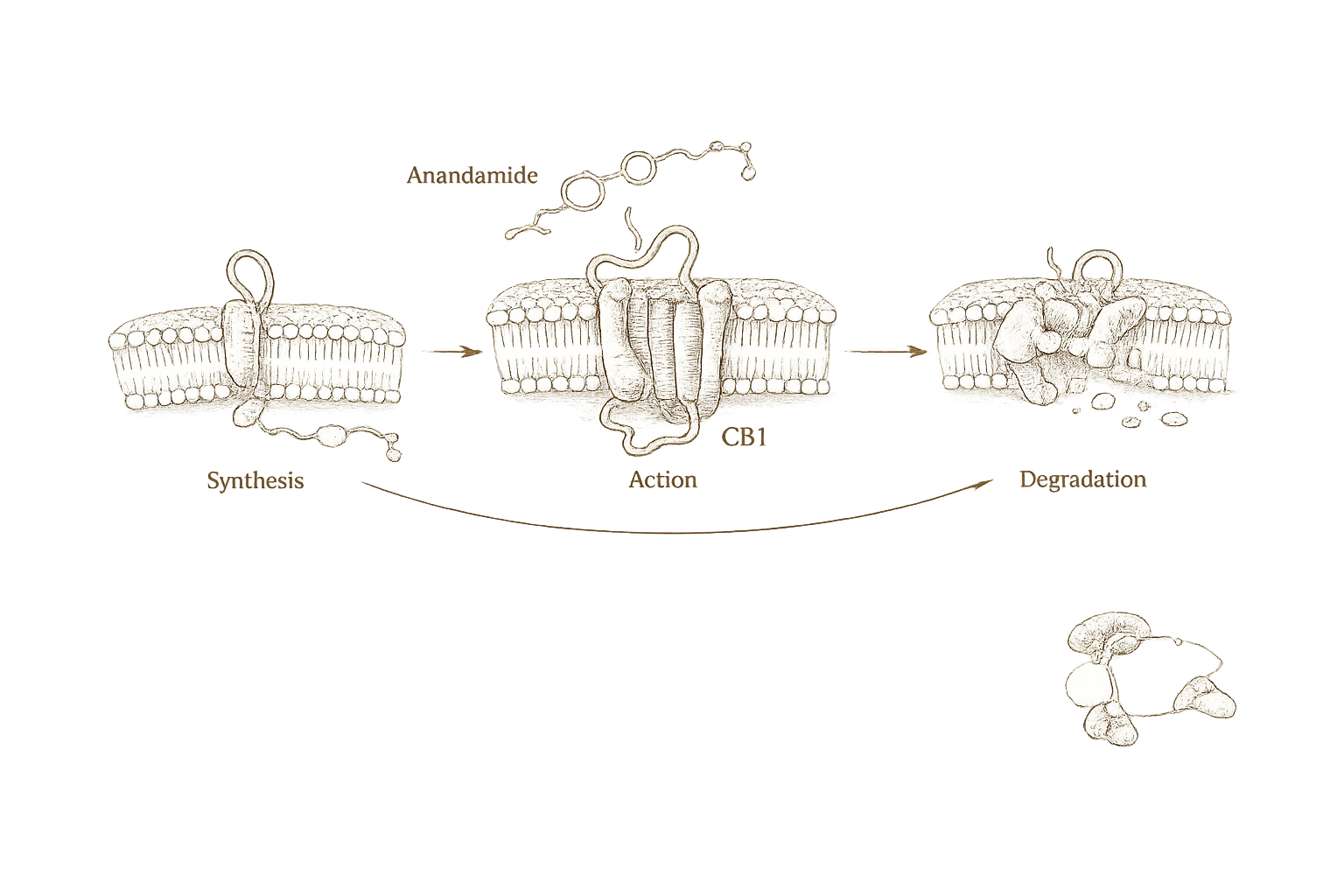
The endocannabinoid system carries its signals through molecules the body produces itself. These molecules — endogenous cannabinoids, or endocannabinoids — are what the receptors described in the previous article are actually built to receive.
Two endocannabinoids have been studied far more extensively than any others: anandamide and 2-arachidonoylglycerol. Understanding what they are, how they differ, and what happens to them after they deliver their signals is essential for reading cannabinoid research with any precision.


Molecules Built from Membrane
Both anandamide and 2-AG are lipid-based signaling molecules — they are derived from fatty acids embedded in cell membranes rather than synthesized in advance and stored somewhere for later use. This on-demand production is one of the endocannabinoid system's defining characteristics. The body does not maintain a reservoir of anandamide or 2-AG waiting to be released. It builds them at the moment they are needed, in the specific cell or synapse where they are needed, from the raw material of the membrane itself.
This localized, moment-to-moment synthesis is what allows the endocannabinoid system to regulate signaling with the precision and specificity that its homeostatic function requires. A neurotransmitter system that stores its molecules in vesicles and releases them in bulk operates differently — and for different purposes — than one that synthesizes molecules on demand and deploys them in real time.
First Endocannabinoid Identified
Anandamide
AEA — Arachidonoylethanolamide
Identified by Raphael Mechoulam's team in 1992. Named from the Sanskrit ānanda — bliss — by the researchers who discovered it. Present at lower concentrations than 2-AG. Degraded primarily by FAAH.
Most Abundant Endocannabinoid
2-AG
2-Arachidonoylglycerol
Identified in 1995. Present in the brain at concentrations approximately 170 times higher than anandamide. Considered the primary endogenous ligand at CB1 receptors. Degraded primarily by MAGL.
The Name That Stuck
When Raphael Mechoulam and his colleagues isolated the first endogenous cannabinoid in 1992, they faced the naming problem that attends any discovery of something genuinely new. They chose anandamide — from ānanda, the Sanskrit word for bliss or joy — partly as a reflection of the excitement of the discovery, and partly because the molecule seemed to be involved in states of pleasure and reward. The name was not a clinical claim. It was an expression of wonder.
It stuck because it was memorable, and because the science that followed gave it enough biological grounding to survive. Anandamide is genuinely involved in mood and stress regulation, in pain modulation, and in the reward circuits associated with experiences of pleasure. The Sanskrit etymology is not quite accurate to the molecule's full behavioral profile — anandamide also participates in appetite, sleep, and immune function — but it captures something true about the spirit of its discovery and the territory it inhabits.
How Anandamide and 2-AG Differ
Despite acting on many of the same receptors, anandamide and 2-AG are not interchangeable. Their concentrations, receptor affinities, degradation pathways, and functional roles are distinct in ways that matter for understanding the endocannabinoid system's behavior.
The concentration difference is particularly worth noting. 2-AG is present in brain tissue at concentrations far exceeding anandamide, and it is now considered the primary endogenous ligand at CB1 receptors under most conditions — despite anandamide receiving the greater share of early research attention. This is partly a consequence of anandamide's more evocative name and partly a reflection of how science progresses: the more memorable finding attracts more investigation, at least initially.
Retrograde Signaling — The Unusual Direction
One of the endocannabinoid system's most distinctive features is the direction in which its signals travel. Most neurotransmitter signaling moves in one direction: a presynaptic neuron releases a molecule, and the postsynaptic neuron receives it. Endocannabinoids frequently work in reverse. They are synthesized in the postsynaptic neuron, travel backward across the synapse, and act on receptors on the presynaptic side. This retrograde signaling allows the receiving neuron to regulate what the sending neuron does — providing feedback control on incoming signals in real time.
2-AG is the primary mediator of this retrograde signaling. It is this backward mechanism that gives the endocannabinoid system much of its regulatory precision — the ability to dampen a signal that has become too strong, or to adjust the sensitivity of a circuit that has been overstimulated.
Why this matters for cannabinoid research
Plant cannabinoids — including CBG and CBD — interact with the same receptors that anandamide and 2-AG act on. But they do not replicate the on-demand, synapse-specific signaling of endogenous cannabinoids. They enter a system with its own existing logic and interact with it from the outside.
This is part of why cannabinoid research findings are difficult to predict from receptor pharmacology alone. The endogenous system is calibrated and localized. Exogenous cannabinoids are systemic. What they do depends substantially on the state and context of the system they are entering.
What Happens to Them After Use
After anandamide and 2-AG have delivered their signals, enzymes break them down rapidly. Fatty acid amide hydrolase — FAAH — is the primary enzyme responsible for anandamide degradation. Monoacylglycerol lipase — MAGL — handles 2-AG. Both enzymes act quickly, keeping endocannabinoid signaling brief and localized. The molecular components are recycled into the cell membrane from which they came.
FAAH has attracted particular research attention because inhibiting it slows anandamide breakdown, extending the availability of anandamide at the synapse. Some researchers have investigated this as an approach to supporting endocannabinoid tone in stress and anxiety contexts without introducing exogenous cannabinoids directly. The FAAH article in this pillar covers that research in detail.
Anandamide and 2-AG are the body's own cannabinoids — synthesized on demand, delivered with precision, and broken down rapidly once their work is done. They are structurally related but functionally distinct, working through the same receptor system in complementary rather than identical ways.
Understanding them is the foundation for understanding why plant cannabinoids are of research interest at all — and for holding that interest proportionately, knowing that the endogenous system these molecules inhabit has its own logic that any exogenous compound enters, rather than replaces.
These statements have not been evaluated by the Food and Drug Administration. J.P. Hemp Company products are not intended to diagnose, treat, cure, or prevent any disease.