Understanding — The Endocannabinoid System
What Is the Endocannabinoid System?
The body has its own system of chemical messengers that help regulate stress, sleep, pain, and mood — here's what it is and why researchers study it.
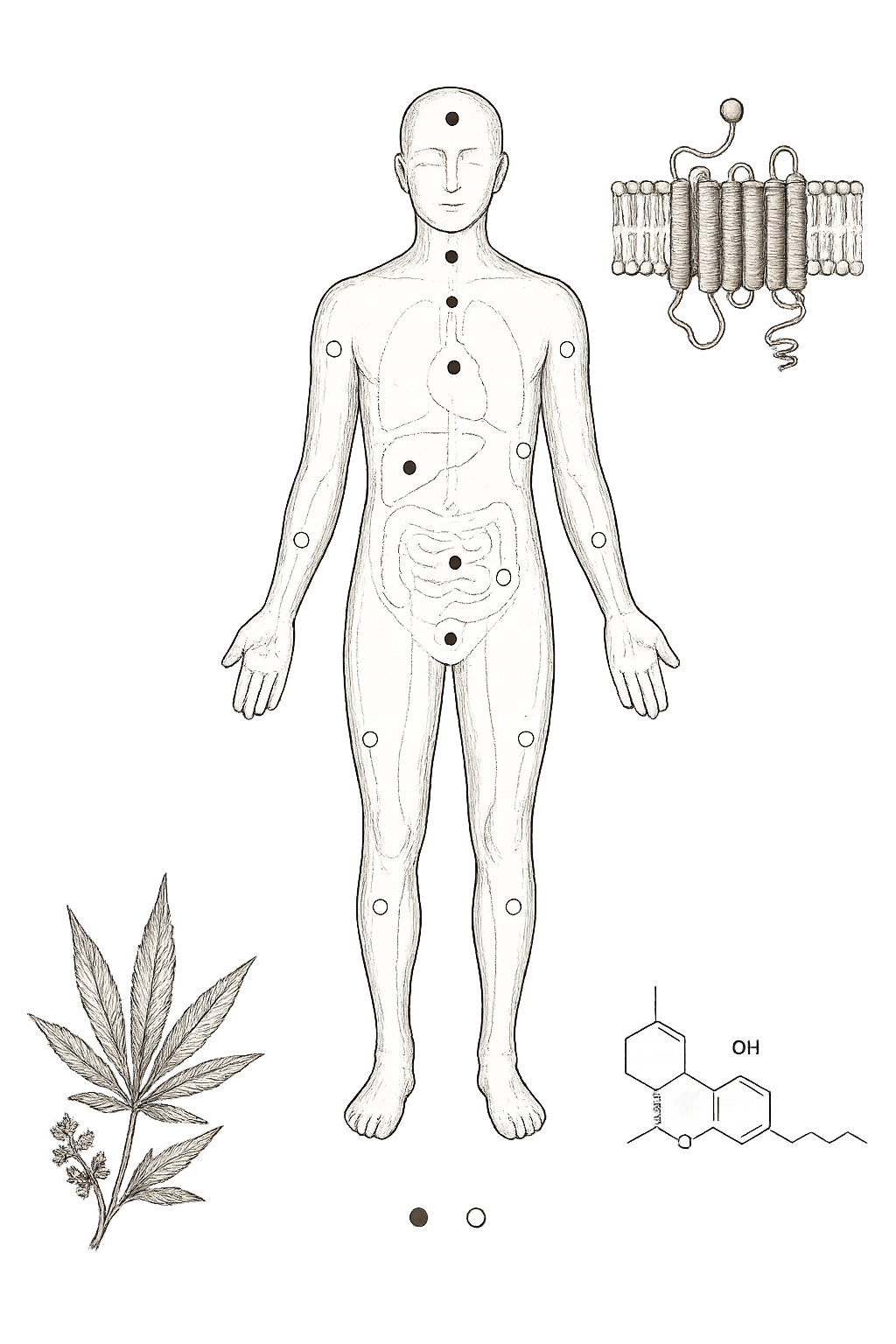
The body contains a signaling system that most people have never heard of, despite the fact that it has been influencing their biology every day of their lives. It is called the endocannabinoid system, and it was not identified by researchers until the early 1990s — which is part of why it remains unfamiliar even as it becomes one of the more actively studied areas of human physiology.
Understanding what it is and what it does is the foundation for understanding why cannabinoid research exists at all.


A System Built for Balance
The endocannabinoid system is not a single organ. It is a distributed signaling network — present throughout the brain, nervous system, immune tissue, and many peripheral organs — whose primary function is regulatory. It does not drive biological processes so much as it modulates them, adjusting the intensity and duration of signaling across systems in response to what the body needs moment to moment.
Researchers study the endocannabinoid system in relation to mood, stress response, appetite, immune signaling, sleep, memory, and pain. This breadth is not a sign that the system controls everything — it is a sign that regulatory feedback is needed everywhere, and this system helps provide it.
The technical term for what it maintains is homeostasis: the body's tendency to keep its internal environment within functional ranges despite changes in external conditions. The endocannabinoid system participates in that maintenance. It is one of several systems that do.
Three Components, One Cycle
The endocannabinoid system has three primary components that work together as a cycle.
Component 1
Endocannabinoids
Signaling molecules produced by the body on demand, when and where they are needed
Component 2
Receptors
Proteins on cell surfaces that receive endocannabinoid signals and adjust cellular activity in response
Component 3
Enzymes
Proteins that synthesize endocannabinoids when needed and break them down once they have done their work
What distinguishes this system from many other signaling systems is the on-demand nature of endocannabinoid production. Most neurotransmitters are synthesized in advance and stored until release. Endocannabinoids are produced at the moment they are required, used, and then rapidly broken down by enzymes. This rapid turnover allows for precise, localized regulation — the body can adjust signaling in one circuit without necessarily affecting others.
The Two Primary Endocannabinoids
The two most extensively studied endocannabinoids are anandamide and 2-arachidonoylglycerol, commonly abbreviated as 2-AG. Both are lipid-based signaling molecules derived from fatty acids in cell membranes. Both act on cannabinoid receptors, though with different affinities and in different contexts.
Anandamide was identified first, in 1992, and named after the Sanskrit word for bliss — a name that reflects the enthusiasm of early researchers rather than a clinical claim about its effects. 2-AG is present in the brain at much higher concentrations than anandamide and appears to be the primary endogenous ligand at CB1 receptors under many conditions. Their roles are complementary and still being characterized.
CB1 and CB2 Receptors
The two primary cannabinoid receptors identified in humans are CB1 and CB2. CB1 receptors are concentrated in the central nervous system — in brain regions involved in emotional regulation, stress response, memory, and motor control. CB2 receptors are more prevalent in immune cells and peripheral tissues, though they are also present in the nervous system. Neither receptor type is confined to these locations, and research continues to identify additional receptor systems — including GPR55 and TRPV1 — through which endocannabinoids and plant cannabinoids may act.
Receptors do not switch systems on or off. They modulate the intensity of ongoing signaling. When an endocannabinoid binds to a receptor, it adjusts what that cell is doing — it does not issue a new command from outside. That distinction matters for understanding what cannabinoid research can and cannot show.
Enzymes: Closing the Loop
After endocannabinoids have delivered their signal, enzymes break them down. Fatty acid amide hydrolase — FAAH — degrades anandamide. Monoacylglycerol lipase — MAGL — degrades 2-AG. This enzymatic breakdown terminates the signal and recycles the molecular components. FAAH has received particular research attention because inhibiting it — slowing anandamide breakdown — increases anandamide availability, which some researchers have investigated as an approach to supporting endocannabinoid tone in stress and anxiety contexts.
Where Plant Cannabinoids Enter
Phytocannabinoids — compounds produced by the cannabis and hemp plant — can interact with cannabinoid receptors because they are structurally similar enough to endocannabinoids to bind to the same sites. THC binds with high affinity to CB1 receptors, which produces its intoxicating effects. CBD interacts with the system through multiple mechanisms and does not produce intoxication. CBG, whose acidic precursor is the parent molecule of the entire cannabinoid family, has a distinct pharmacological profile — interacting with both CB1 and CB2 receptors as well as alpha-2 adrenoceptors and GABA reuptake mechanisms in ways that have recently become the subject of controlled human research.
Plant cannabinoids do not replicate endogenous signaling exactly. Their effects depend on receptor affinity, dosage, individual biology, and the broader chemical context of the preparation. The endocannabinoid system evolved independently of plant cannabinoids — it functions whether or not they are present. Plant cannabinoids interact with a system that already exists and already has its own regulatory logic.
A note on proportionality
The endocannabinoid system is sometimes described in popular writing as a kind of master controller — a universal explanation for why cannabinoids work. Research describes it more carefully: a modulatory signaling network involved in maintaining physiological balance. It participates in regulation. It does not fix systems, override biology, or produce outcomes independently of the broader physiological context in which it operates.
The endocannabinoid system is a real, well-documented biological network with a genuine regulatory role across multiple physiological domains. Its identification is relatively recent — the early 1990s — which means the research is still developing and the picture is still becoming clearer. Understanding its basic architecture is the starting point for reading cannabinoid research intelligently, which is what this archive is designed to support.
The articles below go deeper into specific components and the systems they interact with.
These statements have not been evaluated by the Food and Drug Administration. J.P. Hemp Company products are not intended to diagnose, treat, cure, or prevent any disease.