Understanding — Hemp, Cannabis & The Plant
Hemp and Cannabis: A Botanical and Legal Distinction
Hemp and marijuana come from the same plant species — what makes them legally and practically different, and why that distinction matters.
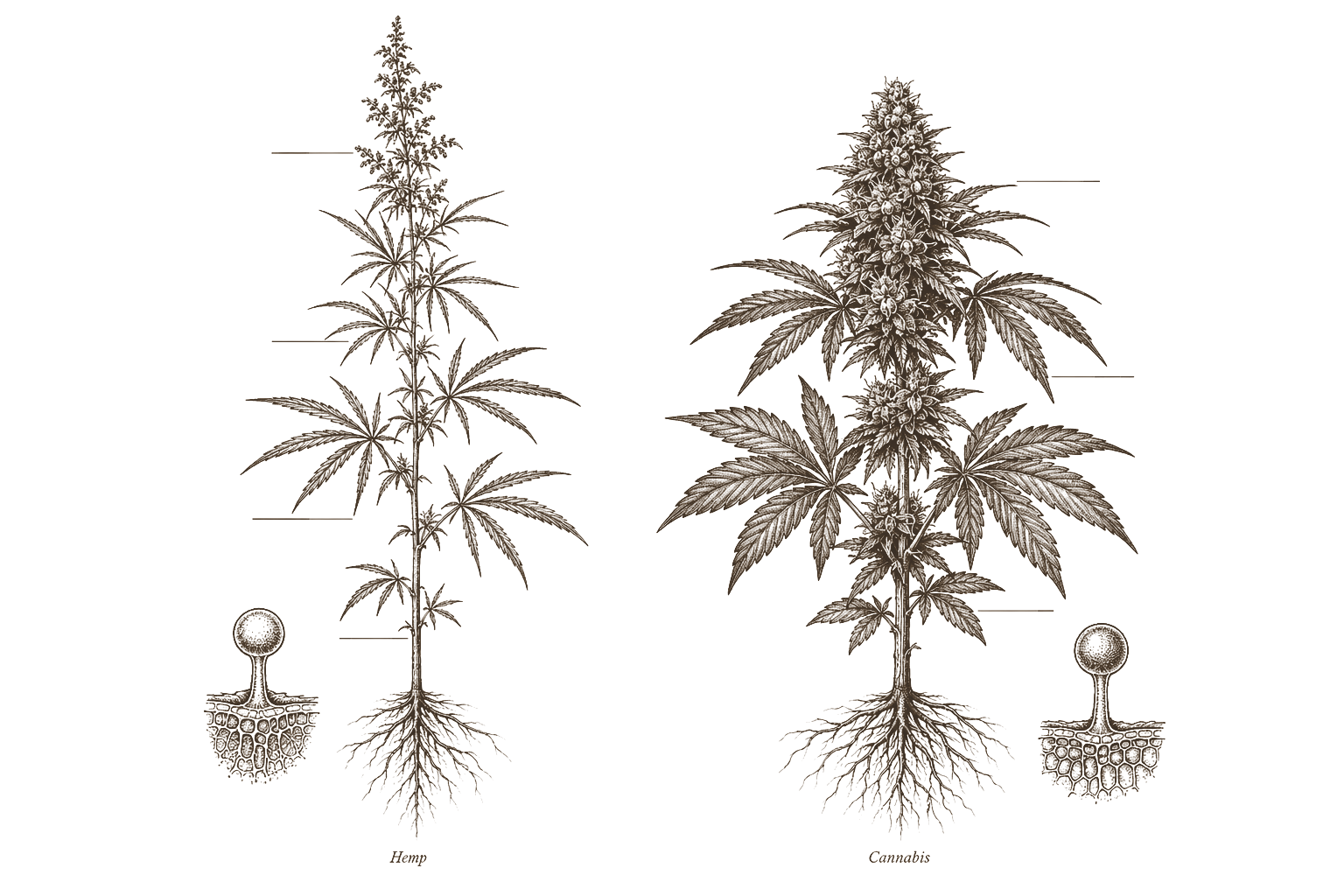
Hemp and cannabis are the same plant. That sentence is the foundation for understanding everything else in this pillar accurately — and it is the sentence most popular accounts of the hemp industry omit or obscure.
The distinction between hemp and cannabis is legal and chemical, not botanical. It was drawn by legislators, not taxonomists. Understanding where it comes from, what it means precisely, and what it does not mean is the prerequisite for reading any claim about hemp preparations honestly.


The Botanical Reality
Cannabis sativa L. is the scientific name for the plant species that includes both hemp and what is legally classified as cannabis or marijuana. It is a single species — annual, flowering, producing seeds — that has been cultivated by human societies for thousands of years across a remarkable range of uses: fiber from the stalks, oil from the seeds, and preparations from the flowers and leaves.
Botanists recognize subspecies and chemotypes within Cannabis sativa — variations in morphology, growth habit, and chemical expression that have been shaped by centuries of cultivation in different environments for different purposes. Fiber hemp cultivars grew tall and thin, optimized for stalk yield. Drug-type cultivars were shorter, denser, selected for resinous flower production. But these are variations within a species, not separate species. The taxonomic record has never supported a clean botanical line between hemp and cannabis.
What produces the high-THC expression that makes some cannabis plants intoxicating and others not is a matter of genetics and cultivation — specifically, which enzymes are expressed at which steps in the CBGA biosynthesis pathway. A plant that expresses more THCA synthase produces more THC. A plant bred to express more CBDA synthase produces more CBD. The underlying chemistry is the same plant running different genetic programs.
The Legal Definition
In the United States, the legal distinction between hemp and cannabis was formalized by the Agriculture Improvement Act of 2018 — commonly called the 2018 Farm Bill. The definition is chemical and quantitative: hemp is Cannabis sativa L. with a Δ9-THC concentration at or below 0.3% on a dry weight basis. Cannabis exceeding that threshold remains a Schedule I controlled substance under federal law.
Legal Classification
Hemp
Cannabis sativa L. containing 0.3% or less Δ9-THC by dry weight. Federally legal agricultural commodity under the 2018 Farm Bill. Subject to USDA regulation, state licensing, and testing requirements.
Threshold: ≤ 0.3% Δ9-THC
Legal Classification
Cannabis / Marijuana
Cannabis sativa L. containing more than 0.3% Δ9-THC by dry weight. Remains a Schedule I controlled substance under federal law. State laws vary significantly — some states have legalized for medical or recreational use.
Threshold: > 0.3% Δ9-THC
The 0.3% threshold is a regulatory convention, not a biological boundary. It does not correspond to a natural break in how Cannabis sativa expresses THC across cultivars. It was drawn at a level considered commercially unviable for intoxicating use and practically achievable through selective cultivation — a workable line for regulatory purposes rather than a reflection of any underlying botanical distinction.
Why this matters for reading hemp research
Research conducted on high-THC cannabis — which constitutes a large portion of the published cannabinoid literature — is not directly applicable to hemp-derived preparations. The compounds present, their concentrations, and their interactions differ between a high-THC cultivar and a hemp cultivar. When a study uses "cannabis" as its preparation, the findings describe that preparation — not hemp preparations in general. The botanical identity is shared; the chemical composition and research applicability are not.
Historical and Agricultural Context
Hemp cultivation predates the legal distinction by millennia. Archaeological evidence places cannabis fiber use in China as early as 10,000 years ago. Hemp was a major agricultural commodity in colonial America — George Washington and Thomas Jefferson both cultivated it, primarily for fiber. The U.S. government promoted hemp cultivation during World War II for rope and canvas production. The prohibition of cannabis that followed in the mid-twentieth century made no botanical distinction; hemp cultivation was effectively ended alongside drug-type cannabis cultivation, and the agricultural knowledge accumulated over centuries was largely abandoned in the United States for several decades.
The 2018 Farm Bill's hemp legalization was in part a restoration of an agricultural tradition interrupted by policy rather than by any change in the plant itself. The cultivars being grown today for CBD and CBG production are the product of selective breeding programs that accelerated rapidly after legalization — producing plants expressing very different cannabinoid profiles than their predecessors, but still Cannabis sativa L. in every meaningful botanical sense.
State Law Context
Federal legalization of hemp does not override state authority. State regulations governing hemp cultivation, processing, and retail vary, and some states have additional restrictions beyond the federal framework. Hemp-derived CBD and CBG products that are federally compliant may face additional state-level requirements depending on where they are sold or shipped. The regulatory landscape continues to evolve as states update their frameworks following federal legalization. This is legal context, not legal advice — specific compliance questions belong with qualified counsel familiar with the applicable jurisdiction.
Hemp is cannabis grown under conditions that keep THC below a regulatory threshold. That framing — precise, agricultural, legally accurate — is more useful than the cultural shorthand that treats them as categorically different plants. The shared botanical identity is why cannabinoid research conducted on Cannabis sativa is relevant to hemp preparations. The chemical differences introduced by cultivation are why that research can't be applied indiscriminately across all cannabis preparations. Both things are true, and holding them together is what reading this field accurately requires.
References
- Agricultural Improvement Act of 2018 (2018 Farm Bill), Pub. L. 115-334. Defines hemp as Cannabis sativa L. with ≤0.3% Δ9-THC on a dry weight basis.
- Small, E. (2015). Evolution and classification of Cannabis sativa (marijuana, hemp) in relation to human utilization. Botanical Review, 81(3), 189–294.
- Andre, C.M., Hausman, J.F., & Guerriero, G. (2016). Cannabis sativa: the plant of the thousand and one molecules. Frontiers in Plant Science, 7, 19.
- Sawler, J., Stout, J.M., Gardner, K.M., et al. (2015). The genetic structure of marijuana and hemp. PLOS ONE, 10(8), e0133292.
- United States Department of Agriculture. (2020). Establishment of a domestic hemp production program. Federal Register, 85(163).
These statements have not been evaluated by the Food and Drug Administration. J.P. Hemp Company products are not intended to diagnose, treat, cure, or prevent any disease.