Understanding — Hemp, Cannabis & The Plant
The Hemp Plant: Cultivation, Harvest, and Extraction
How hemp is grown, harvested, and turned into a preparation — and how those choices affect what ends up in the final product.
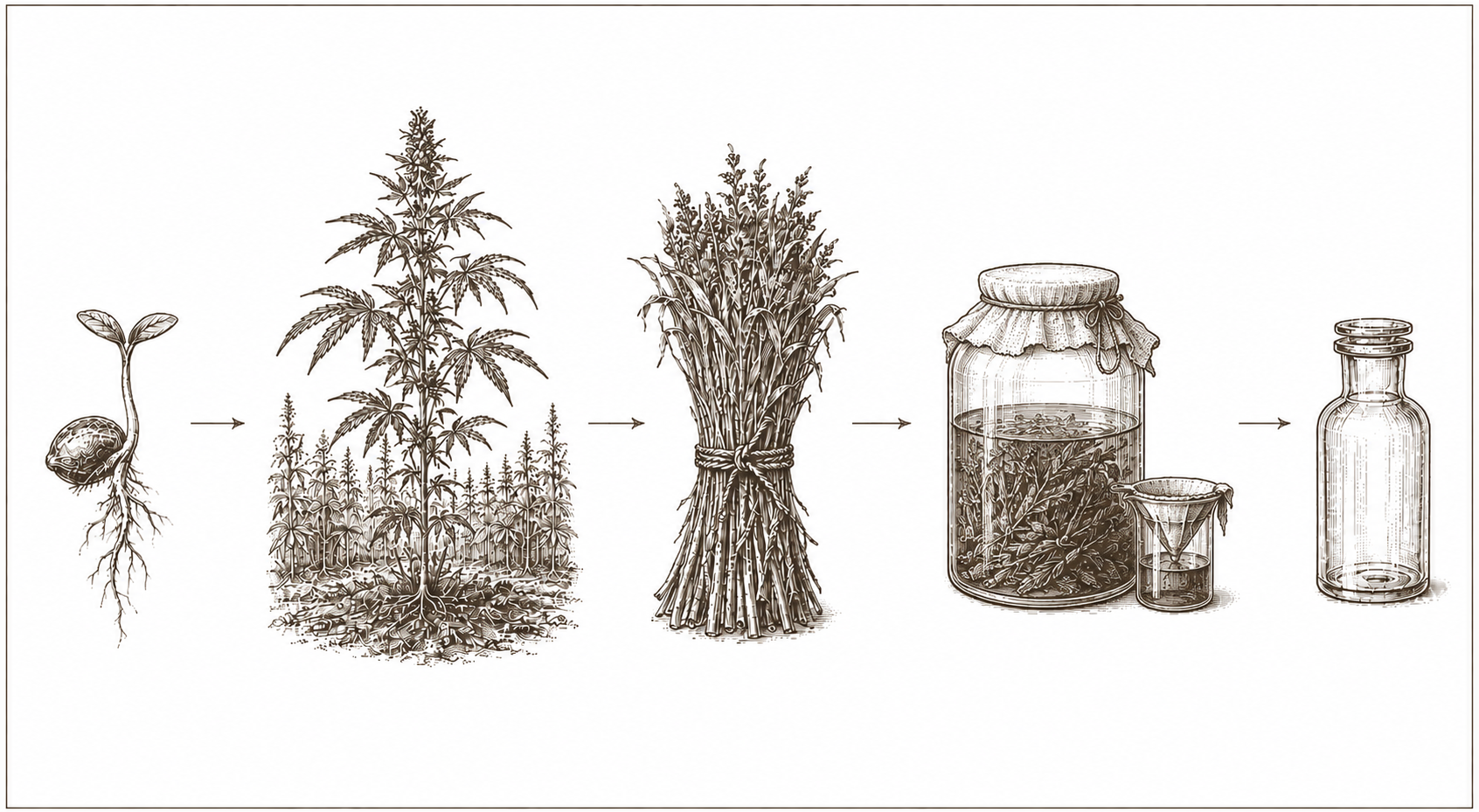
A hemp preparation begins in the ground, not in a laboratory. The compounds that eventually appear in a tincture or an infused oil were synthesized by a living plant in response to its environment — to the biology of the soil beneath it, the light above it, the temperature and water available to it, and the genetic program expressed by the specific cultivar planted. Extraction preserves what cultivation produced. It cannot improve on it.
Understanding how hemp moves from seed to finished preparation clarifies why cultivation decisions and extraction method are both preparation decisions — not processing steps that happen after the important work is done.


The Soil: Where Cannabinoid Expression Begins
Hemp is a demanding crop in one specific respect: it is a bioaccumulator. The plant draws compounds from the soil it grows in with unusual efficiency — which means healthy soil produces clean, well-expressed plant material, and compromised soil produces plant material that reflects those compromises. Heavy metals, residual agricultural chemicals, and biological imbalances in the soil do not stay in the soil when hemp is growing in it. They move into the plant.
This is why soil health is the first agricultural consideration for a producer whose preparations will be consumed rather than processed industrially. Organic matter content, microbial diversity, pH balance, and drainage all influence how the plant's root system functions and how efficiently it accesses the mineral nutrition that enzymatic processes — including cannabinoid synthesis — depend on. A plant growing in biologically active, well-structured soil has access to a more complete nutritional environment than one growing in depleted or chemically managed ground. That difference is expressed in the plant's secondary compound profile, including its cannabinoids and terpenes.
Hemp as a soil indicator
Hemp's bioaccumulation capacity has been studied as a tool for phytoremediation — using the plant to draw contaminants out of polluted soils. This is an agricultural application, not a criticism of hemp as a crop. But it is the reason that third-party testing for heavy metals and agricultural residues is not optional for preparations intended for consumption. Clean cultivation and independent laboratory verification are two stages of the same commitment to what ends up in the finished preparation.
Cultivation: Season, Light, and Sexing the Crop
Hemp grown for cannabinoid production is cultivated very differently from hemp grown for fiber or seed. Cannabinoid-rich hemp is grown from feminized seed or clonal starts — female plants, because it is the unfertilized female flower that produces the highest concentration of resinous trichomes where cannabinoids and terpenes are concentrated. Male plants, if present in the field, pollinate females and redirect the plant's energy toward seed production rather than resin. Managing for a female-only crop is the primary cultivation discipline specific to cannabinoid hemp.
Hemp is a photoperiod plant — its transition from vegetative growth to flowering is triggered by day length. As summer days shorten, the plant shifts its metabolic priority from leaf and stalk growth to flower development. The timing and duration of this transition, combined with the cultivar's genetic program, shapes both the cannabinoid profile and the terpene expression of the mature flower. Harvest timing — catching the plant at peak trichome development before cannabinoid degradation begins — is one of the most consequential decisions in the cultivation season.
Harvest and Post-Harvest Handling
Hemp flower is harvested by hand or mechanically and then dried and cured before extraction. The drying process removes moisture while preserving the volatile terpene compounds that contribute to the plant's aromatic profile and full-spectrum character. Drying temperature and airflow matter: too much heat accelerates terpene loss; inadequate airflow creates conditions for mold development. Curing — a controlled rest period after initial drying — allows remaining moisture to equalize throughout the plant material and permits continued enzymatic activity that can refine the terpene profile.
Properly dried and cured hemp flower is stable for extraction. Improperly handled material — harvested too early, dried too fast, stored in conditions that permit moisture reabsorption — carries those compromises into whatever is extracted from it.
Soil Preparation
Biological activity, organic matter, pH, and drainage established before planting. Soil quality determines what the plant can access and what it accumulates.
Cultivation Season
Feminized crop managed through vegetative and flowering phases. Photoperiod triggers the transition to flower development. Cultivar genetics and environmental conditions shape cannabinoid and terpene expression.
Harvest
Timed to peak trichome development. The window between peak expression and the onset of cannabinoid degradation is narrow — harvest timing is a primary quality decision.
Drying and Curing
Controlled moisture removal at temperatures that preserve terpene integrity. Curing stabilizes the dried material and allows the compound profile to settle before extraction.
Extraction
Solvent or infusion method carries cannabinoids and accompanying compounds from plant material into the finished preparation. Extraction method shapes what is retained and what is lost.
Testing and Standardization
Third-party analytical verification of cannabinoid content and contaminant screening. Standardization ensures labeled concentrations reflect measured content across batches.
Extraction as the Final Agricultural Step
Extraction is the bridge between the plant and the preparation — the step that carries what cultivation and harvest produced into the form that reaches a consumer. The choice of extraction method determines which of the plant's compounds are captured and in what proportions. Ethanol's amphiphilic chemistry — its ability to interact with both fat-soluble and water-soluble compounds — makes it suited to full-spectrum preservation. Oil infusion captures fat-soluble compounds through gentle heat and time. CO₂ extraction is efficient and selective, suited to producing concentrated cannabinoid outputs with minimal co-extraction of other plant constituents.
What extraction cannot do is recover compounds that cultivation failed to produce or that post-harvest handling degraded. The quality ceiling for any extraction is set by the plant material entering it. This is the agricultural logic that makes cultivation the first preparation decision rather than the last agricultural step: the choices made in the field determine the range of what extraction can preserve.
A hemp preparation is the accumulated result of decisions made at every stage from soil preparation through extraction. That chain of decisions is not visible in a finished bottle — but it is present in what the bottle contains. Understanding it is part of reading any preparation claim accurately, and part of why the questions worth asking about a hemp product begin with how it was grown, not only what it contains.
References
- Cherney, J.H., & Small, E. (2016). Industrial hemp in North America: production, politics and potential. Agronomy, 6(4), 58.
- Andre, C.M., Hausman, J.F., & Guerriero, G. (2016). Cannabis sativa: the plant of the thousand and one molecules. Frontiers in Plant Science, 7, 19.
- Amaducci, S., Zatta, A., Raffanini, M., & Venturi, G. (2008). Characterisation of hemp (Cannabis sativa L.) roots under different growing conditions. Plant and Soil, 313(1–2), 227–235.
- Fischedick, J.T., Hazekamp, A., Erkelens, T., Choi, Y.H., & Verpoorte, R. (2010). Metabolic fingerprinting of Cannabis sativa L., cannabinoids and terpenoids for chemotaxonomic and drug standardization purposes. Phytochemistry, 71(17–18), 2058–2073.
- Rheay, H.T., Omondi, E.C., & Brewer, C.E. (2021). Potential of hemp (Cannabis sativa L.) for paired phytoremediation and bioenergy production. GCB Bioenergy, 13(4), 525–536.
These statements have not been evaluated by the Food and Drug Administration. J.P. Hemp Company products are not intended to diagnose, treat, cure, or prevent any disease.