Understanding — The Endocannabinoid System
Anandamide and the Stress Response
How one of the body's own cannabinoid molecules interacts with the stress response, and what research has found about what happens when that system is disrupted.
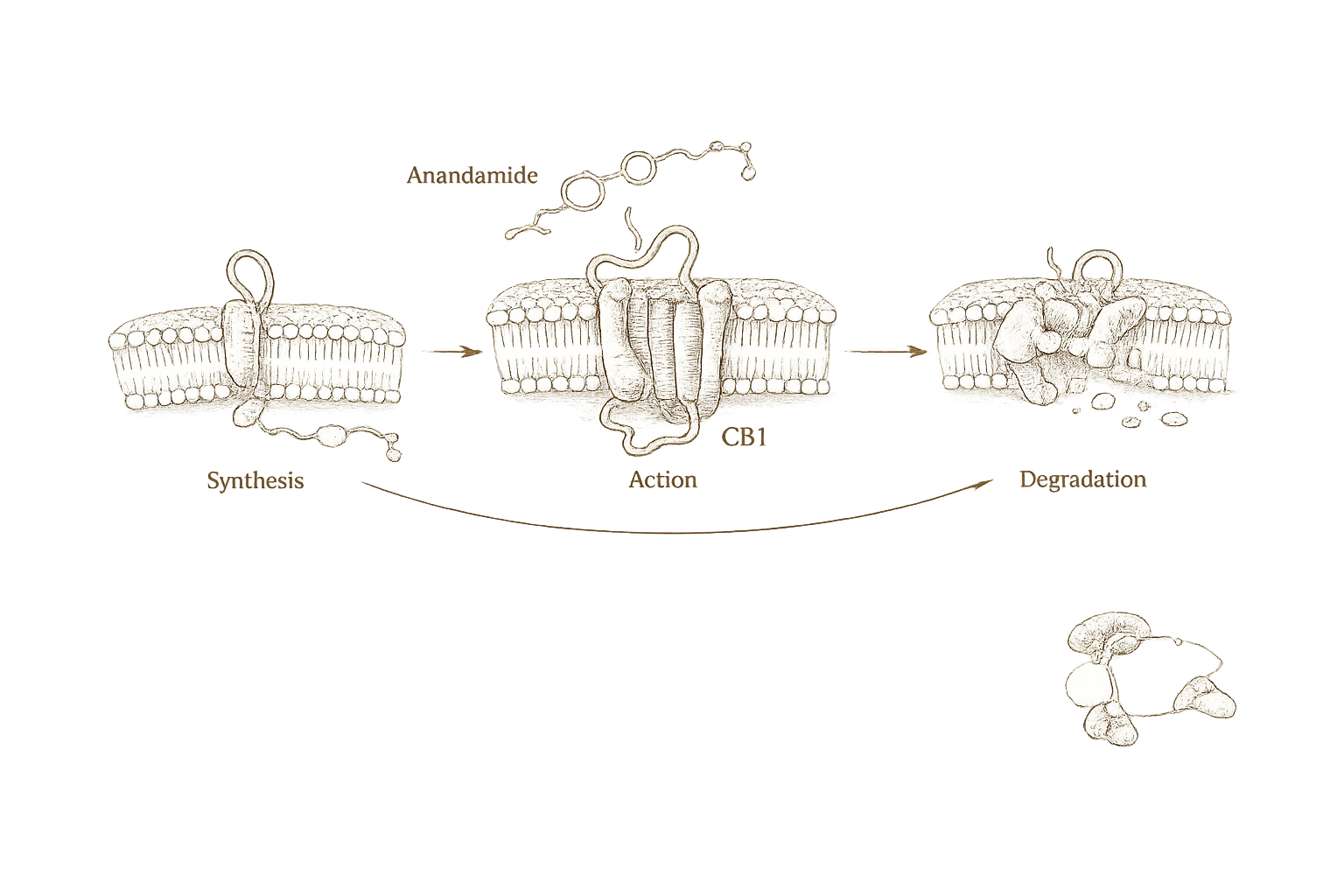
Of the body's two primary endocannabinoids, anandamide is the one most consistently studied in relation to stress. Not because 2-AG is uninvolved — it is — but because anandamide's distribution, its vulnerability to rapid enzymatic degradation, and its documented interactions with the stress response system have made it a focus of research into why some people recover from stressors more readily than others.
What that research shows is specific and, in places, still provisional. This article covers what is established, where the evidence is still developing, and why anandamide's behavior under stress has become part of the rationale for cannabinoid research in this domain.


Anandamide's Position in the Stress System
The body's central stress coordination pathway is the HPA axis — the hypothalamic-pituitary-adrenal axis. When a threat is perceived, the hypothalamus signals the pituitary gland, which signals the adrenal glands to release cortisol. Cortisol mobilizes energy, sharpens attention, and prepares the body for response. A negative feedback loop is supposed to bring cortisol back to baseline once the threat has passed, suppressing further HPA activation.
Anandamide participates in that feedback loop. CB1 receptors are expressed in the hypothalamus, the amygdala, and the prefrontal cortex — three regions central to stress detection, emotional response, and HPA axis regulation respectively. When anandamide binds to CB1 receptors in these regions, it modulates the intensity and duration of the stress response. In animal models, higher anandamide availability has been associated with more efficient stress recovery — a faster return to baseline after a stressor resolves. Lower availability has been associated with slower recovery and more persistent stress activation.
Anandamide in the HPA Axis Feedback Loop
What Happens to Anandamide Under Stress
The relationship between acute stress and anandamide levels is not simple or uniform. Research — primarily from animal models, with some human data — has shown that anandamide levels can fluctuate during and after stress exposure, but the direction and magnitude of those fluctuations depend on the type of stressor, its duration, the brain region being examined, and the individual biological context.
Some animal studies have found acute reductions in anandamide following stress exposure, consistent with the idea that the stress response suppresses endocannabinoid signaling transiently. Others have found compensatory increases in certain regions following repeated stress — a pattern that might represent the system attempting to restore equilibrium after chronic activation. The picture is not a clean linear relationship. It is a dynamic and context-dependent one.
What the research does suggest more consistently is that chronically low endocannabinoid tone — sustained low anandamide availability over time — is associated with heightened stress reactivity, increased anxiety-adjacent behavior, and impaired stress recovery. This has been documented across multiple animal models and is supported by human genetic research examining variants in the FAAH gene, the enzyme responsible for anandamide degradation.
FAAH, Anandamide Tone, and Individual Variation
Anandamide's availability at any given moment depends partly on how quickly FAAH — fatty acid amide hydrolase — breaks it down. Individuals with genetic variants that reduce FAAH activity tend to have higher circulating anandamide levels. Research examining these variants has found associations with reduced amygdala reactivity to threatening stimuli and lower trait anxiety — findings that provide some of the strongest human evidence for anandamide's role in stress and emotional regulation, even though they come from genetic association studies rather than intervention trials.
The logic that follows from this research — that supporting anandamide availability might support stress resilience — is what has driven interest in both FAAH inhibition as a pharmacological strategy and in plant cannabinoids that interact with the endocannabinoid system's stress-related circuits. It is a plausible and biologically coherent line of investigation. It is not, on its own, clinical evidence that any particular intervention works.
The gap between mechanism and outcome
The FAAH genetic research provides human evidence that endocannabinoid tone is relevant to stress reactivity. It does not establish that interventions designed to raise anandamide levels will reliably reduce stress in clinical populations. Genetic association findings and intervention trial findings are different kinds of evidence — both informative, neither substitutable for the other.
Not the Bliss Molecule — A More Accurate Description
Anandamide is frequently described in popular media as the body's "bliss molecule" — a characterization that emerged from its Sanskrit name and from early research associating it with pleasure and reward. The characterization is not wrong exactly, but it is incomplete in ways that matter for reading stress research accurately.
Anandamide is involved in mood and reward, but it is also involved in appetite regulation, pain modulation, immune function, neuroprotection, and — as this article has described — the regulation of the stress response. It is a broad-spectrum signaling molecule whose effects depend substantially on where it acts, when, and at what concentration. Describing it as the bliss molecule flattens a complex regulatory role into a single emotional association and implies a kind of direct mood control that the biology does not support.
In stress research specifically, anandamide is better understood as a modulator of stress system intensity and recovery — one input into a multi-system response — than as a molecule that produces wellbeing independently of context.
The Bridge to Cannabinoid Stress Research
Understanding anandamide's role in the stress response provides the biological foundation for understanding why cannabinoid research in the stress domain has developed the way it has. The endocannabinoid system is genuinely involved in stress regulation — not as a metaphor, but as a documented physiological participant. Anandamide's interactions with CB1 receptors in HPA axis circuitry, its vulnerability to degradation under stress conditions, and the individual variation in FAAH activity that produces measurable differences in stress reactivity — these are the mechanistic threads that researchers have followed toward human trials.
CBG's alpha-2 adrenoceptor agonism and GABA reuptake inhibition represent a pharmacological profile that intersects with this stress biology through different mechanisms than direct CB1 agonism. The Cuttler et al. (2024) trial — the first randomized controlled trial of CBG in healthy humans — documented statistically significant reductions in acute stress and anxiety at a single 20mg dose. That trial did not measure anandamide directly. But the mechanistic context that makes the finding worth taking seriously is the one this article has described.
What the Understanding pillar is for
This article establishes mechanism. The Health Topics articles — CBG and Stress Regulation, CBG and Anxiety — establish what human trials have actually found. Mechanism provides the rationale for investigation. Trials provide the evidence. The two are related but not the same. Readers who want the clinical picture should follow the cross-links below.
Anandamide is not a stress-relief molecule in any simple sense. It is a short-lived, context-sensitive signaling molecule that participates in the body's stress response system — modulating the intensity and duration of HPA axis activation and contributing to the feedback processes through which the system returns to baseline.
The research connecting anandamide tone to stress reactivity is real, growing, and not yet complete. It is also precisely the research that gives cannabinoid stress investigations their biological grounding — rather than their commercial appeal.
These statements have not been evaluated by the Food and Drug Administration. J.P. Hemp Company products are not intended to diagnose, treat, cure, or prevent any disease.