Understanding — The Endocannabinoid System
Full-Spectrum, Broad-Spectrum, and Isolate: What the Terms Actually Mean
Three different ways of preparing hemp — what each one contains, how they differ, and why the distinction matters for reading research and product labels.
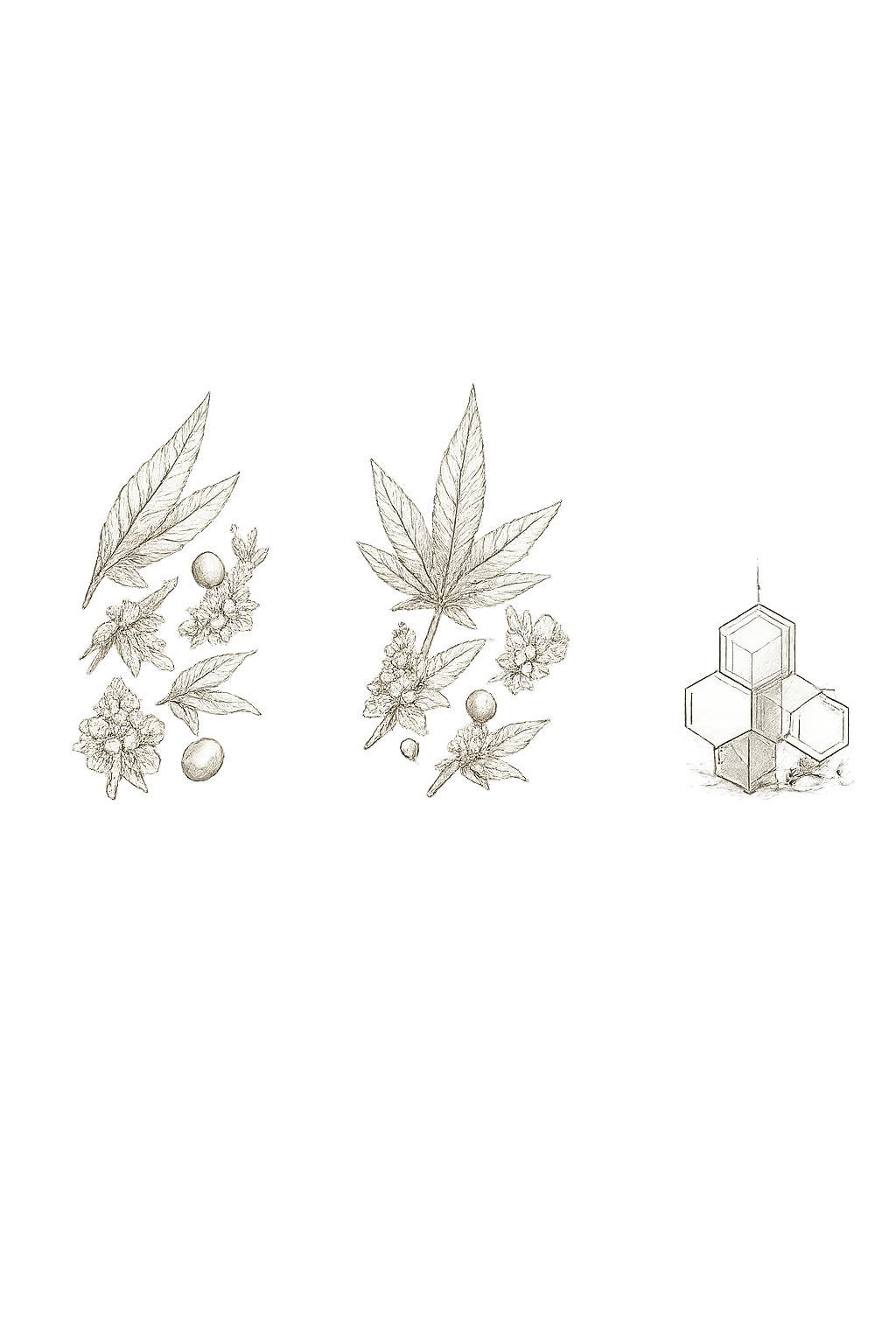
Hemp is a chemically complex plant. In the field it develops cannabinoids, terpenes, flavonoids, and other secondary compounds through interconnected biosynthetic pathways. After harvest, preparation method determines how much of that natural complexity is carried forward into the finished product.
Full-spectrum, broad-spectrum, and isolate are preparation terms. They describe how much of the plant's original chemistry is retained, selectively adjusted, or separated during processing. They do not describe clinical outcomes, and they do not rank preparations by quality. Understanding what they mean precisely is the prerequisite for reading claims about them accurately.


The Three Categories
These terms emerged as extraction methods became more precise and the industry needed language to distinguish preparation approaches. They describe compositional architecture — the range of compounds present in a finished preparation — not potency, purity in the sense of quality, or therapeutic value.
Category 1
Full-Spectrum
Retains the representative range of naturally occurring compounds present in the plant — cannabinoids, terpenes, flavonoids, and other botanical constituents — within regulatory THC limits. Extraction shifts proportions relative to raw flower; full-spectrum describes compositional breadth, not unprocessed material.
Defining feature: broad retention
Category 2
Broad-Spectrum
Begins as a multi-compound extract and undergoes additional refinement to remove or reduce specific constituents — most commonly Δ9-THC — while attempting to preserve other cannabinoids and terpenes. The result is still multi-compound, but selectively adjusted.
Defining feature: selective removal
Category 3
Isolate
A single purified compound separated from the broader plant matrix through repeated refinement and crystallization. Contains one identified cannabinoid. Does not carry the broader compositional character of the plant. Standardized to chemical singularity.
Defining feature: chemical singularity
What Full-Spectrum Does and Doesn't Mean
Full-spectrum is the most frequently misunderstood of the three terms. It does not mean identical to raw flower — extraction unavoidably shifts compound ratios, and post-extraction handling introduces further variation. What it signals is that the preparation was designed and processed to retain the plant's natural range of compounds rather than narrow it toward a single molecule or a selectively reduced profile.
The composition of a full-spectrum preparation is not fixed or standardized across producers. It reflects the cultivar's genetics, the growing conditions, harvest timing, extraction method, and handling — all of which vary. Two full-spectrum preparations from different producers can have meaningfully different compound profiles even if both are accurately described with the same term.
What shapes full-spectrum composition
Cultivar genetics determine which cannabinoids are present and in what ratios before harvest. Soil conditions, climate, and growing practices influence secondary compound expression throughout the plant's development. Harvest timing affects both cannabinoid maturity and terpene peak. Extraction method determines what the solvent captures. Post-extraction handling determines what survives intact. Full-spectrum is a description of preparation intent and architecture — not a guarantee of any specific compound profile.
The Entourage Effect Hypothesis
The scientific rationale frequently offered for full-spectrum over isolate preparations is the entourage effect — the hypothesis that cannabinoids, terpenes, and other plant compounds interact synergistically in ways that alter their combined biological activity relative to any single compound administered alone.
Russo (2011) is the foundational paper proposing this hypothesis. It makes a mechanistic argument based on receptor pharmacology and documented terpene-cannabinoid interactions — a review paper constructing a biological rationale rather than reporting trial results. The hypothesis is biologically plausible and internally coherent. The human clinical evidence supporting it as a consistent, predictable effect across preparations and populations is limited.
Holding the entourage hypothesis proportionately
The entourage effect is a legitimate scientific hypothesis with a documented mechanistic basis. It is not an established clinical finding. Studies examining whether multi-compound preparations produce reliably different outcomes from isolates in human populations — controlling for dose, bioavailability, and preparation quality — are limited in number and variable in findings. The hypothesis is worth taking seriously as a research question. It is not yet established well enough to function as a clinical claim.
Preparations marketed as full-spectrum that cite the entourage effect as their primary clinical rationale are making a stronger claim than the evidence currently supports. Preparations that explain full-spectrum as a compositional choice consistent with how the plant develops — without claiming proven synergistic superiority — are describing it accurately.
How These Terms Appear in Research
Cannabinoid research uses all three preparation types depending on the question being asked. Mechanistic studies examining receptor binding and signaling pathways typically use isolated compounds because clarity of attribution requires chemical singularity — if you want to know what CBD does at CB1, you need to study CBD alone. Preclinical and human studies examining therapeutic effects sometimes use full-spectrum or multi-compound extracts because they may better represent what people are actually consuming.
Why preparation type matters for reading research
A finding from a study using purified isolated CBD does not automatically apply to a full-spectrum preparation containing CBD alongside other compounds, and vice versa. The preparation used in a study is part of its methodology and limits the generalizability of its conclusions. When reading cannabinoid research, identifying whether the study used an isolate, a defined multi-compound formulation, or an uncharacterized whole-plant extract is one of the first steps in assessing what the findings actually show — and to whom they apply.
Preparation category alone does not determine biological outcome. Study design, dose, delivery method, population, and outcome measurement all matter. Preparation type is one variable among several.
Regulatory and Labeling Context
Preparation category intersects with regulatory requirements in ways that matter for transparency and compliance. THC thresholds apply regardless of preparation type — full-spectrum hemp preparations must remain within the federally permitted Δ9-THC limit. Broad-spectrum preparations undergo additional processing specifically to meet this threshold while preserving other compounds. Isolates contain no THC by definition.
Strength labeling on hemp preparations reflects cannabinoid concentration per bottle or per serving, not preparation category or preparation quality. A 1,000mg full-spectrum tincture and a 1,000mg isolate tincture are described by the same quantity label — the difference in what they contain is compositional, not quantitative. Understanding that distinction is part of reading labels accurately.
Full-spectrum, broad-spectrum, and isolate are structural descriptions. They tell you how a preparation was made and what range of compounds it contains. They do not, on their own, tell you how it will perform biologically, whether it is higher quality than an alternative, or whether it matches the needs of a specific research question or use context.
The entourage hypothesis gives full-spectrum preparations a biological rationale worth taking seriously. The clinical evidence behind that rationale is still developing. Both of those things are true simultaneously, and holding them together — rather than resolving the tension prematurely in either direction — is what reading this literature accurately requires.
References
- Russo, E.B. (2011). Taming THC: potential cannabis synergy and phytocannabinoid-terpenoid entourage effects. British Journal of Pharmacology, 163(7), 1344–1364.
- Andre, C.M., Hausman, J.F., & Guerriero, G. (2016). Cannabis sativa: the plant of the thousand and one molecules. Frontiers in Plant Science, 7, 19.
- Hazekamp, A., & Fischedick, J.T. (2012). Cannabis — from cultivar to chemovar. Drug Testing and Analysis, 4(7–8), 660–667.
- ElSohly, M.A., Radwan, M.M., Gul, W., Chandra, S., & Galal, A. (2017). Phytochemistry of Cannabis sativa L. Progress in the Chemistry of Organic Natural Products, 103, 1–36.
These statements have not been evaluated by the Food and Drug Administration. J.P. Hemp Company products are not intended to diagnose, treat, cure, or prevent any disease.