Understanding — How Cannabinoids Work
Cannabinoid Safety and Dosing: What Research Shows About Therapeutic Range
The safety profile of CBD and CBG is among the most studied aspects of cannabinoid pharmacology. Here is what the research record actually shows — including the honest answer to the question most people are asking.
Cannabinoid Safety and Dosing: What Research Shows About Therapeutic Range
The safety profile of CBD and CBG is among the most studied aspects of cannabinoid pharmacology. Here is what the research record actually shows — including the honest answer to the question most people are asking.
The question behind most questions about cannabinoid dosing is a simple one: is this safe? People ask about milligrams and serving sizes and how often to take something, but what they are usually trying to establish is whether they are in territory where harm is possible. That question deserves a direct answer, and the research record provides one — more clearly and reassuringly than most of the content written about this topic suggests.


The Safety Profile — What Research Has Established
CBD is among the most extensively studied cannabinoids in human trials, with a safety record that spans decades of research. The World Health Organization published a critical review of CBD in 2018 concluding that CBD is generally well-tolerated with a good safety profile, that it does not exhibit effects indicative of abuse or dependence potential, and that there is no evidence of recreational use or public health-related problems. This assessment has not been revised. The safety profile of CBD in human studies is one of the most consistent findings across the cannabinoid research literature.
CBG has a shorter human research history — the Cuttler et al. (2024) trial was the first double-blind placebo-controlled human trial of CBG's acute effects — but the safety data that exists is consistent with CBD's profile. In the Cuttler trial, 20mg oral CBG was well-tolerated across all 34 participants, with no adverse events that distinguished it from placebo in terms of safety signals. Preclinical toxicology studies of CBG have not identified concerning toxicity profiles at doses relevant to human use.
The absence of a lethal dose threshold in the human research record for CBD and CBG is not a gap in the data. It reflects a genuine pharmacological property of these compounds. Unlike opioids — which produce respiratory depression at elevated doses — or alcohol — which produces dose-dependent organ toxicity — cannabinoids like CBD and CBG do not act on the brainstem respiratory centers that govern breathing. The physiological mechanism for lethal overdose does not exist for these compounds in the same way it does for many other substances, including legal ones in common use.
When this archive states that CBD and CBG have well-established safety profiles, it is describing what peer-reviewed human research has found about adverse effects, tolerability, and dose-response in the doses and administration routes studied. It is not making a claim about any individual's response, which can vary based on body weight, metabolism, other medications, and individual physiology. And it is not a claim that these compounds are appropriate for everyone — people taking certain medications, people who are pregnant or breastfeeding, and people with specific health conditions should consult a healthcare provider before using cannabinoid preparations. This is the same standard of care that applies to any active botanical preparation.
Dose-Response: What Research Has Found
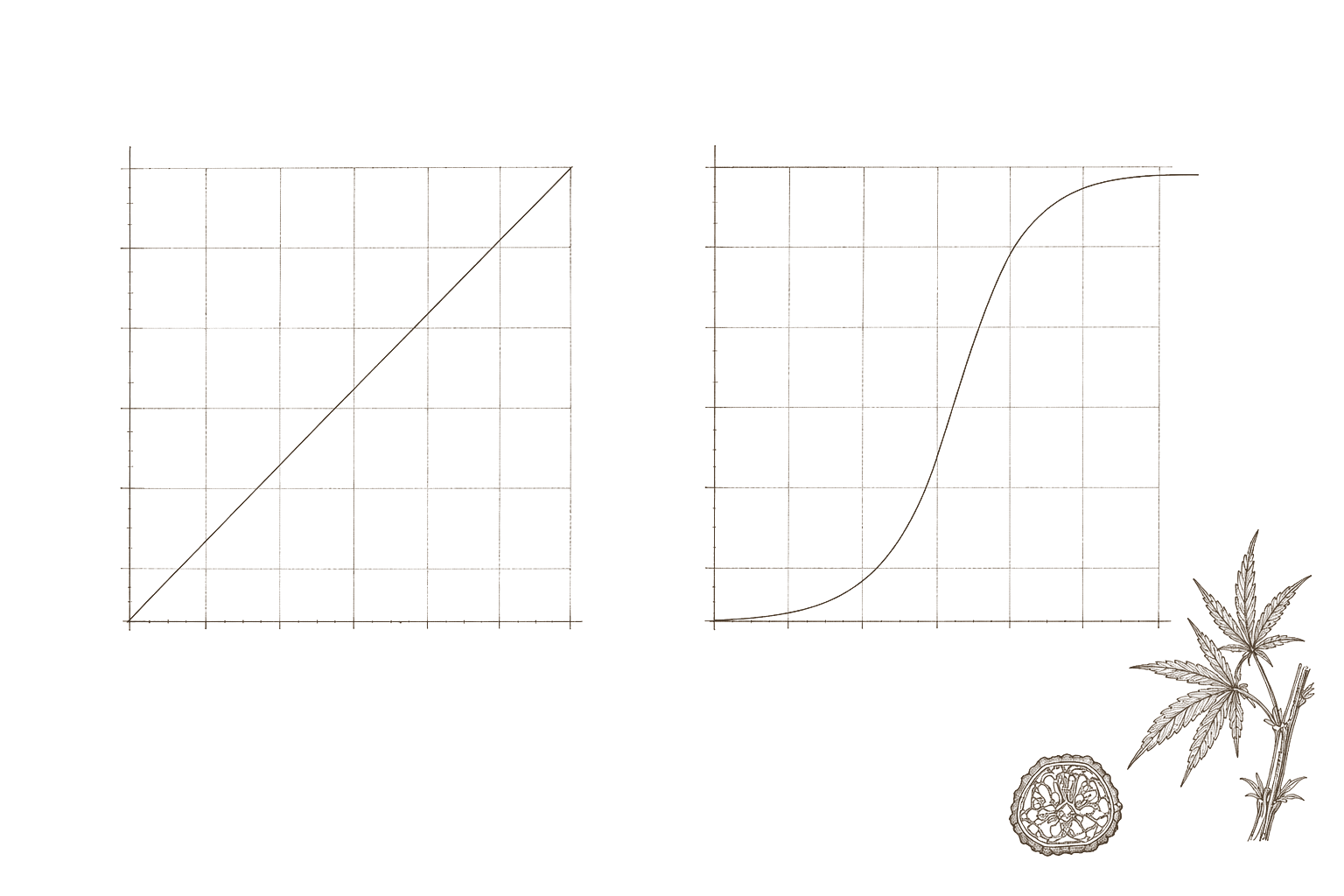
Dose-response research examines what happens as the amount of a compound increases — whether effects increase proportionally, plateau, reverse, or produce new effects at higher doses. For CBD and CBG, the dose-response picture is more complex than a simple linear relationship, and understanding that complexity helps explain why "more is not always better" is genuinely good advice rather than marketing caution.
CBD's dose-response relationship for anxiety, the most studied outcome domain, follows an inverted U shape in some research — moderate doses producing the largest effect, with both lower and higher doses showing reduced response. This pattern has been observed across several human studies and is consistent with CBD's multiple receptor mechanisms, some of which may produce opposing effects at different concentration ranges. The clinical implication is that finding an effective dose for an individual is not simply a matter of taking as much as possible.
For CBG, the dose-response research is limited by the available human data — the Cuttler (2024) trial used a single 20mg oral dose and did not examine dose-response across a range. The preclinical CBG literature suggests dose-dependent effects for several outcomes, but translating preclinical dose-response findings to human dosing is complicated by the significant bioavailability differences between animal models and human administration routes.
The single dose used in the Cuttler CBG trial — 20mg oral — is within the lower range of what many consumers use. The trial documented statistically significant anxiety and stress reduction at this dose in healthy adults. What this establishes: 20mg oral CBG is an active dose that produces measurable effects in a controlled research setting. What it does not establish: whether higher doses would produce stronger effects, whether lower doses would still be active, or what the optimal dose is for any specific individual or purpose.
Individual Variation — Why the Same Dose Affects People Differently
The most consistent finding in human cannabinoid dosing research is not a specific effective dose — it is the degree of individual variation in response. Two people taking identical preparations at identical doses can have substantially different experiences. Understanding why this happens is more practically useful than any specific milligram recommendation.
The primary sources of individual variation in cannabinoid response are metabolic: how quickly an individual's liver enzymes — particularly the CYP3A4 and CYP2C19 enzyme families — process cannabinoids affects both the concentration that reaches circulation and the duration of effect. People who are fast metabolizers may experience shorter, less pronounced effects at the same dose. Slow metabolizers may experience stronger, longer effects. Body composition affects distribution — cannabinoids are lipophilic and distribute into fatty tissue, which affects both peak concentration and duration of effect in people with different body composition. Gut microbiome differences affect absorption of oral preparations. And the endocannabinoid system's own baseline tone — which varies between individuals and fluctuates over time based on stress, sleep, and other factors — affects how a given dose interacts with the system it acts on.
None of these variables can be predicted from a milligram number on a label. This is why responsible cannabinoid use guidance consistently recommends starting with a lower dose and adjusting based on individual response — not because high doses are dangerous, but because individual variation is real and the most informative data point about what works for any individual is their own response to a moderate starting dose.
Administration Route and Effective Dose
The route of administration significantly affects what dose is actually required to produce a given response, because routes differ substantially in bioavailability — the proportion of a dose that reaches systemic circulation. Sublingual administration, which is the delivery route for tinctures held under the tongue, bypasses first-pass liver metabolism and delivers a higher proportion of the dose to circulation than swallowing the same amount. Swallowed oral preparations pass through the liver before reaching circulation, where first-pass metabolism reduces the effective dose significantly and converts some CBD to 11-hydroxy-CBD, a metabolite with its own pharmacological activity.
What this means practically: a dose that produces a noticeable response when held sublingually may require a larger nominal dose when swallowed to achieve a comparable systemic concentration. The milligram number on the label describes what is in the bottle — not what reaches your bloodstream, which depends on how you take it and on the individual metabolic variables described above.
Topical preparations operate through a separate and distinct mechanism — local action in skin tissue at the site of application — rather than systemic absorption. The dosing considerations for topical preparations are therefore different from ingestible preparations, and the two should not be compared directly on a milligram basis. The topical skin delivery article in the How Cannabinoids Work section of this archive addresses topical mechanisms in detail.
Drug Interactions — The Most Relevant Safety Consideration
For most people using CBD and CBG preparations, the safety consideration that matters most is not dose toxicity but drug interactions. CBD is a moderately potent inhibitor of certain cytochrome P450 liver enzymes — particularly CYP3A4 and CYP2D6 — that are responsible for metabolizing a significant number of pharmaceutical medications. When CBD inhibits these enzymes, medications that depend on them for metabolism can accumulate to higher plasma concentrations than expected at a given dose.
This is the same mechanism as the well-known grapefruit interaction with certain medications — grapefruit juice inhibits CYP3A4, and the same medications that carry grapefruit warnings are the ones most relevant to CBD interactions. If you are taking any medication that carries a grapefruit warning on its label, that is a signal to discuss CBD use with the prescribing physician before beginning.
CBG's CYP450 inhibition profile is less well-characterized than CBD's — the human research base is smaller. Caution with medications that are narrowly therapeutic-window compounds — anticoagulants, antiepileptics, certain cardiac medications — is appropriate regardless of which cannabinoid is being used, pending more complete pharmacokinetic data for CBG specifically.
This archive does not provide individual medical or pharmaceutical advice. If you are taking prescription medications — particularly for heart conditions, epilepsy, blood clotting, psychiatric conditions, or immunosuppression — the drug interaction question is the most important safety question to resolve before using cannabinoid preparations, and it should be resolved with the prescribing physician, not with product literature. The general safety profile of CBD and CBG does not eliminate the drug interaction consideration for people on relevant medications.
What This Means for Using J.P. Hemp Company Preparations
J.P. Hemp Company does not provide dosing guidance on its product labels or in its archive. This is a deliberate decision consistent with the archive's governance standards — the research does not support universal dosing recommendations because individual variation is too significant for a single number to be meaningfully accurate, and because dosing guidance without clinical context is not responsible for a general-audience product. What the preparations carry on their labels is the cannabinoid content — milligrams per bottle and milligrams per serving — which gives a user the information they need to start low, observe their own response, and adjust from there.
The preparations in the J.P. Hemp Company range are formulated at concentrations consistent with the doses used in the research literature — within the range where human studies have documented both safety and activity. They are not ultra-low doses that are unlikely to reach a pharmacologically active threshold, and they are not extreme doses that would place a user in territory without research support. The concentration decisions reflect the same research literacy that governs every other aspect of this archive.
Can you take too much CBD or CBG? In the sense of a dose that causes serious physiological harm — what toxicologists call acute toxicity — the research record does not establish such a threshold at doses anywhere near what preparations like these contain. The WHO's critical review of CBD and the broader human safety literature have not identified a lethal dose or a dangerous acute toxicity level at consumer-relevant doses.
In the sense of taking more than is useful — a dose that exceeds what your individual system responds to, or that conflicts with a medication you are taking — too much is a meaningful concept. The practical ceiling for most people is not a safety ceiling but an efficacy ceiling: a point at which more does not produce more benefit and may, for some outcomes and some people, produce less. Start with a moderate dose. Observe your own response. Adjust from there. That approach is more consistent with the research than any specific milligram recommendation this archive could offer.
If you are taking prescription medications, discuss cannabinoid use with your physician before beginning — not because the safety profile is generally concerning, but because the drug interaction question is specific to your medications and cannot be answered from general product literature.
References
- Bergamaschi MM, Queiroz RH, Zuardi AW, Crippa JA. Safety and side effects of cannabidiol, a Cannabis sativa constituent. Current Drug Safety. 2011;6(4):237-249.
- Cuttler C, Cooper ZD, Atkinson EJ, et al. Acute effects of cannabigerol on anxiety, stress, and mood: a double-blind, placebo-controlled, crossover trial. Scientific Reports. 2024;14(1):4516.
- Iffland K, Grotenhermen F. An update on safety and side effects of cannabidiol: a review of clinical data and relevant animal studies. Cannabis and Cannabinoid Research. 2017;2(1):139-154.
- Kaufmann R, Aqua K, Lombardo J. Observation of strain-specific dose-response curves in patients using botanical cannabis for anxiety management and related quality of life issues: a preliminary report. Medical Cannabis and Cannabinoids. 2021;4(1):17-27.
- Lim K, See YM, Lee J. A systematic review of the effectiveness of medical cannabis for psychiatric, movement and neurodegenerative disorders. Clinical Psychopharmacology and Neuroscience. 2017;15(4):301-312.
- Millar SA, Stone NL, Bellman ZD, Yates AS, England TJ, O'Sullivan SE. A systematic review of cannabidiol dosing in clinical populations. British Journal of Clinical Pharmacology. 2019;85(9):1888-1900.
- World Health Organization Expert Committee on Drug Dependence. Cannabidiol (CBD) Critical Review Report. Geneva: WHO; 2018.
- Zendulka O, Dovrtělová G, Nosková K, et al. Cannabinoids and cytochrome P450 interactions. Current Drug Metabolism. 2016;17(3):206-226.
These statements have not been evaluated by the Food and Drug Administration. J.P. Hemp Company products are not intended to diagnose, treat, cure, or prevent any disease.